




Fact Finding
• Mobile telephone Industry is an important contributor to Ghana's economic growth, societal improvement and increased quality of life for individuals
• Indirect contribution of the industry far outweighs the direct contribution that comes in the form of taxes and levies
• In 2010, mobile operator's revenues accounted for 2 percent to the Gross Domestic Product (GDP)
• Mobile industry also benefits other industries and economic sectors by raising the labor productivity of workers
Introduction
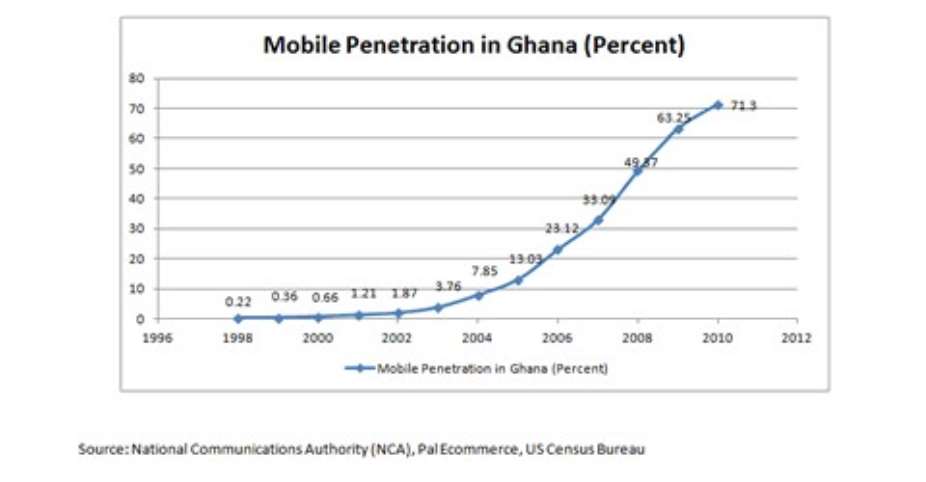
Within the last 18 years, Ghana's mobile industry has done a fantastic job in providing affordable telecommunications services to the public. This has resulted in a phenomenal mobile penetration rate of over 70 percent, which is translated into every 7 people out of 10 in the country with access to mobile telephony. The industry has played a vital role in driving wider economic growth across the country and contributing significantly to the government finances.
Most importantly, the proliferation of mobile telephony has streamlined business processes, reduced cost and increased the productivity of workers, including those in the informal sector which constitutes the bulk of the national workforce.
Thus, a healthy financial environment and a proactive policy initiative is crucial for the industry's sustainability to meet the objectives of accessibility, affordability and a better quality of service that are well enshrined in the national telecom policy.
Network reliability and coverage has always been the most important ingredient used to enhance competitive advantage in the marketplace. It is this competitive pressure that drives mobile operators to invest significant parts of their revenues each year to expand their services nationwide, improve the quality of service and capacity of their networks, and bring innovations to their subscribers across the country.
It is the same pressure that attracts investors to pour capital into the industry to generate returns sufficient to compensate for their cost of capital.
The dramatic growth in mobile subscription in recent years and the incessant attempt to improve quality of service could not have been realized without the commitment of mobile operators to provide innovative technology and infrastructure. As a result of the investment undertaken by mobile operators, mobile subscribers across the country have been given the opportunity to access mobile telephony services, including mobile broadband. Anecdotal evidence in the country suggests that mobile telephony has allowed businesses to be more productive and also allows people to remain in contact, whilst out of the office and on the move.
Since 1992, the mobile operators have made enormous investment in their networks, committing more than $6 billion in cumulative capital expenditures. Despite the current economic crisis unfolding in the global financial markets, the mobile telephony sector in the country continues to invest in the industry.
The sector has made a significant contribution to the overall economic development of the country. In addition to the direct contribution to aggregate output through value added by the industry, the industry also provides benefits to other sectors by raising labor productivity of workers.
In 2010, mobile operators contributed approximately 9.2 percent to the government income and 2 percent to the gross domestic product. According to the World Bank and other renowned economic think tanks, 10 percent mobile penetration leads to about 1.2 percent growth in GDP.
In 2010, the mobile operators and certified mobile dealers employed over 6,000 full time workers. There are over I.5 million people whose employment is related to the industry through retailing of telecom accessories and scratch cards.
The economic benefit of the mobile telecommunications industry far exceeds the revenues and value-added services it generates, the workers it employs and the wages paid out to these workers. Strong competition in the market place has pushed prices downwards providing an increased benefit to consumers.
As the mobile market is at or approaching saturation, mobile operators have started to invest massively in data services to mitigate the declining average revenue per subscriber (ARPU) for voice. In the last three years, the average revenues per user (ARPU) fell 35.6 percent from 14.7 GHC in 2008 to 9.5 GHC in 2010. Over the same period, the industry has invested over $300 million in upgrading and providing infrastructure for the 3G services across the country.
The 3G service offerings are intended to provide better quality of service and a faster transmission capability for data. The mobile telephony industry is continuing to expand coverage and services into the rural areas. Even to areas, where marginal cost is less than the average price. In order to reach subscribers, the mobile industry has deployed thousands of cell sites across the country.
• As of December 2010, mobile operators have deployed over 4 thousands base transceiver stations (BTS) across the country.
• The number of new cell sites continues to increase as new operators enter the market place.
• We expect that the number of cell sites will continue to increase as mobile operators roll out broadband wireless networks in the 2500-2690 MHz spectrum.
Despite the magnificent growth and success experienced by mobile telephony in the country, there are still many areas where mobile networks have not been able get to. It is in this light that the mobile operators are working closely with the Ghana Investment Fund for Electronic Communication (GIFEC) to provide information and communications infrastructure to the under and un-served areas. The mobile operators pay one percent of their net revenues to GIFEC to support and subsidized information and communication infrastructure deployed in deprived and un-served areas.
In the 2007-2010 periods, the mobile subscriber-base grew by 35.3 percent at an annually compounded growth rate. This was driven by a substantial growth in mobile subscription, with the total number of mobile subscribers increasing from 7.6 million to 17.4. The industry's cedi denominated revenues grew at 15.5 percent in the same time frame, which was higher than inflation rate of 9.8 for 2010.
This high growth in mobile subscribers has more than offset the downward pressure that falling average revenue per subscriber has had on revenues figure.
With competition exerting downward pressure on mobile prices coupled with an increase in network operating expenses, the mobile industry will soon begin to experience declines in financial performance. Lately, subscriber growth rates have begun to ease with year-on-year growth hitting the lowest level in 2010 at only 15.4 percent over the previous year. View stats
In dollar terms, revenues grew at an annual compounded growth rate of 3.7 percent and the average revenues per user also tumbled by 23.4 percent in the 2007-2010 period. The dollar denominated figure incorporates both internal trends and swings in exchange rates. The financial health of the industry will need attention from all stakeholders. While we expect the cedi to depreciate further during the next five years, it will be at single-digit rates reflecting the fact that inflation has come down. The relative stability of the cedi will make it easier and relatively less expensive for mobile operators in the country to purchase telecommunications infrastructure from abroad and will make Ghana attractive to foreign investors who value stability and currency.
As a result of mobile industry's investment and consumer's rapid adoption of the innovative services, the industry has become one of the major (and growing) components of the Ghanaian economy. For the past decade, it has grown at well over 60 percent per year, while the remainder of the economy grew between 6 and 7 percent. It provides employment and employment compensation to over 6,000 full time workers and is an integral part of the economy. Mobile communication is a vital hub of a much larger sector of the economy that includes other networked services and related industries. It is for this reason that we need to pay attention to the business viability of the operators to enable them advance the growth of the sector to all Ghanaians, irrespective of their geographical location and economic status.
Written by Victor Teppeh, former Senior Economist at Wilkofsky Gruen Associate, (NY) and Co-author of Tia's ICT Market Review and Forecast and Global Entertainment and Media Outlook 2010-2014 (Pricewaterhousecoopers, NY)
 Bank of Ghana mops up GH¢17.24bn in major liquidity tightening move
 NDC marks 34 years of political influence and democratic governance
 UTAG threatens nationwide strike over delayed book and research allowances
 808 presidential staffers on payroll as Parliament receives annual staffing repo...
 24-Hour Economy cannot succeed without data — GSS tells Parliament
 Captain Smart declares bid for NDC parliamentary slot in Gomoa West
 24-Hour Economy will promote prostitution – NPP Chairman warns government
 US, Iran exchange airstrikes after Trump accuses Tehran of downing army helicopt...
 BoG's $260 million building: It was Ato Forson who first proposed 'sell-and-leas...
 'We have to do soul-searching' — Mahama orders nationwide flood assessment


