




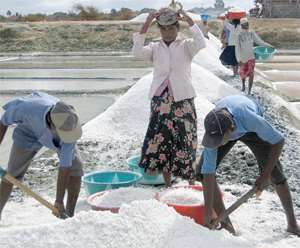
A $50 million salt project that will produce over 330,000 tonnes of salt in a year will commence soon at Makoadze in the Gomoa West District of the Central region.
Unlike the existing methods employed at most salt production sites in Ghana where salt is produced through solar evaporation, a salt crystallization plant would be used in the proposed vacuum salt project.
The plant, which would be the first of its kind in West Africa according to Nana Kwame Osei, Chief Executive Officer (CEO) of Dernan Salt and Trading Limited, would produce 49 tonnes of salt per an hour.
Dernan Salt and Trading Limited, in accordance with the Environmental Protection Agency Act 1994, Act 490 Section 12(1), has conducted an Environmental Impact Assessment of the proposed project and presented a draft statement to the EPA.
Having met this requirement, the company was also required to hold a public hearing, where the residents of the community would be educated about the project and allowed to expressed their concerns after which a report would be submitted to the EPA.
If the report is approved the company would be issued a permit which would facilitate the commencement of construction works.
The public forum was held at Makoadzi on Tuesday to address the social concerns and the potential environmental implications of the proposed project in compliance with the provisions of the EIA regulations LI 1652, June 1999 regulation 17.
Kwame Osei, Managing Director of the project, told the gathering numbering over 300 people, which included traditional leaders, EPA officials that a total of 150 acres of land has been procured for the project, adding that plants that are almost the size of a four-storey building would be mounted.
Other facilities that would be sited on the land would include offices and accommodation of the workers among other things.
After the salt has been extracted from the sea water, the company also intends to produce 159 tonnes of purified drinking water per an hour.
The liquid waste would then be pumped back into the sea after it has been cooled.
'Without doubt the living conditions of the people would improve as we will employ the youth in our operations.'
He said pipes would be laid to about 100 meters deep in the sea and connected to the plants and promised that the management, as part of its corporate social responsibility, would discussed with the traditional leaders to ascertain the needs of the people.
The paramount chief of the Gomoaman Traditional Area, Oberempong Aymful Krampah, in a speech read on his behalf by Gomoa Abaasa Mankrado, Nana Kweku Kra Agyeman urged the EPA to ensure that the environment is protected.
'The EPA is responsible for ensuring that the environment is free form activities that endanger the lives of people and the EPA.'
He promised the commitment of the traditional leaders to the success of the project which is aimed at reducing unemployment among the youth and improving infrastructure in the area.
Earlier, residents expressed fear over the effect of the company's activities on fishing but they were assured that the company would use a chemical free process in extracting the salt while the pipes would be submerged 100 meters deep into the water.
They welcomed news that the company would recruit some of them but warned the company to deliver on its promises.
'The fish stock in our sea has depleted and we sometimes sleep on an empty stomach. We, the youth, are looking forward to gaining employment from this project so we can take care of our families,' said Kwadwo Acquah, a youth, whose comment attracted thunderous applause.
Ransford Sakyi, Deputy Director and Head of Mining at the EPA, on his part, cautioned that the operations of the company would be highly technical.
'I do not want to give you false hope. The location of the company here does not mean they would employ just anyone' he said, urging the youth to take advantage of the opportunity to sharpen their skills.
He noted that though the pipes would be submerged some parts would be visible, warning that 'that would be a no go area.'
He said the concerns of the people relating to emission of gases, temperature of the liquid waste and other issues like how the salt particulate matter would be captured, would be looked at and considered in the final report.
'It is important for the people to understand the social implications.'
By Emelia Ennin Abbey
 GJA Applauds Ghana’s Sharp Rise in Global Press Freedom Rankings
 US Embassy Cautions Against Censorship in Fight Against Misinformation
 Interior Minister Blames Weak Enforcement by Assemblies After Avenor Building Co...
 Gov’t Warns Against Rising Misinformation, Calls for Stronger Journalistic Stand...
 Ramaphosa Warns Against Vigilante Crackdowns on Foreign Nationals
 Global InfoAnalytics Boss Rejects Claims Polls Are Destabilising NDC
 Bawumia to Propose Policy Alternative as Cocoa Sector Tensions Deepen
 ECG Announces Scheduled Outages and Technical Fault Affecting Multiple Regions o...
 Investigation committee uncover GH¢19.5m loss at Bolgatanga Technical University...
 Afenyo-Markin calls for protection of journalists, warns against suppression of ...


