




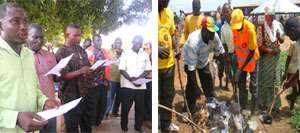
The District Chief Executive (DCE) for the East Gonja District, Alhassan Mumuni, has inaugurated the various Unit Committees in the district, in line with local government regulations to promote decentralisation, grassroots participation, for the accelerated development of the district.
According to the DCE, the East Gonja District was fully poised to implementing its development plans and programmes, hence the urgent need for the Assembly to put in place the necessary structures.
Addressing chiefs, opinion leaders and the elected Unit Committee members at separate durbars at Makango, Salaga, Kpembe, Binjai, Kpariba and Abromase to inaugurate the committees, Mumuni explained to the members their roles and responsibilities as the decision-making body of their local areas, and also as the voice of the people at the assembly level.
The inauguration of the committees coincided with the East Gonja District Sanitation Day, a day set aside by the DCE and his officials every first day of every month, to woo residents and most especially, school children, to clean their environment.
The DCE reminded them to be disciplined, responsible, promote sanitation, and also mobilise revenue for the assembly to boost development.
He noted that the members have two main responsibilities – encouraging their people to pay their taxes regularly, and also ensuring proper sanitation.
Alhassan Mumuni maintained that the District Assembly's Common Fund from the Central Government was too meager to satisfy the development needs of the over 550 communities in the district, and therefore, encouraged the district revenue collectors and the various assembly members to intensify their revenue collection drive.
He gave the assurance that 50% of revenue to be generated from the electoral area would go to the Committee to support local development programmes, and also take care of the remunerations of the members.
The DCE therefore, warned: 'Any Unit Committee that would downplay the assembly's policies of mobilising more revenues, or ensuring clean environments, would face serious sanctions.'
He hinted that the assembly had put in place measures to encourage the traditional authorities to complement its revenue generational efforts, setting aside special royalties out of revenue generated in their localities.
On the other hand, the DCE disclosed that the East Gonja District Assembly also had plans to encourage the people to develop the spirit of tree planting, to protect their communities from being destroyed by heavy storms, and that the assembly was also setting aside a special budget towards the tree planting exercise, especially, in schools.
On his part, the Chief of Makango, Ewuntomah Issifa, who partook in the clean up exercise earlier in day, led by the DCE, commended him (the DCE) for initiative, which sought to encourage the youth and the entire people of the district to keep clean environments at all times.
According to the Chief, the DCE, irrespective of his busy schedule, had been in constant touch with the people, especially, those in the deprived communities, citing last year's flooding as an example, where the DCE constantly visited the victims with some relief items.
The chiefs further recounted that at some point, the DCE willingly vacated his official residence just to accommodate some health personnel and teachers who were also affected by the flood, and were threatening to leave the district.
He noted the two years of Mumuni's administration had seen the elimination of schools under trees in communities in the Makango divisional area, and the construction of a health center.
The chief, on that basis, assured the DCE of his personal commitment towards ensuring clean environments in the communities under his jurisdiction, play a leading role in the tree planting exercise, and also assist the Unit Committee and revenue collectors to succeed in their operations.
However, at Salaga, the district capital, the East Gonja DCE, Alhassan Mumuni, unveiled plans for the construction a new ultra modern government hospital at Salaga this year, which is aimed at improving the health care services of the people in the district.
That notwithstanding, the government, according to the DCE, was considering the rehabilitation and expansion of the Salaga Water System, which has been a source of worry to the people over the years, as well as the Tamale-Salaga-Makango road to boost economic and agricultural activities.
The government of Ghana and its partners, including the International Development Agency (IDA) and the World Bank, has provided financial support of $75 million for the implementation of the government's water supply project in 14 districts of the Northern Region.
Under the project, the Community Water and Sanitation Agency would offer technical assistance to the beneficiary district assemblies to extend and expand their water systems to cover other communities within their districts.
Launching the project at Wulensi on behalf of the District Chief Executive, the Engineer for the Nanumba South District, John Bosco Aabulleh, said the project would greatly improve water supply coverage in the districts, under the National Community Water and Sanitation Project.
He said the current coverage of potable water supply in the Nanumba South was estimated to be the lowest in the region.
Mr. Aabulleh acknowledged the contributions of the government and its development partners, especially, the IDA and the World Bank, to their district in efforts to improve access to these essentials.
He expressed his appreciation to the various bodies, including the World Bank and other non-governmental organisations (NGOs) on their contributions to the provision of potable water and safe sanitation for the people in the district.
The Regional Officer of the Community Water and Sanitation Agency in charge of monitoring, Jacob Banamin Kombian, stated that the project was in three components – Water, Sanitation and Institutional Capacity Building – for all the beneficiary districts.
He said the CWSA, with the active participation of major stakeholders, would adopt resource mobilisation capacity building and standard setting in small towns to achieve its set targets of the project.
Mr. Kombian said providing water for communities without the corresponding advocacy for cleanliness, would mean the neglect of the health needs of the people.
This, he noted, would go a long way to stop open defecation and ensure good health.
Mr. Kombian called on stakeholders, water and sanitation development boards, and members of the district water and sanitation team, to help promote hygiene and sanitation in their communities.
He, therefore, advised the beneficiary communities to embrace the sanitation concept, and take advantage of the hygiene and sanitation project to improve upon personal hygiene and environmental sanitation in their communities.
 Anti-LGBTQ Bill is duly passed, I believe it is too late in the day to reverse i...
 Here are areas to face power outages over maintenance works today
 RNAQ ex-wife petitions court to restrict Hajia4Reall’s closeness to her children...
 One dead, two children trapped after three storey building collapse at Adenta
 Obuasi Circuit Court jails farmer 8years over violent mining site attack at Obua...
 Health Minister summons KATH CEO over emergency centre closure
 Unauthorised structures demolished at Haatso
 Fire guts shops opposite Accra Central Police Station
 Stephen Yeboah appointed new registrar of Sunyani Technical University
 Abandoned 250-bed Sewua Regional Hospital rots as KATH battles congestion


