




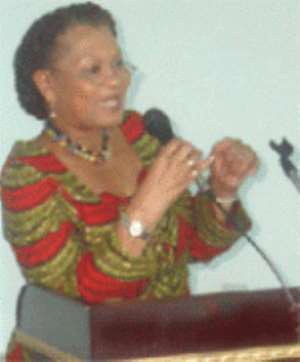
In the government’s quest to find the most appropriate means to ensure prudent management of the oil find, the Chief Executive Officer of the Ghana Chamber of Mines, Ms Joyce Aryee, has stressed the need for the government to seriously draw lessons from the mining sector to guide its strategies to manage what has been termed the ‘Black Gold’.
She said the country have not generated enough benefits from the gold, diamonds and other rich minerals mined in the country, hence the need for Ghanaians to be cautious about what to expect from the oil and the onus lies on the government to manage such expectations with the mining sector serving as a guide.
Her call comes at a time when many Ghanaians expect the oil to drastically transform the economy from its present poor state to one beyond the middle income status just as in the case of Norway and Canada, among others.
But these expectations are what Ms Aryee warned against and asked the government to devise a decisive strategy to manage the expectations of the people.
Speaking at the 2nd Graphic Business Roundtable Forum in Accra on the topic “Addressing Environmental and Security Concerns:
Legal Frameworks, Civil Society and Community Issues”, she said if the mining experience was used as a guide in managing the expectations of the people, the security concerns would have been addressed to a large extent.
She also raised the issue of transparency in the management of the oil revenue and the development of policies to guide the resource and noted that judging from the keen interest shown by the people, there was the need for all that was being done to be exposed to the people to avoid any conflicts.
Already tensions are high in some areas within the Western Region as to which community owns the oil and how the government intended to ensure that the area becomes the major beneficiary of the proceeds.
Arguably, much as they may be right with the demand for a fair share of the proceeds in terms of the provision of infrastructure and other amenities to better the lives of the people, there are reports of some civil society groups pushing them to demand greater transparency on how the wealth from the find would be used.
“Transparency, fairness, accountability and good governance are key to ensure maximum security in the country when the oil starts flowing”, Ms Aryee said as she advised the government on what could be done to allay the fears of the people.
Ghana is expected to pour its first oil by the end of the year almost three years after the “Black Gold’ was discovered at Cape Three Points of the Western Region.
Since the discovery that set an agenda in the country, the expectations of the people are high and it is against this background that no week passes without a group organising a forum to discuss how the oil could be used to transform the socio-economic fortunes of the country.
Analysts have asked the government to draw lessons from not only the mining sector in the country, which had given the country almost nothing, but the Nigerian and Angolan experiences which are described as a curse and the Norwegian and Canadian experiences which are obviously a blessing.
A Research fellow of the Kofi Annan Peacekeeping Training Centre, Dr Kwesi Aning, who was the main speaker for the topic, said.
“The fact that we are having this discourse shows the willingness of all Ghanaians to know about what is happening within the oil and gas (O&G) industry, and the rationale for the exuberant optimism that this find has generated despite the negative track record of oil finds in Africa”.
However, he said there was also the need to be honest and frank about the potential dangers to the communities, the country and the environment as a whole as the country celebrated this discovery, so as to prevent the emergence of an ‘oil curse’.
Dr Aning who has been passionate about the security concerns of the find said.
“Even more important is to start a discussion, shifting it away from the high and flowery rhetoric to practical, operational, commonsensical everyday ‘what can or ought to be done’ to ensure that our find is beneficial”.
He said talking about potential security and environmental concerns about this discovery was well placed.
“Today, however, I focus on something that in Ghana is taken for granted, and when it is not, is shrouded in mystery; namely the national security implications of Ghana’s oil discovery and the national security concerns that such discoveries raise and why Ghana must by necessity be concerned with them”, he stated frankly.
According to him, the argument is that, if in making such strategic choices concerns of citizens or communities do not become the centre-piece of such considerations, then natural resource management as conflict prevention becomes a charade.
“Indeed, the history of natural resource exploitation in this country gives us cause for concern; Furthermore, many countries hope that Ghana could get it right as a means of giving not only direction to others but proof that it can be done,” he said.
Mr Kofi Bentil of the Imani Institute, a development think-tank, for his part said any attempt to hide issues concerning the oil from the people would amount to robbing them of vital information that was needed to enable them know what was happening with their resource.
He observed that such acts could be a recipe for disaster and cautioned the government to guard against them.
The Executive Director of the Environmental Protection Agency (EPA), Mr Jonathan Allotey, said the agency had done a lot of work on various environmental issues regarding the oil find.
He said the Oil Spill Contingency Plan for instance had been revised to make it more relevant to recent times.
- Graphic Business
 GWL resumes production at Barekese Water Treatment Plant after completion of rep...
 Economic performance most powerful source of Mahama’s goodwill — IEA
 Nyinahini SHS assault: Court strikes out case, urges reconciliation
 Even traffic lights in front of police headquarters are being stolen — Roads Min...
 One major cause of Ablekuma North rerun violence was lack of security coordinati...
 BTU Council divided as Chairman rejects parliamentary mediation in VC dispute
 Roads Ministry needs 1,000 additional staff — Governs Agbodza
 Stop tweeting and brief Parliament on South Africa situation — Patrick Boamah to...
 Roads Minister reassigns Bogoso–Prestea road project to new contractor over dela...
 President Mahama’s approval rate remains positive at 58.9% — IEA survey shows


