




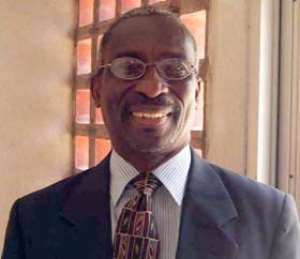
The Chairman of the Constitution Review Commission (CRC), Professor Albert K. Fiadjoe, says anybody who has any grievance with the setting up of the commission should go to the government and not him or any member of the commission.
“I have come home to retire only to be given such a national assignment. I was not part of the decision to set up the commission but as the Chairman, I will supervise and ensure a very transparent and professional exercise,” he said.
Prof. Fiadjoe, an expert in public law, was answering questions at the maiden news conference in Accra yesterday to outline the commission's programme of activities for the review exercise.
The ceremony was attended by all the nine members of the commission, with the exception of Akenten Appiah-Menka, a lawyer and industrialist whom the chairman apologized on his behalf, saying he had asked for permission to travel to Kumasi to attend “an urgent family matter.”
Prof. Fiadjoe said the commission is an independent body which does not represent any particular interest group, adding “the process of reviewing the constitution will be open, impartial and transparent in order to afford all Ghanaians at home and abroad an opportunity to the process.”
According to the professor, the commission will deploy the assistance of competent and professional experts to assist in measuring, evaluating and comparing its work with best practices elsewhere.
He also asked the public to discount rumours that the commission is working to sideline the Parliament of Ghana in the whole review exercise, stressing “this cannot be possible.
There can be no change or amendment to the constitution without the active involvement of Parliament so the public should not entertain such rumours”.
The chairman said the commission has categorized its work into three phases, starting from the establishment of the commission, research, consultation and documentation as well as the commencement of a national constitution review conference which will aim at finalizing their work.
He stated that although the commission had just commenced full work, “it has already received a number of submissions, some going the 39 issues initially identified.”
“We will ensure fair and credible exercise. We will tap the numerous expertise available to Ghana and elsewhere”.
Prof. Fiadjoe disclosed that the exercise will not be an elitist one because “the consultation strategy has been designed to ensure that it is not an Accra-based exercise. It is going to be a nationwide exercise”.
The chairman said the commission will partner the media effectively during the exercise, adding “the media are the anvil on which the commission's work is going to be anchored. The media is key to the success or failure of this exercise.”
He divulged that at the end of the whole exercise, it could be possible that the public would call for the retention of the constitution or “retain the constitution, but institute some corrective administrative actions or retain and further develop portions or of the constitution; or amend/repeal some portions of the constitutions.”
According to Prof. Fiadjoe, the commission was prepared to meet with all those who have reservations about the usefulness of the exercise, intimating “this is not a platform for disputation. It is a platform for sharing ideas.”
Dr. Raymond Atuguba, Executive Secretary of the CRC, said the commission's sources of funding will come from the government, development partners and the private sector, adding “we have a projected budget of 2.7 million US dollars but we are yet to receive any amount from anybody.”
He said the commission will embark on a nationwide exercise and make effective utilization of the District Assemblies and the traditional authorities, revealing, “We have already received more enquiries from outside Accra than within Accra.”
On January 15, 2010, President J.E.A Mills inaugurated a nine-member CRC to “ascertain from the people of Ghana, their views on the operation of the 1992 Fourth Republican Constitution and, in particular, the strengths and weaknesses of the Constitution”.
The commission is also to “articulate concerns of the people of Ghana, as regards the amendments that may be required for a comprehensive review of the 1992 Conctitution.”
It is also to “make recommendations to the government for the consideration and provide a draft bill for possible amendments of the 1992 Constitution”.
By William Yaw Owusu
 Our expenditure ceiling for first half of 2026 was capped at GH¢910 million - Ag...
 Agric Ministry refutes Finance Ministry’s GH¢1.6bn allocation claim
 NIA begins one-month mop-up Ghana Card registration for children in Volta, Oti r...
 Barekese Water Treatment Plant to be closed from June 9 - 11 for maintenance — G...
 Prioritize safety and security of nurses and midwives — GRNMA urges government
 Man who assaulted midwife at Tema Community 22 Polyclinic to face court on June ...
 Dozens dead of thirst after truck breaks down in Niger desert
 CTN-SPN reintroduction will cost Ghanaian shippers between €187.2 million and €3...
 How guests wade through floodwaters after Longji Hotel submerges in Tarkwa
 Questions raised over claims of budget releases to MOFA


