




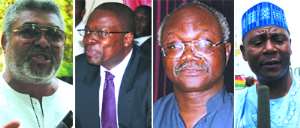
The revelation in a London court that Mabey & Johnson, a construction firm based in the United Kingdom, paid bribes to a number of Ministers in the Rawlings government, appears to have sent shivers down the spine of the former President, who is well noted for his crusading role against corruption and describing his former appointees as men of integrity.
The former air force pilot, who handed power to his successor, Mr. John Agyekum Kufuor, has on several occasions accused the New Patriotic Party government of amassing wealth through illegal means.
Mr. Rawlings has recently also brought pressure to bear on the Atta Millsí government to prosecute former government officials who he accused of stealing state money.
On his numerous visits abroad, Mr. Rawlings had also harped on allegations of corruption against everyone, except members of his government.
The ruling by the London court, which named some of Mr. Rawlings Ministers as having taken bribes from Mabey and Johnson has, therefore, come to him as a surprise.
In a statement issued in Accra over the weekend in reaction to the scandal, the former President noted that Probity, accountability and service to the people are the basis upon which the National Democratic Congress was founded. “I have espoused these tenets since 1982 and have consistently reminded the current NDC government of the need to urgently pursue and prosecute persons who have been and continue to remain unaccountable to the people”., he said According to him, The quick response by President Mills in requesting further investigations into these allegations can only be applauded. However, hesitancy and inaction in the days to come will be seen as not serving the greater good.
Despite the question marks that this court ruling has hanged on the neck of his tenure in office, the former President still finds the voice to accuse the Kufuor government of corruption. “Since coming to power in 2009, we have failed to pursue and prosecute the criminal activities of the past NPP government, who in connivance with foreign partners have stolen millions of dollars and accepted huge bribes”, he said.
President Mills, who is currently attending the United Nations General Assembly meeting in New York, had already ordered the Attoney General, Mrs. Betty Mould-Iddisu to investigate the court findings that have been made against the former Ministers and government officials. The AG has in turn ordered the Serious Fraud Office (SFO) to go into the case.
Among the former government officials who have been named in the scandal are Dr. Ato Quarshie, a former Minister of Road and Highways, Mr. Kwame Peprah, a former Minister of Finance, Dr. Sipa Yankey, the current Minister of Health, Alhaji Boniface Saddique, a former Minister of Works and Housing in the Kufuor government, Baba Kamara, Ghana's High Commissioner to Nigeria.
Attempts to reach the accused persons proved futile as Dr. Sipa Yankey is currently in the U.S.A, and Mr. Kwame Peprah could also not be reached. Dr. Ato Quashie would not comment on the issue because he was driving on the highway when this reporter called him. He, however, promised to call back to give his side of the story when he gets to his destination. He did not return the call before we went to press.
Below is the official court documents that implicated the aforementioned former ministers.
THE GHANA CONTRACTS
107. M&J has conducted business with government departments in Ghana over a number of decades. From the mid 1980's until approximately 1996, M&J's interests in Ghana were represented by Kwame Ofori. During the early 1990's Kwame Ofori acted as M&J's agent in Ghana. He controlled a Ghanaian bridge building company, and apparently had influence within the ruling circles of the then ruling party in the Ghanaian government - the National Democratic Congress (“NDC”).
108. To promote its business transactions with government departments of Ghana, M&J paid commissions to its agent or agents in relation to the business it won in Ghana. It is accepted by M&J that through the creation of the GDF (the notional fund created by M&J known as the “Ghana Development Fund”), its executives facilitated corruption on behalf of M&J and that its executives were in (or sought to create) a corrupt relationship with a variety of decision making Ghanaian public officials with responsibilities affecting M&J's affairs. These funds were purportedly for the development of M&J business in Ghana but, in truth and reality, were capable of and were understood to be capable of, being used for corrupt purposes. 109. When appointing and permitting its agents in Ghana to act on its behalf or for it, M&J knew that there was a risk that unknown proportions of the agents' commission totalling £750,000 might be used for corrupt purposes.
110. The budget representing the GDF was managed by Director D, an executive who later became a director of M&J. Whilst Director D had responsibility for different territories during his career, in particular he had responsibility for Ghana. Consequently during the material period, the affairs of M&J in Ghana were heavily influenced by his direction and control.
111. On 3 April 1996 Mr. Ofori and a relative attended a meeting at Twyford with the Office Manager. It appears that Director B and other Directors made their excuses for not attending. The Office Manager' note of the meeting records that Mr Ofori did not have control over the "total 15% commission". Mr Ofori complained that he had problems as he did not believe Director D had distributed 5% to the "relevant personnel" or “local personalities”. The note records Mr Ofori saying that had he been involved in the payment of the total amount of the 15% commission the present difficulties would not have existed and said that this aspect had been dealt with ably by him in the past.
112. On 14 March 1996 Mr. Ofori had sent a fax on “Danielli Mabey Ltd” headed notepaper (a Ghanaian company which was wholly unrelated to M&J and which is understood to have been owned by Kwame Ofori). The fax was marked for the attention of Mrs Margaret Ofori in Accra and appears to have been then passed to M&J. The fax detailed how it was that “the situation in Ghana has been deteriorating gradually ever since Director D came in to Ghana.” There can be little doubt that the contents of the fax had become known at Twyford before Mr. Ofori visited M&J's Head Office.
This is because Director D had himself sent a “confidential memo” dated 25 March 1996 direct to Director B rebutting Mr. Ofori's assertions, and detailing how it was that he had had a meeting recently with the only person who “can guarantee M&J's position in this market”: Kwame Peprah. Mr. Peprah was at that time the acting Minister of Finance and the Chairman of the NDC Finance Committee.
113. In fact Director D had been introduced to Mr. Peprah through Baba Kamara (aka I. B. Ibraimah), who was the NDC Treasurer, and 'political overseer' for the Ministry for Roads and Highways.
114. The role of Baba Kamara and his value as an agent to M&J is made clear in a document authored by a M&J executive, probably prior to July 1996, and sent to Director A; Director B; Director C and Director E. The document is entitled “Ghana” “Review of existing Agent and introduction of alternative Agent”. Concerning the value of the proposed new agent, “Kamara Ltd is a small Ghanaian contractor owned by Baba Kamara. He is the NCE (sic) Treasurer and also the political overseer for the Ministry of Roads and Highways. He is a member of the all powerful NDC Finance Committee which includes Kwame Peprah (Minister of Finance and Minister of Mines and Energy), Obed Asamoah (Justice Minister and Foreign Minister) and Mrs Rawlings amongst others….[he] has considerable influence over Ato Quarshie, the Minister for Roads, the Deputy Minister and other top ranking civil servants and has been working with us since June 1994.
This has been demonstrated over the allocation of the extra Stg 1.3 mil for the Tano bridge and the Stg 4.5 mil allocation for the Priority Bridge Programme.”
115. Additionally, Mr. Kamara's wife was secretary to the then President of Ghana - the former Flight Lieutenant 'Jerry' Rawlings, who had originally achieved power by means of a military coup in 1981. Unsurprisingly, a person in the position of influence of Mr. Kamara was an attractive prospect to M&J as agent for their business in Ghana, and the SFO contend, that M&J knew and intended that commission paid to Mr. Kamara would be deployed as and when required to corruptly promote M&J's commercial interests.
The SFO believe that because he had demonstrated his effectiveness to attract business corruptly, he was appointed by M&J. This is not accepted by M&J.
116. Allied to the decision to use Mr. Kamara as their agent from some time early in 1996, M&J had plainly also decided to “sideline” Mr. Ofori, and to impose more direct control over the payments made to “local personalities” by Director D supervising and control from 1994 and the creation of the notional GDF.
117. As will become apparent, whereas in Jamaica corrupt payments were directed towards a specific individual, payments allocated against the GDF were more general and numerous government ministers and officials were potentially in line for a bribe. Each such payment required the authorisation of two M&J directors.
18. Payments allocated against the GDF did not relate specifically to stages of contracts in progress. The SFO says that they were obviously made with the intention of securing and maintaining those contracts when it was deemed prudent to do so. It is accepted by M&J that in creating and making payments from this fund corrupt payments would be made to public officials in order to affect the decision making process in favour of M&J. Thus payments were made for a variety of purported purposes to a variety of ministers and officials. Some of those purposes were self-evidently unrelated to M&J's legitimate business such that the payments can best - and, indeed, only - be described as bribes. Not only were the bribes overt, so too was the means of collection on the part of the Ghanaian ministers and officials, most of whom had UK bank accounts. Some, indeed, visited the UK in order to collect their payments in sterling.
119. During the 1990's M&J entered into three principal contracts with the Ghanaian Ministry of Roads and Highways (“MRH”) for the provision of bridges: Priority Bridge Programme Number 1, worth £14.5 million, was agreed in 1994; Priority Bridge Programme Number 2, worth around £8 million, was agreed in 1996; and the Feeder Roads Project, worth £3.5 million, was agreed in 1998.
120. Throughout the relevant period, and until the general election in 2000, the NDC formed the Government of Ghana and many of the GDF payments were directed to its members.
Thus the then Minister at the MRH, Dr. Ato Quarshie, received a cheque when he visited London in July 1995 in the sum of £55,000 for “contract consultancy”. The cheque was drawn on M&J's Clydesdale Bank account at the Victoria branch in Buckingham Palace Road, and signed by Director A, and another M&J director at that time. Director A also faxed the bank instructions to enable Dr. Quarshie to cash the cheque.
121. The payment to Dr. Quarshie and the following payments are but examples of a wider-ranging series of bribes to various ministers and officials, which will be set out in a schedule. Even relatively junior officials were the willing recipients of bribes.
In 1996 Saddique Bonniface was the ECGD desk officer in the Ministry of Finance (he was recently until the change of government a highly placed politician within the Ghanaian administration). He had a bank account at the National Westminster Bank in Rickmansworth. On 29 February 1996 Saddique Boniface received a transfer of £10,000 from M&J to an account at Barclays Bank Plc in Watford. On 29 October 1996 the same account received a transfer of £13,970 from M&J. On or about 29 October 1996 Amadu Seidu, the Deputy Minister at the MRH, received £5000 in his Woolwich account held in St. Peter Port, Guernsey and Dr. George Yankey the Director of Legal and International Affairs at the Ministry of Finance, received £10,000 in his Midland Bank account in Hill Street, London W1; and Edward Lord Attivor, the ex minister at the MRH, also received £10,000 in his London bank account. This was the same branch of the Clydesdale Bank which was used by M&J. Authorisation from M&J directors for each of these transfers was requested by Director D. Amadu Seidu received a further £5,000 on 7 March 1997, the same date on which Saddique Boniface received a further £2,500. The latter two transfers were authorised by Director B.
122. Mr. Boniface's son was a student at Exeter University, where, on or about 26 March 1998, he received a cheque from M&J in the sum of £500. Although this is a relatively small sum it is indicative of the nature of the corruption M&J was then practising: it is a payment which could have no conceivable legitimate commercial purpose.
123. M&J's payments to Dr. Yankey were not confined to the payment on or about 24 October 1996, since his Hill Street account received £5,000 on 26 August 1998 from M&J. Dr. Yankey was subsequently convicted in Ghana of conspiring to willfully cause losses to the state and served a prison sentence, along with Kwame Peprah.
Their convictions cannot be directly related to payments from M&J, but reflect the culture of government corruption at the time, a culture with which M&J was only too willing to engage.
124. From December 1994 to 18 August 1999, M&J used the GDF and associated accounts to pay bribes directly to named Ghanaian public officials totaling £470,792.60.
125. None of the payments set out above, obviously, could be said to have anything remotely resembling a legitimate commercial purpose.
Thus M&J was able to engage in wholly corrupt business practices without any effective level of external scrutiny being applied.
Plainly, those who governed and directed the affairs of M&J were responsible for arranging and authorising payments which, no matter they were eagerly sought and accepted, were considered vital in securing M&J's business in a developing nation – at the expense of those least able to avoid the expenditure that is inevitably involved in the making of corrupt payments: the people of Ghana.
IX: M&J's INTERNAL INVESTIGATIONS
126. The counts on the indictment are in one sense specimen counts. They fully reflect the defendant Company's criminality in the two jurisdictions concerned.
However, during the course of the investigation thus far, indicators have emerged to the effect that corruption has been practised in other jurisdictions.
127. The Company's solicitors Herbert Smith LLP, have been instructed by M&J's present board to instigate an internal investigation into suspected corruption practiced by M&J under its previous directorial and managerial regime.
128. Their investigations are ongoing. Before they have been completed, what was initially revealed by the Company's investigations has caused the Company to come forward and make disclosures to the SFO.
129. Of necessity the investigations have been limited to a review of Company documentation and interviews of current Company employees. It follows that the internal investigations are incapable of inquiring into foreign bank accounts, the activities of foreign agents and the like – which are matters which would ordinarily be the subject of MLA requests.
130. These investigations have revealed other corruption indicators. Some of these might not necessarily be provable cases of corruption in this jurisdiction or at all.
The SFO is not in a position as of this date to determine with certainty whether charges could be brought in all or the majority of cases.
131. M&J accepts that in order to establish and secure its business abroad, it appointed agents to act on its behalf in the various countries where it was seeking to win contracts to supply bridges.
Commission fees paid to local agents ranged from contract to contract and by jurisdiction. In a number of jurisdictions; Jamaica, Ghana, Mozambique, Bangladesh, Madagascar and Angola M&J did not pay all those commission fees to its agents but in some cases it also used some of the funds set aside for commission to make direct payments to public officials.
Those officials were either responsible for or involved in the allocation of contracts to build bridges.
 No room in our standing orders for reconsideration of anti-LGBTQ+ Bill – Sam Geo...
 Court threatens to struck out Mamprobi Baby theft case over disclosure delays
 How ex-convict allegedly sealed teenager's mouth with super glue, raped and murd...
 About 70% of buildings in Ada East lack permits, to be demolished – DCE
 Accra will no longer be sanctuary for indiscipline — Linda Ocloo declares after ...
 Bono Region: Police investigate murder of retired veterinary officer
 GMA says no emergency patient was denied care at KATH despite congestion concern...
 VIDEO: Fuel tanker driver burnt to death in fiery crash at Adubinso, seven shops...
 IMF boosting financial support for four African nations over war impact
 Anti-LGBTQ+ bill: Public clash between Speaker Bagbin and Majority Leader needle...


