




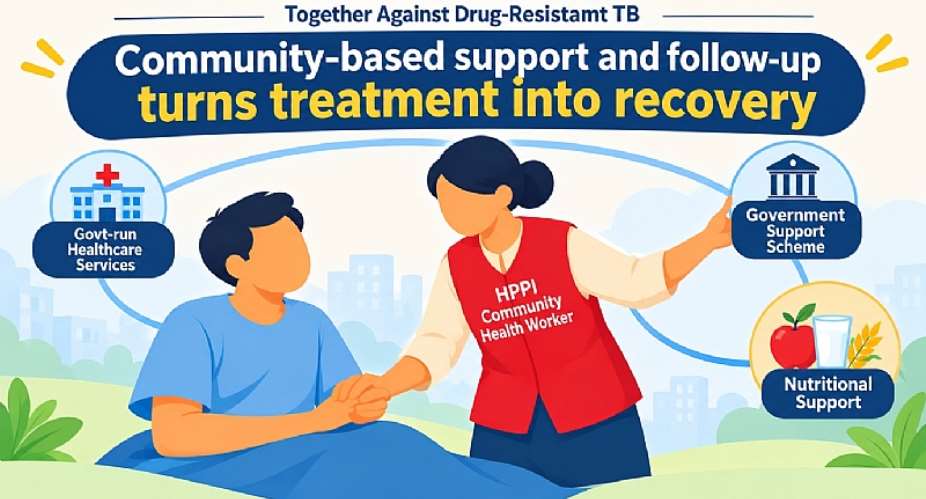
For people facing drug-resistant tuberculosis (TB), there are multiple battles: from getting right and timely diagnosis, starting right treatment, and getting the needed care and support to tide through the treatment and get cured.
Poverty, livelihood insecurity, migration and physical disability can derail even the most determined efforts to get cured.
As world's largest lung health and TB conference happens (Union World Conference on Lung Health) and to mark World AMR Awareness Week 2026, let us share our experience from the frontline of fighting drug-resistant TB among those who are least likely to get served with equity.
The experience of a 55-year-old resident of an urban slum in Delhi demonstrates how community health workers, healthcare professionals, government support schemes and coordinated follow-up can come together to keep treatment on track.
When Mahesh (name changed to protect his identity), a 55-year-old daily-wage worker living in a densely populated slum settlement in central Delhi, was diagnosed with multidrug-resistant TB (MDR-TB), he faced a daunting journey towards recovery. Not only was the disease challenging enough, but the circumstances of his everyday life made completing treatment an even greater struggle.
His experience reveals a critical reality in the fight against TB: access to medicines alone does not guarantee recovery. For people living with economic insecurity and other vulnerabilities, sustained treatment adherence often depends on a wider ecosystem of support that connects communities, frontline health workers, healthcare providers and social protection services.
For Mahesh, this collective support became the lifeline that helped him overcome repeated setbacks.
A diagnosis compounded by vulnerability
Mahesh lives with his wife, 22-year-old son and other family members in a small, overcrowded house in an urban slum settlement in central Delhi. His livelihood depends on daily-wage employment, leaving his household financially vulnerable whenever illness prevents him from working.
In early 2025, he began experiencing persistent high fever, severe body aches, extreme weakness and deteriorating health. Initially, he sought treatment from private practitioners, but the medicines offered little relief. As his condition worsened, a doctor advised him to visit the government-run Jhandewalan Chest Clinic for further investigations.
An X-ray and sputum examination were conducted at the chest clinic, while an ultrasound was performed at government-run Dr NC Joshi Memorial Hospital.
The diagnosis was multidrug-resistant TB (MDR-TB), a serious form of TB in which the bacteria are resistant to at least two of the most powerful first-line anti-TB medicines - isoniazid and rifampicin.
Mahesh said he was the first person in his family to contract TB. His treatment began in April 2025.
However, the road to recovery soon became complicated by the realities of earning a living.
When the struggle to earn threatens the struggle to recover
As Mahesh started feeling better, he resumed travelling outside Delhi in search of work. For a daily-wage worker, staying home to recover from an illness can mean losing essential income. But travelling for employment made it difficult for him to maintain regular treatment and follow-up.
Eventually, he discontinued his medication.
Such interruptions in MDR-TB treatment can have serious consequences. They increase the risk of treatment failure, prolong illness and can contribute to continued transmission of drug-resistant TB. They may also increase the risk of further drug resistance.
Mahesh's experience illustrates how economic insecurity and livelihood pressures can undermine treatment adherence, even after a patient has successfully accessed diagnosis and initiated treatment.
It was in this context that community-based follow-up became critical.
Reconnecting a patient with treatment
In October 2025, during routine door-to-door TB screening in the neighbourhood, Shimpi and Geeta, frontline field officers with Humana People to People India (HPPI), met Mahesh. Geeta is herself a TB survivor, bringing valuable lived experience to the community-based support they provide.
Recognising the seriousness of his treatment interruption, Shimpi had repeated counselling sessions with Mahesh. She explained the importance of completing the prescribed MDR-TB treatment, highlighting the implications for his own recovery as well as for the health of his family and community.
Her engagement went beyond creating awareness. It involved building trust, addressing concerns and encouraging Mahesh to reconnect with the public healthcare system.
With sustained motivation and emotional support, Mahesh agreed to restart treatment. Shimpi accompanied him to the Jhandewalan Chest Clinic, coordinated with the doctors and requested that his medication be restarted.
Mahesh resumed treatment, taking seven tablets every morning after breakfast. Although he experienced hot flushes after taking his medicines, he was able to undertake some light work to support his livelihood.
But another unexpected challenge was around the corner.
When coordinated support prevents another treatment interruption
Mahesh met with an accident that fractured his legs. He was advised complete bedrest, leaving him unable to visit the chest clinic to collect his medicines.
For someone with a history of treatment interruption, this presented a serious risk of another break in therapy.
Once again, the response demonstrated the importance of coordination between community-based organisations and public healthcare providers.
Shimpi informed the chest clinic doctors about Mahesh's condition and appealed for a special arrangement to ensure uninterrupted access to his medication during his recovery. She assured the authorities of her continued involvement in supporting his treatment adherence.
The healthcare authorities agreed to the arrangement, permitting her to collect Mahesh's medicines regularly from the clinic and deliver them directly to his home till he could walk again.
This coordination between the frontline worker and the government health facility helped prevent another interruption in treatment.
Mahesh has since recovered sufficiently to visit the clinic and collect his medicines himself.
His experience demonstrates how responsive healthcare systems, supported by community-level outreach, can adapt service delivery to the circumstances of vulnerable patients rather than allowing physical and economic barriers to disrupt essential treatment.
Nutrition and financial assistance strengthen the recovery journey
The support extended to Mahesh also addressed some of the economic and nutritional challenges associated with TB.
With assistance from Shimpi and Geeta, he received nutritional support twice under the Government of India's Pradhan Mantri TB Mukt Bharat Abhiyaan.
He also received INR 1,000 per month during the months he remained on treatment, directly transferred to his bank account under the Ni-Kshay Poshan Yojana. This assistance was not received during the months when he had discontinued treatment.
For a daily-wage worker whose ability to earn is affected by illness, such support can make a meaningful difference. Nutritional assistance and financial transfers help address some of the immediate vulnerabilities that can otherwise make sustained treatment difficult.
These interventions underline the importance of linking TB care with social protection. Recovery is not simply a medical process; it is also shaped by whether patients have the resources and support necessary to follow their treatment.
A collective effort, a deeply personal impact
For Mahesh, the support he received from the community health workers and the wider healthcare and social protection systems made a profound difference.
Expressing his gratitude, he said: “I could not have adhered to MDR-TB treatment without the help of didi.” Didi in Hindi means 'sister'. This is how Mahesh addressed Shimpi - the community healthcare worker.
His words acknowledge contribution of HPPI's Shimpi while reflecting the wider network of support that helped him navigate his treatment journey.
For Shimpi, the motivation comes from the opportunity to make healthcare accessible to people who might otherwise remain disconnected from essential services.
“It gives me genuine satisfaction to help people who are surrounded by problems so much so that they are not able to reach even a nearby chest clinic on their own. Trying to help them access health services gives me tremendous energy and hope to keep striving on. I do not work here just to earn a living but also to render services to other needy human beings,” she said.
Her experience reflects the commitment of frontline community health workers who serve as a vital link between underserved populations and the public healthcare system. Their contribution is reinforced by fellow field workers, healthcare professionals, government programmes and organisations working to address the social barriers that affect treatment access and adherence.
The larger lesson for India's TB elimination efforts
TB is both preventable and curable. Yet it continues to be one of the deadliest infectious diseases globally, with its burden disproportionately affecting people facing poverty, overcrowding, insecure livelihoods and limited access to healthcare.
For key and other vulnerable populations, the barriers to TB care are often interconnected. Delayed diagnosis, stigma, migration, financial insecurity, inadequate nutrition and difficulties accessing health facilities can prevent people from receiving timely care or completing treatment.
Mahesh's experience offers an important lesson: the fight against TB cannot be won through medical interventions alone. It requires a sustained, people-centred response that brings together healthcare systems, community networks and social protection mechanisms.
Community-led screening, counselling, regular follow-up and treatment support help identify people who may otherwise be missed by conventional healthcare delivery. Equally important is ensuring that these efforts are connected to responsive public health facilities and government support programmes.
As India advances its TB elimination ambitions, strengthening these connections must remain a priority. Treatment initiation must be accompanied by sustained support that responds to the realities of people's lives.
Mahesh's journey is a powerful reminder that behind every successful treatment outcome lies more than a medical prescription. There may be a frontline worker of community-based organisations like HPPI who follows up, a fellow survivor who inspires, a doctor who facilitates access, a government programme that provides nutritional support and an organisation that brings these elements together.
Because ending TB is not just about making medicines available. It is about building systems of care and solidarity that ensure no one is left behind on the road to recovery.
Shobha Shukla – CNS (Citizen News Service)
(Shobha Shukla is a feminist, health and development justice advocate, and an award-winning founding Managing Editor and Executive Director of CNS (Citizen News Service). She serves as Chairperson of Global AMR Media Alliance (GAMA), Host and Coordinator of SHE & Rights (Sexual Health with Equity & Rights), President of Asia Pacific Media Alliance for Health, Gender and Development Justice (APCAT Media), and founder leader of DJOP (Development Justice for Older Persons) initiative. She is the author of 2026 book "Justice Unbound: Feminist Voices on Gender Equality, Health Rights, and Inclusive Futures" and was also the Lead Discussant for SDG-3 at United Nations inter-governmental High Level Political Forum 2025. GAMA , led by her, received the AMR One Health Emerging Leaders and Outstanding Talents Award at UN High Level Ministerial Conference on AMR 2024. Follow her on X @shobha1shukla or read her writings here www.bit.ly/ShobhaShukla)


 Bank of Ghana cuts policy rate to 11% as economic conditions improve
 El Niño: Ghana Health Service urges early preparedness against meningitis, heat-...
 24-Hour Economy is a subset of the New Economy – Ricketts-Hagan
 Some people contest elections to strengthen political bargaining power, not to w...
 Polls help presidential aspirants assess chances and avoid wasting money – Mussa...
 $60m presidential jet could save Ghana up to $2m annually in charter costs – Nkr...
 August 6 helicopter crash should end politicisation of presidential jet purchase...
 Three leaders, three agendas: Who wants what from Xi-Trump-Putin summit?
 Policewoman allegedly insults Don Little, says 'My clitoris is longer than you'
 GRA identifies 19 out of 22 non-compliant shops at West Hills Mall


