




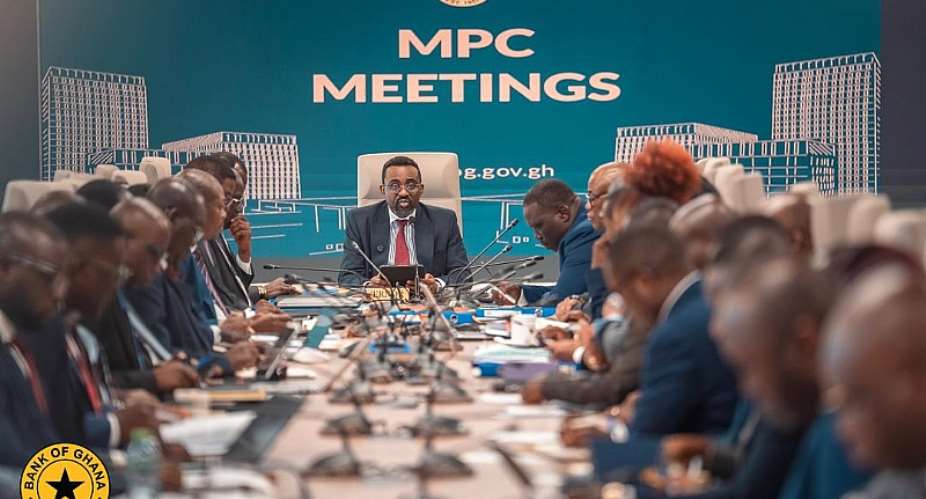
The Bank of Ghana has lowered its Monetary Policy Rate by 300 basis points, from 14% to 11%, citing improvements in the country's macroeconomic conditions, stronger economic activity and easing credit conditions.
The decision was announced by the Governor of the Bank of Ghana, Dr Johnson Pandit Asiama, following the 133rd meeting of the Monetary Policy Committee (MPC), held from November 16 to 18, 2026.
The rate reduction comes despite a slight rise in headline inflation, which increased to 5.5% in October 2026 from 5.2% recorded in September.
Explaining the Committee's decision, Dr Asiama said members had considered developments in economic activity, private sector lending and the government's fiscal performance.
“Taken together, the Committee noted significant improvements in domestic macroeconomic conditions,” he said.
He noted that economic growth had remained strong, supported by improved credit conditions and increased lending to the private sector.
The Bank's Composite Index of Economic Activity recorded a year-on-year growth of 17.7% in September 2026, compared with 9.6% during the corresponding period in 2025.
Growth in private sector credit also accelerated to 37.2% in October 2026, from 13.9% a year earlier. In real terms, credit expansion reached 30%, up from 5.4% over the same period.
The latest policy rate adjustment is expected to create further opportunities for commercial banks to reduce lending rates. The average bank lending rate had already declined to 15.8% in October 2026, compared with 22.2% in October 2025.
In addition to the rate cut, the MPC announced changes to the Bank's monetary operations framework to strengthen the transmission of monetary policy decisions to market interest rates.
The reforms include replacing the existing 14-day Open Market Operations instrument with a seven-day facility and reducing the monetary policy corridor from plus or minus 400 basis points to plus or minus 100 basis points around the policy rate.
Dr Asiama said the changes were necessary because market interest rates had been trading below the existing policy rate, suggesting that the actual monetary policy stance was less restrictive than the announced rate indicated.
“As a result, prevailing market rates have evolved at levels below the current monetary policy rate, indicating that the effective policy stance is actually lower than the announced rate,” he said.
On inflation, the Governor attributed the marginal increase in October largely to developments in the non-food sector, where inflation rose to 7.9% from 6.2% in September. He said higher utility tariffs and elevated crude oil prices were among the main contributing factors.
Food inflation, however, declined from 4.0% to 2.8%, supported by improved food supply conditions.
The Bank expects inflation to gradually move towards its medium-term target range, although the outlook remains vulnerable to fluctuations in crude oil prices, food production challenges and periodic adjustments in utility tariffs.
Meanwhile, Ghana's gross international reserves stood at US$12.1 billion as of November 17, 2026, equivalent to 4.4 months of import cover. This represents a decline from US$13.8 billion, or 5.7 months of import cover, recorded at the end of December 2025.
Dr Asiama said the external sector remained resilient, supported by strong export earnings. However, he noted that increased external payment obligations and pressures from foreign exchange demand had contributed to the decline in reserves.

 Bank of Ghana cuts policy rate to 11% as economic conditions improve
 El Niño: Ghana Health Service urges early preparedness against meningitis, heat-...
 24-Hour Economy is a subset of the New Economy – Ricketts-Hagan
 Some people contest elections to strengthen political bargaining power, not to w...
 Polls help presidential aspirants assess chances and avoid wasting money – Mussa...
 $60m presidential jet could save Ghana up to $2m annually in charter costs – Nkr...
 August 6 helicopter crash should end politicisation of presidential jet purchase...
 Three leaders, three agendas: Who wants what from Xi-Trump-Putin summit?
 Policewoman allegedly insults Don Little, says 'My clitoris is longer than you'
 GRA identifies 19 out of 22 non-compliant shops at West Hills Mall


