




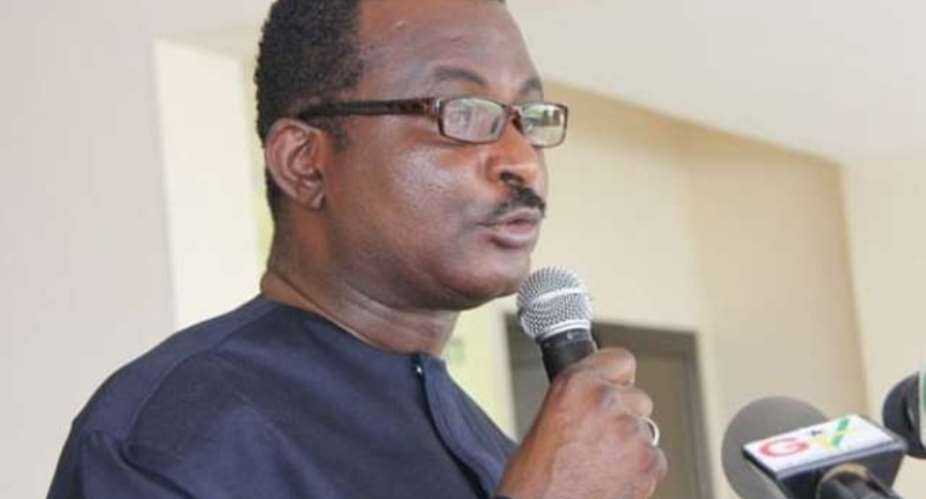
Deputy Majority Leader in Parliament, George Kweku Ricketts-Hagan, has described the 24-Hour Economy as a subset of the government's broader New Economy programme.
He said the two initiatives were not competing policies, explaining that the New Economy provides the broader framework for economic transformation, while the 24-Hour Economy is focused on private sector-led production and business operations.
Ricketts-Hagan, who is also the Member of Parliament for Cape Coast South, made the remarks during debate on the 2027 Budget in Parliament on Wednesday, November 18.
“The 24-hour economy is not the same as the New Economy. The best you can say is that the 24-hour economy is actually a subset of the New Economy,” he told the House.
He explained that the New Economy involves government financing the preparatory work and infrastructure needed to support economic activities, while the 24-Hour Economy is expected to rely on private sector participation to expand production and create jobs.
According to him, the government's role under the 24-Hour Economy is to provide the necessary operational structures and support to enable businesses to operate across multiple shifts.
Ricketts-Hagan said the New Economy was also designed to promote value addition by encouraging Ghana to process its raw materials locally rather than exporting them without significant processing.
He argued that expanding local processing and production would create jobs and help transform the country's economy.
The comments come after Finance Minister Dr Cassiel Ato Forson announced a US$10 billion New Economy programme covering the 2027 to 2030 period in the 2027 Budget.
The programme has eight pillars: macroeconomic stability and affordable finance, commercial agriculture, energy infrastructure, critical minerals value addition, tourism, culture and creative arts, textiles and garments, pharmaceuticals and biomanufacturing, and the technology economy.
Government has earmarked GH¢30 billion for the programme in 2027, with the broader initiative expected to support domestic production, industrial expansion and job creation.
The 2027 Budget also provides GH¢165 million for the 24-Hour Economy Secretariat to support the implementation of the private sector-led initiative.

 El Niño: Ghana Health Service urges early preparedness against meningitis, heat-...
 24-Hour Economy is a subset of the New Economy – Ricketts-Hagan
 Some people contest elections to strengthen political bargaining power, not to w...
 Polls help presidential aspirants assess chances and avoid wasting money – Mussa...
 $60m presidential jet could save Ghana up to $2m annually in charter costs – Nkr...
 August 6 helicopter crash should end politicisation of presidential jet purchase...
 Three leaders, three agendas: Who wants what from Xi-Trump-Putin summit?
 Policewoman allegedly insults Don Little, says 'My clitoris is longer than you'
 GRA identifies 19 out of 22 non-compliant shops at West Hills Mall


