





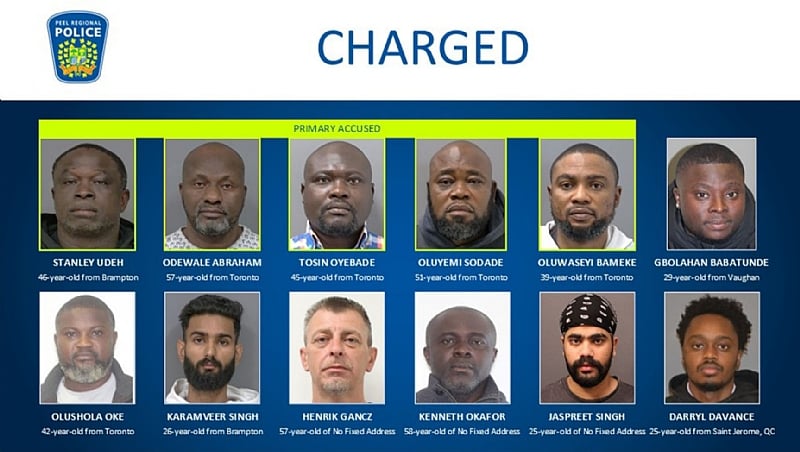
The international business of stealing luxury vehicles from Canadian streets and allegedly shipping them to overseas markets has suffered another major setback after Peel Regional Police announced the arrest of 12 individuals in an extensive investigation that recovered 96 stolen vehicles valued at approximately $4.5 million.
The operation, code-named Project Cadetta, has exposed what investigators describe as a sophisticated criminal network allegedly involved in stealing, concealing, transporting and exporting high-value vehicles from the Greater Toronto Area (GTA).
According to a November 16, 2026, news release issued by Peel Regional Police, investigators laid 231 charges following an investigation launched in March 2026 in partnership with the Canada Border Services Agency (CBSA).
At the centre of the investigation was a warehouse in Brampton, allegedly being used as a major staging point where stolen vehicles were concealed inside shipping containers before being transported towards Canadian ports for export to West Africa.
But the investigation did not end at the warehouse.
Police say they uncovered a wider criminal network operating across the GTA and surrounding jurisdictions, with five key suspects allegedly responsible for coordinating the theft, movement and exportation of stolen vehicles.
Other accused individuals are alleged to have supported different stages of the operation, including loading vehicles, moving shipping containers and transporting vehicles whose identification numbers had allegedly been altered.
The scale of the recovery raises a disturbing question: how many stolen vehicles have already disappeared from Canadian communities and reached international markets before investigators could intercept them?
A criminal supply chain beyond the driveway
Project Cadetta is another indication of how organized auto theft can extend far beyond the person who physically steals a vehicle.
Investigators allege that the operation involved different levels of criminal activity, from the theft of vehicles to their transportation, concealment and eventual exportation.
This is particularly concerning because stolen vehicles are not simply disappearing from neighbourhood driveways. According to the police investigation, some are allegedly being prepared for international shipment through organized networks.
Deputy Chief Nick Milinovich of Peel Regional Police described organized auto theft as a predatory business model operated by transnational syndicates.
He said Project Cadetta helped dismantle the alleged supply chain, from street-level thieves to international export brokers.
The 96 vehicles recovered included luxury SUVs, pickup trucks and other high-value vehicles. Their estimated combined value was $4.5 million.
Nine of the 12 individuals charged were released with future court dates, while three were held for bail hearings and later released.
Police also confirmed that arrest warrants had been issued for additional individuals and that further charges were anticipated as the investigation continued.
Ghana and Nigeria in the international auto-theft conversation
For Ghanaians and Nigerians living in Canada, the investigation carries an important international dimension.
Previous auto-theft investigations in the GTA have raised concerns about stolen Canadian vehicles allegedly being shipped to West African destinations, including Ghana and Nigeria.
In earlier investigations, York Regional Police described criminal networks involving vehicle thieves, traffickers and individuals responsible for loading stolen vehicles into shipping containers.
One such investigation, Project Victory, resulted in the recovery of 70 stolen vehicles valued at approximately $4.5 million. Police also linked the alleged network to 32 stolen vehicles shipped to Ghana or Nigeria.
Another investigation, Project Majestic, focused on the theft of Lexus, Toyota and Honda SUVs.
These cases illustrate why Canadian authorities are increasingly examining auto theft as a cross-border and international crime rather than simply a local property offence.
However, the nationalities of those arrested in Project Cadetta have not been established in the police news release. It would therefore be inaccurate to identify the accused by nationality without confirmation from investigators or court records.
Equally important, the recovery of vehicles allegedly destined for overseas markets does not mean that every person purchasing a luxury vehicle in Ghana or Nigeria is involved in criminal activity.
Nevertheless, the investigations raise serious questions for international vehicle buyers, shipping companies, vehicle dealers and port authorities.
What happens to the vehicles already shipped?
One of the most important questions emerging from these investigations concerns vehicles that may have left Canada before police could identify and recover them.
In previous GTA investigations, police reported that stolen vehicles were transported to the Port of Montreal, sometimes by road and sometimes in shipping containers moved by train, before being loaded onto vessels bound for overseas destinations.
That raises an important challenge for Canadian and international authorities: identifying stolen vehicles after they have crossed international borders.
The CBSA's involvement in Project Cadetta demonstrates the importance of intelligence-sharing and coordinated container examinations.
Acting Regional Director General Trishann Pascal said CBSA officers play a critical role in stopping stolen vehicles from reaching international markets through targeted container examinations and referrals.
For potential buyers in Ghana and Nigeria, the message is equally important: a luxury vehicle offered at an attractive price should not automatically be considered a legitimate bargain. Buyers should verify its documentation, ownership history and vehicle identification number before completing a transaction.
A vehicle that appears legally registered in one country could still be connected to an unresolved theft investigation elsewhere.
The bigger battle is not over
Peel Regional Police report that auto thefts across the region have declined by more than 50 per cent since reaching a peak in 2023, with a further 10 per cent year-to-date reduction recorded in 2026.
While that represents progress, Project Cadetta demonstrates that investigators continue to face organized criminal networks capable of operating across municipal, provincial and international boundaries.
The question now is whether the latest arrests will lead investigators to additional suspects, overseas buyers, shipping intermediaries and other participants in the alleged criminal supply chain.
For the families whose vehicles have disappeared, recovering a stolen car is more than a financial victory. It is about restoring security, protecting livelihoods and ensuring that criminal networks cannot turn ordinary Canadian neighbourhoods into starting points for international illegal trade.
The investigation remains ongoing. Anyone with information is urged to contact Peel Regional Police Commercial Auto Crime Bureau at 905-453-2121, extension 3410.
One thing is clear: the fight against organized auto theft cannot end at the Canadian border. If stolen vehicles are being moved across oceans, the response must reach across borders too.


 Bank of Ghana cuts policy rate to 11% as economic conditions improve
 El Niño: Ghana Health Service urges early preparedness against meningitis, heat-...
 24-Hour Economy is a subset of the New Economy – Ricketts-Hagan
 Some people contest elections to strengthen political bargaining power, not to w...
 Polls help presidential aspirants assess chances and avoid wasting money – Mussa...
 $60m presidential jet could save Ghana up to $2m annually in charter costs – Nkr...
 August 6 helicopter crash should end politicisation of presidential jet purchase...
 Three leaders, three agendas: Who wants what from Xi-Trump-Putin summit?
 Policewoman allegedly insults Don Little, says 'My clitoris is longer than you'
 GRA identifies 19 out of 22 non-compliant shops at West Hills Mall


