




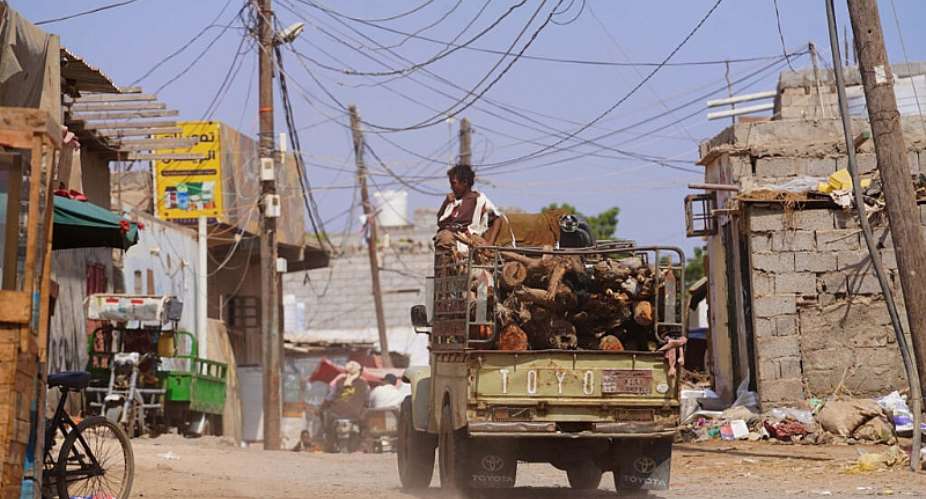
After seizing Yemen's western coast in September and establishing a foothold near the Bab el-Mandeb Strait, the Houthis are now at the gates of the densely populated southern port city of Aden.
The Iran-backed Houthi rebels bore down earlier this week on the strategic city, where the Saudi-backed internationally recognised Yemeni government established their headquarters after losing control of the capital, Sanaa, to the Houthis in 2014.
Read more Yemen's Houthis advance on Aden as government forces retreat to defend their capital
The potential fall of Aden would deprive Yemeni authorities of their last major stronghold and cement a near-total Houthi control of a country located on the southwestern tip of the Arabian Peninsula, where the Red Sea meets the Indian Ocean. Aden lies around 170 kilometres east of the Bab el-Mandeb Strait, literally the “Gate of Tears” in Arabic, the narrow chokepoint that serves as a southern exit from the Red Sea to the Gulf of Aden and the Indian Ocean, where shipping lanes connect Asian and European markets.
On Wednesday, the Saudi-led coalition said it launched a major air attack across rebel-held territories in Yemen, which the Houthis said killed at least 17 people. The attack followed international alarm over the Houthi advance to around 60 kilometres outside Aden, a city of more than 1.20 million inhabitants that has served as the Yemeni government's interim capital.
But many experts question whether the Shiite rebels really have an interest in launching a deadly urban battle in Aden, where the government has deployed military reinforcements.
Encirclement or siege for better ceasefire conditions
Karim Sader, a political scientist and consultant specialised in the Gulf states, favours “the scenario of an encirclement, or even a siege” of the city, rather than launching “a lengthy and costly frontal offensive”.
Despite their advances on the ground, the Houthis appear to want to negotiate, according to Sader. “They know that conquering Aden will not be easy,” he explained. “While they have achieved significant military successes, they do not have the necessary resources to storm Aden so far.” Analysts also question whether the Houthis have the resources to maintain control of Aden should they opt for a lightning sweep.
“Since their primary objective is to put themselves in a position of strength ahead of potential talks, they will seek to gradually strangle the city to force their opponents to negotiate,” he said. Houthi rebels march in Sanaa on September 10, 2026.
The current escalation was sparked this summer, when Saudi Arabia bombed the runway of the airport in Houthi-controlled Sanaa, in an attempt to prevent an Iranian plane carrying Yemenis who had attended the funeral of the late Iranian supreme leader Ayatollah Ali Khamenei from landing.
The Houthis promptly announced a naval blockade of Saudi Arabia and sent missiles towards the country's oil facilities. With that, the Saudi-Houthi ceasefire, in place since 2022, was over.
Mona Safwan, a Yemeni journalist and political analyst, believes the Houthis may be eyeing more advantageous conditions for a new ceasefire. “The Houthis have set forth very clear conditions for a ceasefire,” said Safwan, referring to the lifting of the blockade and an end to the Saudi military intervention in Yemen. “The current military escalation is specifically aimed at forcing Riyadh to accept these conditions, and the further the Houthis advance, the tougher their conditions become and the more firmly they stick to them.”
The city already demonstrated its ability to resist the Houthis in 2015, when the rebels seized control of the presidential palace in Aden but only managed to hold it for one day. The Houthi withdrawal at that time was achieved by a combination of coalition air strikes as well as a mobilisation by Aden residents and neighbouring governorates to defend the city alongside paramilitary groups.
Saudis 'need' UAE-backed southern separatists
In order to defend Aden and halt the Houthi advance, Saudi Arabia needs fighters from the Southern Transitional Council (STC), a separatist movement backed by the UAE. In early January, Saudi Arabia attacked the STC after the UAE-backed separatists seized control of Yemen's eastern territories that had previously been held by government troops.
Read more Yemen is back from the brink, but frenemies Saudi Arabia and UAE have much to negotiate
Sader noted that “the southern forces, while somewhat disinterested in what is happening in the north, are nonetheless not prepared to surrender the city of Aden.”
With the Houthi advance towards Aden, the interests of the Saudis and the STC have aligned, said Sader. “The Saudis once again need the STC forces that they had attacked and sidelined earlier this year, and must therefore reach out to the Emirates, which sponsor them,” he explained. “Coordination between Riyadh and Abu Dhabi appears to be taking shape, but their alliance of convenience remains fragile: while the southern forces are ready to defend Aden, they will not abandon their goal of independence, which is incompatible with the Saudi desire to preserve Yemen's unity.”
Houthis 'always' decide and 'impose their will'
On Monday, Saudi Arabia replaced the commander of the Saudi-led coalition supporting the Yemeni government, following the Houthi advance towards Aden and the withdrawal of government forces from areas near the Bab el-Mandeb Strait.
General Fahd bin Hamad bin Abdelaziz al-Salman, who had been leading coalition operations since 2024, was relieved of his coalition command duties and replaced by General Fayyad bin Hamed bin Ruqad al-Ruwaili, according to a royal decree.
Read more Saudi Arabia dismisses commander of anti-Houthi coalition as rebels advance
But in addition to the post shakeup and the push for an agreement between the Saudis, Emiratis and STC, the defence of Aden also requires better coordination within the government camp, which has been ridden with fragmentation and internal strife, which in turn has benefitted the rebel advance.
“The Houthis deserve credit for being clear about their intentions, and they are taking the initiative on the ground, since they are always the ones who decide and impose their will,” said Safwan. “But militarily speaking, nothing is really stopping them from advancing toward Aden. If they aren't doing so, it's because they don't want to invade the south or provoke a crisis with the people of the south.”
But if the rebels believe Aden is of vital strategic interest, Safwan warned that the Houthis could sacrifice the interests of the local populace to gain control of the entire stretch of Yemen's southern coast, from the Bab el-Mandeb to the Yemeni archipelago of Socotra, located far offshore to the southeast in the Gulf of Aden near major shipping lanes. “If Saudi Arabia uses Aden as a staging ground for its forces and as a launching point for an offensive against Sanaa, then the Houthis will seek to take the city – or even the entire south of Yemen, all the way to Socotra,” she said.
This article has been translated from the original in French.


 Bank of Ghana cuts policy rate to 11% as economic conditions improve
 El Niño: Ghana Health Service urges early preparedness against meningitis, heat-...
 24-Hour Economy is a subset of the New Economy – Ricketts-Hagan
 Some people contest elections to strengthen political bargaining power, not to w...
 Polls help presidential aspirants assess chances and avoid wasting money – Mussa...
 $60m presidential jet could save Ghana up to $2m annually in charter costs – Nkr...
 August 6 helicopter crash should end politicisation of presidential jet purchase...
 Three leaders, three agendas: Who wants what from Xi-Trump-Putin summit?
 Policewoman allegedly insults Don Little, says 'My clitoris is longer than you'
 GRA identifies 19 out of 22 non-compliant shops at West Hills Mall


