




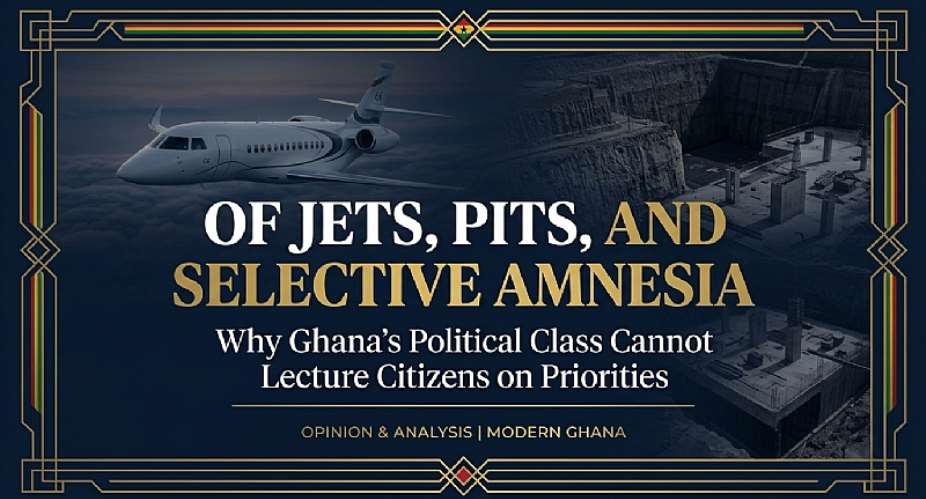
In the grand theatre of Ghanaian politics, moral outrage is rarely a matter of principle; it is strictly a matter of geography—specifically, which side of the parliamentary divide a politician currently occupies. Nowhere is this comedy of selective amnesia more vivid than in the national uproar following the touchdown of Ghana’s new US$60.68 million Dassault Falcon 6X presidential aircraft.
When New Patriotic Party (NPP) Deputy Director of Legal Affairs, Enoch Afoakwa, Esq., appeared on JoyNews to question the very utility of a presidential jet—proclaiming with theatrical solemnity that Ghanaians elected the President to remain in Accra and work rather than fly while rural clinics rely on aboboyaa (tricycles) as ambulances—one could almost admire the audacity. Coming from a senior legal officer of a political tradition that poured US$97 million into an uncompleted National Cathedral excavation while chartering ultra-luxury private jets at US$21,000 an hour, such sudden fiscal piety requires a remarkable suspension of memory.
When accomplished minds—armed with advanced degrees in law, diplomacy, and business—reduce complex statecraft and international diplomacy to village-square populism, citizens must look past the comedy and interrogate the cold legal, financial, and institutional realities behind both controversies.
1. The Ledger of Double Standards: Comparing Jet and Pit
Before entertaining any partisan sermon on misplaced national priorities, Ghanaians deserve an honest narrative comparison of the two expenditures dominating our national conversation.
- Total Financial Outlay: The Dassault Falcon 6X carries a total contract price of US$60.68 million, comprising an estimated US$53 million commercial base price and US$7.68 million for specialized military avionics, security upgrades, and crew training. By contrast, the National Cathedral project incurred US$97 million in public commitments—US$58 million already disbursed from state coffers and US$39 million in outstanding contractor liabilities—exceeding the entire cost of the jet by more than US$36 million.
- Physical and Operational Reality: Whereas the Falcon 6X (9G-ONE) is a delivered, airworthy sovereign aircraft operated by the Ghana Air Force with a 5,500-nautical-mile nonstop range capable of reaching London or New York directly from Accra, the National Cathedral remains an abandoned, waterlogged excavation pit in central Accra that formally reverted to the state in October 2026 with zero superstructure above ground.
- Procurement and Audit Standing: While Parliament approved the Falcon 6X acquisition in December 2025 without formal objection from the Minority at the committee stage—though the Minority now legitimately questions the US$7.68 million equipment variance—the National Cathedral was flagged in both the July 2025 Deloitte & Touche audit and a subsequent PwC forensic audit for severe breaches of Ghana’s procurement laws.
2. The Legal & Operational Reality of the Falcon 6X
Stripped of political caricature, acquiring a modern long-range aircraft is neither an endorsement of executive vanity nor a novel concept in statecraft.
- The Death of the Legacy Fleet: The 16-year-old Falcon 900EX was not merely aging; it had become an operational liability. Grounded in France for months in 2025 due to severe fuel tank corrosion and technical faults, the aircraft could no longer guarantee presidential safety or execute nonstop transcontinental flights.
- Ending the Charter Drain: Between 2021 and 2024, taxpayers routinely absorbed between US$300,000 and US$500,000 per multi-nation trip on chartered Boeing Business Jets and Airbus ACJ320neos—expenditures defended at the time by the previous administration as indispensable to "presidential security and prestige." Over a 15-to-20-year lifecycle, owning a dedicated Ghana Air Force jet is demonstrably cheaper than enriching foreign charter brokers.
- The Legitimate Parliamentary Question: Satire aside, the Minority in Parliament is within its constitutional oversight mandate to demand a line-by-line breakdown of the US$7.68 million differential between the Falcon 6X’s commercial list price and its US$60.68 million contract figure. Even though the Minority raised no formal objection during committee approvals in December 2025, public transparency on defense and executive procurement remains non-negotiable.
3. The $97 Million Monument to Impunity
If the Falcon 6X debate warrants scrutiny, the National Cathedral audit demands legal reckoning. The July 2025 Deloitte & Touche audit report read less like a financial review and more like a textbook on how to dismantle public procurement laws.
- Spending Without Contracts: Over GH¢15.7 million was disbursed to lead architects before formal contracts were executed, alongside US$12.4 million billed for unapproved extra works and GH¢4.93 million in unexplained consultancy fee variances.
- Paying for Failure: State funds were used to pay US$523,500 on expired contracts and US$110,600 for fundraising campaigns that yielded zero cedi—all while board trustees drew GH¢29,000 monthly allowances atop an empty pit.
- From Audit to Prosecution: With the PwC forensic audit now before the Attorney-General following the October 2026 state takeover of the site, Ghanaians do not need partisan press conferences; they need indictments under the Public Financial Management Act and full recovery of misappropriated funds.
4. Recommendations for Institutional Reform & Citizen Action
To rescue Ghana’s public discourse from perpetual hypocrisy and opaque spending, we must replace partisan noise with enforceable rules:
- Publish a Declassified Falcon 6X Procurement Brief: The Ministries of Defence and Finance must release an itemized public summary accounting for the US$7.68 million military avionics, communications, and training package to permanently settle questions of price padding.
- Enforce Surcharges and Prosecutions on the Cathedral: The Attorney-General and Auditor-General must invoke Article 187(7)(b) of the 1992 Constitution to surcharge public officials who authorized unlawful payments on the National Cathedral and initiate criminal prosecutions where fraud is established.
- Legislate a Sovereign Fleet & Executive Travel Act: Parliament should pass binding legislation prohibiting ad-hoc private jet charters except in verified emergencies, while establishing transparent 15-year replacement sinking funds for presidential and military aircraft.
- Institutionalize Real-Time Media Fact-Checking: Broadcast journalists must stop serving as passive microphones for partisan revisionism—confronting political communicators on air with their own past statements, voting records, and party track records.
- Adopt Non-Partisan Civic Vigilance: Citizens must refuse to applaud fiscal recklessness when committed by their preferred party, holding every administration to one uniform standard of integrity.
A serious republic cannot govern itself on memes, amnesia, and partisan convenience. The US$60.68 million Falcon 6X is a tangible national asset whose value depends on transparent accounting and disciplined maintenance. The US$97 million National Cathedral, by contrast, remains an expensive scar—a cautionary tale of what happens when political hubris trumps the rule of law.
Until Ghana’s educated elite trade cheap television applause for intellectual honesty, our national debates will remain an entertaining distraction from the real business of nation-building. ✍️By Retired Senior Citizen
For and on behalf of all Senior Citizens of the Republic of Ghana 🇬🇭
Teshie-Nungua
[email protected]


 Bank of Ghana cuts policy rate to 11% as economic conditions improve
 El Niño: Ghana Health Service urges early preparedness against meningitis, heat-...
 24-Hour Economy is a subset of the New Economy – Ricketts-Hagan
 Some people contest elections to strengthen political bargaining power, not to w...
 Polls help presidential aspirants assess chances and avoid wasting money – Mussa...
 $60m presidential jet could save Ghana up to $2m annually in charter costs – Nkr...
 August 6 helicopter crash should end politicisation of presidential jet purchase...
 Three leaders, three agendas: Who wants what from Xi-Trump-Putin summit?
 Policewoman allegedly insults Don Little, says 'My clitoris is longer than you'
 GRA identifies 19 out of 22 non-compliant shops at West Hills Mall


