




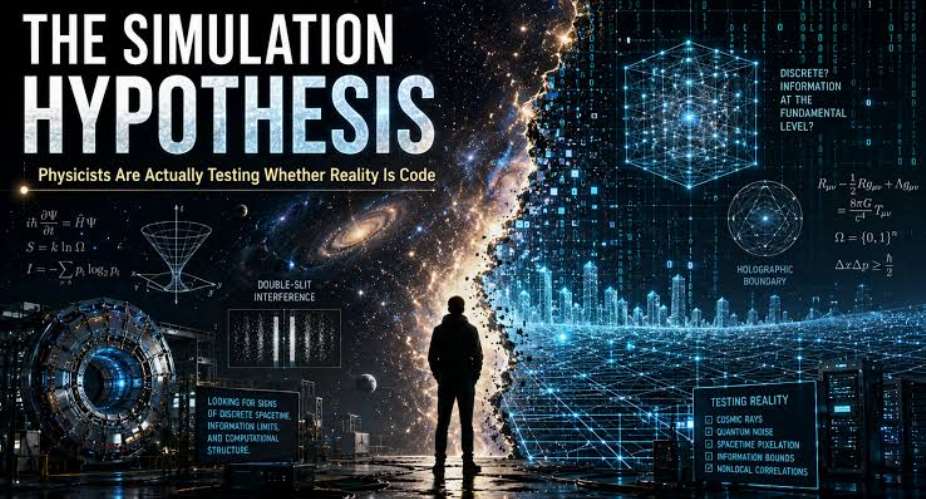
Right now, as you read this sentence, there is a non-trivial chance that none of this is base reality. Your memories, the room you are sitting in, the person you love most: all of it could be running on hardware you will never see. And the math that gets us there is disturbingly clean.
I know how that sounds. It sounds like a film pitch, or like something a friend says at 2 a.m. after too much coffee. But I want you to stay with me, because the people who take this idea seriously are not cranks. They are philosophers at major universities, physicists, and the engineers building the technology that will shape your children's lives. And I will tell you now where I land: I think the claim is probably false. I also think it may be the most useful question our generation has been handed.
## An Old Fear in New Clothes
Humans have always suspected that the world is not quite what it seems. Plato imagined prisoners chained in a cave, mistaking shadows on a wall for reality. In the seventeenth century, René Descartes wondered whether an evil demon might be feeding him a perfect illusion. In ancient China, the sage Zhuangzi dreamed he was a butterfly, then woke and could not tell whether he was a man who had dreamed of a butterfly or a butterfly now dreaming of being a man.
Every age has asked the same thing in its own language. Ours happens to be written in code.
In 2003, the philosopher Nick Bostrom published a paper in *The Philosophical Quarterly* titled "Are You Living in a Computer Simulation?" It did not say what most people think it said. That difference matters, so let me be precise.
## What Bostrom Actually Argued
Bostrom did not claim that we are living in a simulation. He argued that at least one of three statements must be true:
1. Almost all civilizations at our stage of development go extinct before they become technologically mature enough to run realistic simulations of their ancestors.
2. Almost all civilizations that do reach that maturity have no interest in running such simulations, whether for ethical reasons, shifting priorities, or plain boredom.
3. We are almost certainly living in a simulation.
The logic behind the third option is about counting. If advanced civilizations exist and they run many simulations, then simulated minds would vastly outnumber the minds living in base reality. If you could not tell which kind of mind you were, the odds would say you are probably one of the simulated ones.
Notice what this does. It is a trap with three doors. To escape the third, you must believe either that humanity will wipe itself out, or that every future civilization will lose interest in simulating its past. Neither is a comfortable thing to bet on. This is why the argument has refused to die for more than twenty years.
## Why It Exploded
Part of the reason is simple. Look at how far we have come. Within one human lifetime we went from two white rectangles bouncing a square on a screen in *Pong* to photorealistic worlds where millions of people play together in real time. Now add artificial intelligence that can write, paint, and hold conversations. When you extend that curve a few centuries, it is hard to laugh the question off.
Powerful voices fed the fire. In 2016, Elon Musk told an audience that the odds we are living in base reality are about one in billions. That same year, the astrophysicist Neil deGrasse Tyson said at a public debate that he thought the odds were about fifty-fifty, though he later sounded more cautious. The philosopher David Chalmers wrote *Reality+* in 2022, arguing that even if we are in a simulation, our lives and the things we love in them are still real. The author Rizwan Virk has pushed the idea toward the mainstream in his own book, *The Simulation Hypothesis*.
And then there is the feeling. You know the one. A moment of déjà vu, a coincidence too strange to be chance, a dream so detailed you cannot believe your own mind built it. I have sat in Accra traffic long enough to wonder whether a world this chaotic could be anything but a poorly optimized program. I say that as a joke, but jokes like that are exactly how a big idea slips into the culture.
## The Case For: Why It Will Not Go Away
Let me give the hypothesis its best shot before I take it apart.
First, the statistical argument. If simulations are cheap and plentiful, the numbers favor being inside one. This is Bostrom's core insight, and it has never been cleanly refuted.
Second, it leans on an assumption many philosophers and scientists find reasonable: that consciousness does not depend on the particular material it runs on. If a mind can arise from neurons, why not from silicon, or from something we have not invented yet? If that is true, a simulated mind would feel exactly as real as yours.
Third, some physicists have wondered whether a simulated universe would leave fingerprints. In 2012, Silas Beane, Zohreh Davoudi, and Martin Savage published work asking whether a universe simulated on a grid might show tiny directional signs in the highest-energy cosmic rays. Nothing conclusive was found. But the fact that someone designed an experiment shows the question can touch real science.
## The Case Against: Where I Start Pushing Back
Here is where my own opinion forms, and I will be honest about my reasons.
**The cost problem.** Simulating a universe, or even a single planet at the level of detail we experience, may demand more energy and computing power than physics allows. In 2025, the astrophysicist Franco Vazza published a paper in *Frontiers in Physics* arguing that, based on what we know about information and energy, it is nearly impossible for a universe like ours to be simulated at that resolution. A fair counter is that we could be running on a simplified or "lazy" simulation that renders detail only when someone looks. But then the question becomes how anyone would ever tell the difference, which brings me to the next problem.
**The testing problem.** A claim that can never be checked struggles to count as science. The physicist Sabine Hossenfelder has been blunt about this. As it is usually stated, the hypothesis can absorb any evidence you throw at it. Found a glitch? That is the simulation. Found no glitch? The simulators are good at their job. An idea that wins in every scenario is not telling you anything about the world.
**The non-computable universe.** Also in 2025, a group of researchers including Mir Faizal and Lawrence Krauss published a paper using ideas related to Gödel's incompleteness theorems. They argued that a full description of physical reality may require something that no algorithm can produce, which would mean the universe cannot be a computer program. I want to be fair here. This work is contested and is far from settled opinion among physicists. I mention it because it shows serious people are attacking the hypothesis from the mathematics itself, and not only from common sense.
**The consciousness question.** Everything depends on the assumption I mentioned earlier, that minds can run on any substrate. Nobody has proven that. It may turn out that consciousness is tied to biology, to living matter, in a way that code can never copy. If so, the whole counting argument collapses, because there would be no simulated minds to count.
**The regress problem.** If our world is a simulation, whoever built it may also be inside one, and so may their builders. Where does the chain end? The idea does not solve the mystery of existence. It only moves it somewhere we cannot see.
**Occam's razor.** The simplest explanation for a universe is a universe. To say we live in a simulation, you must add a second, larger reality, plus beings who built ours, plus their computers, plus their reasons. That is a lot of extra baggage for an idea with no direct evidence behind it.
## My Verdict
So here is where I stand. I think the Simulation Hypothesis is probably false as a literal claim about our universe. I cannot prove it, and I am not sure anyone can. But when I weigh the cost problem, the consciousness assumption, and the complete absence of evidence, I do not find the story convincing enough to believe.
Yet I refuse to call it a waste of time. Here is why.
The hypothesis forces us to ask questions we have been dodging. If a mind built from code could suffer, would we owe it anything? That is no longer a fantasy question. We are building systems that talk to us like people, and the world has not decided how to treat them. The simulation debate is the rehearsal for that conversation. It also forces us to think about our own survival. Remember the first door in Bostrom's trilemma. Reaching technological maturity is not guaranteed. The argument quietly asks whether we will make it, and that question deserves our attention far more than any glitch in the sky.
There is another thing I find striking. Strip away the circuits, and the Simulation Hypothesis sounds a lot like older ideas. A creator beyond our sight. A world that may not be the final one. A sense that what we see is not everything. Many readers, from many faiths, will recognize the shape of that. I am not saying the two are the same. I am saying that when a modern, secular, technical theory begins to sound like ancient spiritual intuition, we should pay attention to what that says about the human mind. We keep reaching for something beyond the surface of things.
## What It Changes, and What It Never Can
Now to the part that matters most. Suppose I am wrong. Suppose tomorrow someone shows you proof that this is a simulation. What changes?
Very little, I think, and this is where I agree with David Chalmers. Your pain would still hurt. Your mother's voice would still comfort you. The meal you share with friends would still taste like home. A kindness would still be kind, and a cruelty would still be cruel. The things that give life weight do not live in the hardware. They live in the experience, and the experience would be just as real to you as it is right now.
If anything, the idea should make us more careful, not less. If there is even a small chance that minds like ours can be built, then how we treat every kind of mind, human or otherwise, becomes a serious moral matter. And if there is a chance that this world is being watched or run, the answer is not to behave for an audience. The answer is to live in a way you would be proud of whether anyone is watching or not.
That is the real gift of this strange idea. It does not tell us what the universe is made of. It asks what kind of people we choose to be inside it.
So I will leave you with the question I have been asking myself while writing this:
**If you woke up tomorrow and somehow knew for certain that this was a simulation, what would you do differently, and what would stay exactly the same?**
Think about your answer. Then notice how much of it you could start living today.


 Bank of Ghana cuts policy rate to 11% as economic conditions improve
 El Niño: Ghana Health Service urges early preparedness against meningitis, heat-...
 24-Hour Economy is a subset of the New Economy – Ricketts-Hagan
 Some people contest elections to strengthen political bargaining power, not to w...
 Polls help presidential aspirants assess chances and avoid wasting money – Mussa...
 $60m presidential jet could save Ghana up to $2m annually in charter costs – Nkr...
 August 6 helicopter crash should end politicisation of presidential jet purchase...
 Three leaders, three agendas: Who wants what from Xi-Trump-Putin summit?
 Policewoman allegedly insults Don Little, says 'My clitoris is longer than you'
 GRA identifies 19 out of 22 non-compliant shops at West Hills Mall


