




Decades of discrimination and extortion against Fulani herders are stoking the growing violence in northern Nigeria -- unrest which will only swell until authorities tame the rampant corruption in the region, a bandit kingpin told AFP in a rare interview.
Northwest and central Nigeria have for years been terrorised by gangs known locally as "bandits", who raid villages, rustle cattle, conduct kidnappings and impose "taxes" on farmers and miners.
The interview with one such gang leader came during the reporting of an article for The New York Review of Books, in a piece published Thursday, co-authored by an American academic and writer Helen Epstein and AFP northern Nigeria reporter Aminu Abubakar.
"Years of injustices are what pushed Fulani herders into banditry. We were never criminals before," a bandit leader named Babangida said.
Banditry traces its roots to conflicts between herders and farmers over access to limited land and water, made worse by climate change and population growth.
Out of the violence emerged powerful gangs, largely composed of Fulani herders.
The conflict has spiralled from raids and revenge attacks into broader, complex criminality by gangs numbering from around a dozen to well into the hundreds.
They have created a kidnapping economy that raises hundreds of thousands of dollars, and at times entered alliances with Nigerian jihadists.
After months of negotiation, Babangida agreed to an interview in a remote Katsina state village, following the intervention of a former government peace negotiator.
"Justice is the only way out. When justice is upheld, everyone will live in peace," said the bandit, who asked only to be identified by his first name.
In the meantime, violence reigns: last week, in neighbouring Zamfara state, bandits set fire to a home during a raid, killing a family of 12.
Earlier this month, gunmen killed eight police officers, and in September, more than 80 people, mostly women, were kidnapped in Zamfara and Niger states -- many while working their fields.
Worsening insecurity has become a major issue in the ongoing presidential campaign, as Bola Tinubu runs for a second term in January polls.
Corruption
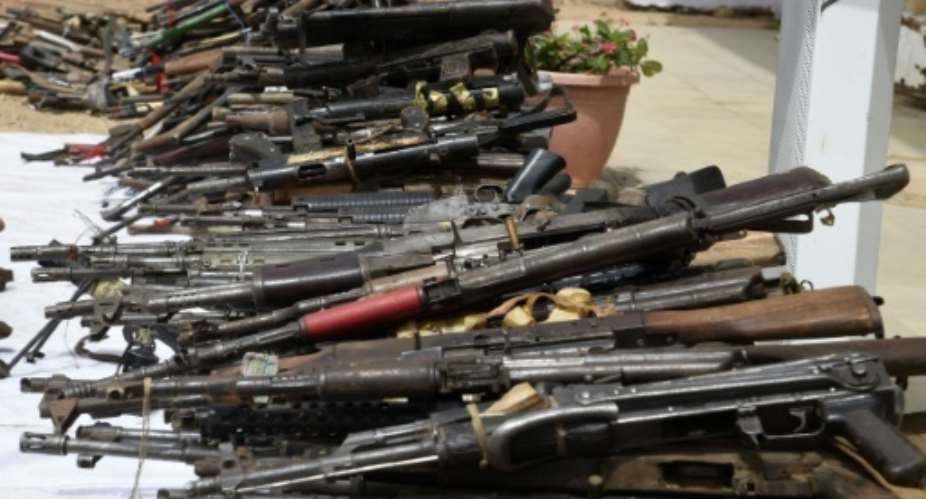
Clad in a blue kaftan, the 38-year-old passes for a normal villager, save for the Kalashnikov rifle in his hand.
"No bandit just picked up a gun overnight and turned to violence. There is always a story behind it," said Babangida, sheltering from the scorching heat under a neem tree.
Babangida said he turned to banditry a decade ago after his family's 97 cows were seized by a team of police and vigilantes.
He described the raid as based on indiscriminate suspicions that all Fulani are bandits.
He was forced to pay millions of naira (thousands of dollars) to post bail for his mother and brother.
He only recovered 10 cattle, which he used "to buy guns, one of which I'm holding now" and moved his family to a camp in the bush.
Fulani herders have for generations practiced semi-nomadic herding, moving from the arid north in the dry season to the more fertile Middle Belt and southern regions, through long-established grazing routes.
Desertification caused by overgrazing, the expansion of farms, climate change, population growth, and the chopping down of forests for firewood have pushed farmers and herders into contact -- including instances where herds move through farmland, eating crops and destroying fields.
Meanwhile, local officials, including village chiefs, police, and the military, have done little to stop farmers from encroaching into grazing areas -- and in some cases, colluded with them.
Discrimination
Both farmers and herders have suffered, with attacks on farming settlements sometimes leaving scores dead.
Fulanis say they face marginalisation and discrimination at the hands of the government and security forces.
When cows damage fields, "the village chief will set the fine well beyond the value of the crops destroyed," Babangida said.
"But when a farmer kills a herder's cattle, it is declared the herder's fault and he receives no compensation," he added.
"If the chief calls the police, they will connive with a judge to raise the fine even more."
'He's right'
The Nigerian military routinely refers to bandits as "terrorists", and runs a dedicated military campaign in the northwest to combat them.
But, addressing Babangida's claims of "injustice", the Katsina state internal security commissioner told AFP: "He's right... You can't divorce that factor (from the) drivers of this criminality".
Nasiru Muazu told AFP his state has made efforts to initiate peace dialogues and solve underlying issues driving criminality, arguing "what is happening here in the northwest is a community-driven crisis," unlike the jihadist conflict in northeast Nigeria.
"It is a serious problem" trying to balance a firm response from security forces and local diplomacy, he added.
'Money' and 'revenge'
Some bandit gangs, driven by economic motivations in the impoverished countryside, have become massive concerns, imposing "taxes" on farmers in areas all but abandoned by the state.
The military often turns to air strikes to try to rein in bandit groups in areas outside its control.
Vigilante groups -- repeatedly accused of extra-judicial killings by herders -- have formed among farmers. Peace deals have been repeatedly struck, only to collapse.
Violence has swelled in recent years.
New generation
But even Babangida is worried about the change among his criminal circle, as older bandits are replaced by a younger -- and more violent, he said -- generation.
He blamed young bandits -- often under the influence of drugs, he said -- for indiscriminate violence, including killing captives after ransoms were paid.
Analysts have expressed concern over alliances between bandits, who have no ideological leaning, with Nigerian jihadists.
Babangida admitted that some bandits align with jihadists for strategic reasons, but maintained that for most of his comrades "it is all about making money -- and revenge."


 2027 Budget: ‘Another round of slogans with no jobs’ – Afenyo-Markin
 Women's Development Bank to begin operations in early 2027 – Ato Forson
 Govt to settle US$590m Eurobond and domestic bond obligations by December 31 – A...
 Govt allocates GH¢1bn to complete 35 Agenda 111 hospitals in 2027
 Ato Forson outlines eight pillars of government's US$10bn economic transformatio...
 Govt allocates GH¢600 million for construction of 10 regional stadia
 Government rules out new taxes in 2027, targets GH¢323.4bn revenue
 2027 Budget: Gov't to improve revenue collection without introducing new taxes –...
 New Economy to help Ghana process more of its resources locally – Ato Forson
 [Full text] Ato Forson presents 2027 budget in Parliament


