




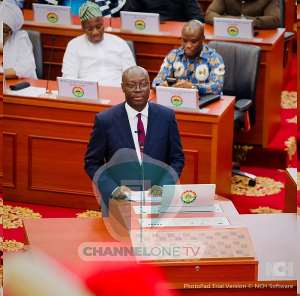
Finance Minister Dr Cassiel Ato Forson has outlined eight strategic pillars underpinning the government's US$10 billion economic transformation programme, which is expected to run for four years from 2027 and shift Ghana towards a production-led economy.
The initiative is intended to reduce the country's reliance on raw commodity exports, expand domestic industries and create sustainable jobs while preventing the recurring cycles of economic expansion and contraction.
Presenting the 2027 Budget Statement and Economic Policy to Parliament on Thursday, November 12, Dr Forson said the programme would combine investments across key sectors to strengthen the economy and build on the gains from macroeconomic stabilisation.
The eight pillars cover macroeconomic stability and affordable finance, commercial agriculture, energy infrastructure, critical minerals value addition, tourism and the creative arts, textiles and garments, pharmaceuticals and biomanufacturing, and the technology economy.
Under the first pillar, Macroeconomic Stability and Affordable Finance, the government intends to sustain fiscal discipline, maintain economic stability and improve access to affordable credit for businesses.
Its targets include maintaining a primary surplus of at least 0.5% of Gross Domestic Product (GDP), keeping public debt at around 45% of GDP and ensuring that inflation remains in single digits.
By 2030, the government is aiming for real GDP growth of 8%, an unemployment rate below 8% and an investment-grade sovereign credit rating. It also intends to reduce borrowing costs to single-digit levels through institutions such as Development Bank Ghana and Ghana EXIM Bank.
Commercial Agriculture, the second pillar, will receive US$3 billion to expand agricultural production, develop agro-processing and reduce the country's food import bill.
The government plans to establish eight integrated agro-industrial hubs covering rice, sugar, poultry, maize and soya feed, aquaculture, oil palm, vegetables and cocoa processing.
Among the key objectives are ending commercial rice imports by 2030 and ensuring that all cocoa produced in Ghana is processed locally by the same year.
The programme will also support the cultivation of 100,000 hectares of oil palm, backed by US$500 million in patient financing from the World Bank. The US$1 billion Pwalugu Multipurpose Dam is expected to provide additional support for agricultural development.
The third pillar, Energy Infrastructure, has been allocated US$2.2 billion, with the government seeking to improve energy security and bring down electricity generation costs from 16 US cents to 8 US cents or less per kilowatt-hour.
Plans include the construction of a 1,450-megawatt thermal power plant at Kafodzidzi-Abrobeano, which the government intends to finance and own fully. Work is expected to begin in December 2026.
A 600-megawatt solar facility, supported by 2,000 megawatt-hours of battery storage, is also planned. The government will further invest US$500 million in upgrading the transmission infrastructure of the Ghana Grid Company Limited (GRIDCo).
The programme also targets the withdrawal of expensive emergency power plants from the generation mix by 2030, alongside a US$200 million investment in a 24-month nuclear-readiness programme.
Under Critical Minerals Value Addition, the fourth pillar, the government intends to increase domestic processing of mineral resources rather than continue exporting them largely in their raw form.
The policy sets a December 2028 deadline for ending raw artisanal and small-scale gold exports, while raw manganese and bauxite exports are expected to cease by the end of 2030.
A 24-hour critical minerals processing enclave is planned for the Western Region, with a proposed railway connection between Takoradi and Nyinahin. The facility is expected to support the processing of bauxite, manganese and battery-grade lithium locally.
Tourism, Culture and Creative Arts forms the fifth pillar, with US$1 billion earmarked to strengthen Ghana's tourism industry and develop the Black Star Experience into a year-round attraction.
Building on the December in Ghana initiative, the government plans to preserve heritage sites, establish a Ghana Medical Tourism Hub and complete a new National Theatre in Kumasi.
It also intends to empower the Social Security and National Insurance Trust (SSNIT) to develop an international convention centre at the La Trade Fair site, as well as support the construction of five four- and five-star hotels across the country.
The sixth pillar, Textiles and Garments, will also receive US$1 billion to modernise the industry and expand local manufacturing capacity.
The government plans to establish dedicated industrial enclaves under the 24-Hour Economy framework to support textile mills and garment factories.
It will also pursue changes to procurement laws to ensure that uniforms, hospital textiles and protective clothing purchased with public funds are sourced exclusively from Ghanaian manufacturers. The measure is expected to create a reliable market for locally produced goods and generate employment.
Pharmaceuticals and Biomanufacturing, the seventh pillar, is designed to reduce Ghana's dependence on imported medicines, which currently account for an estimated 70% to 75% of the country's pharmaceutical requirements.
The government plans to commit US$1 billion to the sector, with state-owned special purpose vehicles expected to establish pharmaceutical hubs in the Eastern and Central Regions.
Under the proposed arrangement, public funds for medicines will be reserved for locally manufactured products that satisfy standards set by the Food and Drugs Authority (FDA) and the World Health Organisation (WHO).
The government is targeting domestic production of between 60% and 80% of essential medicines and the creation of 20,000 jobs by 2030.
The final pillar, the Technology Economy, has an allocation of US$300 million and focuses on strengthening digital infrastructure while building local expertise in emerging technologies.
Between 2027 and 2028, the government plans to upgrade rural 2G mobile networks to 4G to improve connectivity and access to digital services.
It will also establish a National Artificial Intelligence Centre to provide shared high-performance computing facilities, support applied research and equip young people and small and medium-sized enterprises with practical digital skills.
The government says the four-year programme is intended to turn economic stability into higher domestic production, industrial expansion and employment, with the broader goal of establishing a more resilient economy and creating lasting prosperity.

 2027 Budget: ‘Another round of slogans with no jobs’ – Afenyo-Markin
 Women's Development Bank to begin operations in early 2027 – Ato Forson
 Govt to settle US$590m Eurobond and domestic bond obligations by December 31 – A...
 Govt allocates GH¢1bn to complete 35 Agenda 111 hospitals in 2027
 Ato Forson outlines eight pillars of government's US$10bn economic transformatio...
 Govt allocates GH¢600 million for construction of 10 regional stadia
 Government rules out new taxes in 2027, targets GH¢323.4bn revenue
 2027 Budget: Gov't to improve revenue collection without introducing new taxes –...
 New Economy to help Ghana process more of its resources locally – Ato Forson
 [Full text] Ato Forson presents 2027 budget in Parliament


