




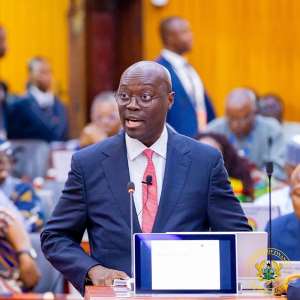
The government plans to expand Ghana's electricity generation capacity through the construction of a 1,450-megawatt (MW) state-owned thermal power plant and a 600MW solar facility, Finance Minister Dr Cassiel Ato Forson has announced.
Presenting the 2027 Budget Statement to Parliament on Thursday, November 12, 2026, Dr Forson said work on the thermal plant at Ekafudzidzi in the Central Region would commence in December 2026.
He explained that the project would be financed entirely by the state, ruling out borrowing to fund its construction.
“We are not borrowing for this project,” he told Parliament.
According to the Finance Minister, the first phase, with a generation capacity of 600MW, is expected to be completed by December 2028, while the remaining 850MW will be ready by December 2030.
The plant is projected to require approximately 150 million standard cubic feet of natural gas daily, to be supplied from the Sankofa and Jubilee fields.
Alongside the thermal project, the government will develop a 600MW solar power facility, also under full state ownership, with a battery storage capacity of 2,000 megawatt-hours (MWh).
Dr Forson said the storage system would enable excess electricity generated during the day to be retained for use when demand rises, while helping to maintain stability across the national grid.
The two generation projects and the battery storage infrastructure are expected to provide additional power for domestic consumers and major industries, including bauxite and manganese processing, steel production, cement manufacturing and agro-processing.
The Finance Minister said expanding reliable and affordable electricity supply was central to the government's industrialisation agenda and efforts to achieve greater energy independence.
“Energy capacity is economic capacity. It powers growth, jobs, and prosperity,” he said.
As part of the reforms, the government intends to discontinue the use of all emergency power plants by December 2030. The new facilities are expected to reduce dependence on costly emergency power arrangements.
Dr Forson also announced a US$500 million investment between 2027 and 2030 to upgrade Ghana's electricity transmission infrastructure and minimise power losses.
The investment will focus on strengthening the north-south transmission corridor, linking new generation facilities to areas of high demand and improving electricity trade with neighbouring countries. It will also support reliable power connections for strategic industrial zones.
On electricity distribution, the government plans to deploy 2 million prepaid meters as part of efforts to reduce losses within the system.
The Finance Minister further disclosed that performance-based private sector participation in electricity distribution would be fully implemented by the end of 2027.
He said the combined investments and reforms were aimed at improving power supply, reducing operational losses and ensuring that industries have access to dependable electricity to support production and the government's 24-hour economy agenda.
 2027 Budget: ‘Another round of slogans with no jobs’ – Afenyo-Markin
 Women's Development Bank to begin operations in early 2027 – Ato Forson
 Govt to settle US$590m Eurobond and domestic bond obligations by December 31 – A...
 Govt allocates GH¢1bn to complete 35 Agenda 111 hospitals in 2027
 Ato Forson outlines eight pillars of government's US$10bn economic transformatio...
 Govt allocates GH¢600 million for construction of 10 regional stadia
 Government rules out new taxes in 2027, targets GH¢323.4bn revenue
 2027 Budget: Gov't to improve revenue collection without introducing new taxes –...
 New Economy to help Ghana process more of its resources locally – Ato Forson
 [Full text] Ato Forson presents 2027 budget in Parliament


