




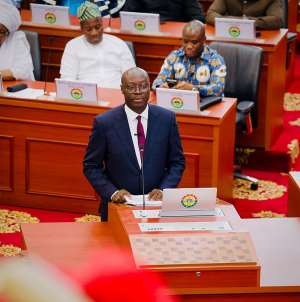
Finance Minister Dr Cassiel Ato Forson has announced that the government will commit GH¢30 billion to the New Economy programme in 2027 to drive economic transformation, expand businesses, increase exports and generate employment.
Presenting the 2027 Budget Statement and Economic Policy to Parliament on Thursday, November 12, he said the investment would lay the groundwork for the government's development agenda while sustaining the country's recent macroeconomic gains.
He explained that the funding would form part of a broader investment programme spanning 2027 to 2030, which the government intends to implement without undermining economic stability or reversing progress made in managing the economy.
Dr Forson assured Parliament that measures would be put in place to ensure transparency and accountability in the use of the resources. He said projects under the programme would undergo strict appraisal and value-for-money assessments before approval.
He added that government spending would be appropriately budgeted, authorised and reported, with public funds channelled into strategic investments capable of delivering wider economic benefits.
Commercial agriculture is expected to receive a significant share of the planned investment, reflecting the government's intention to use the sector to stimulate growth, create jobs and strengthen export performance.
“Next year, we will invest GH¢30 billion into the New Economy. This will finance the foundation for the economic transformation needed to expand businesses, increase exports and create jobs for the Ghanaian people. Out of the US$10 billion equivalent, US$3 billion of that amount will be invested in Pillar Two, Commercial Agriculture,” he said.
The Finance Minister noted that the sector's economic potential went beyond crop production to cover transportation, processing, packaging, trading and other rural services that support agricultural activities.
He, however, expressed concern about Ghana's continued expenditure of billions of dollars on food and agricultural imports, arguing that many of the products could be produced competitively within the country.
According to him, reliance on imported food puts pressure on the cedi, leaves the economy exposed to external price fluctuations and deprives local businesses and communities of opportunities to grow.
Dr Forson said reducing unnecessary food imports would stimulate activity across the agricultural value chain, including access to financing for farmers, the revival of factories, expansion of transport services and the creation of jobs.
“Every avoidable import is more than a customs entry into our country. It is a farm that was not financed, a factory that remained idle, a transport contract that was never signed and a job that was created elsewhere,” he told Parliament.

 [Full text] Ato Forson presents 2027 budget in Parliament
 2027 Budget: Stability returned in Ghana's economy, Ghanaians can breathe again ...
 2027 Budget: Ghana has emerged from painful economic crisis - Finance Minister
 Government to invest GH¢30bn in New Economy programme in 2027 – Ato Forson
 Best Assurance donates 28,500 exercise books worth GH¢100,000 to GETFund
 Ato Forson unveils four-year New Economy plan ahead of Ghana’s 70th independence...
 Ghana recorded 5.2% average growth in 35 years but unemployment remains a challe...
 2027 budget: Reckless spending, weak revenue and expensive debt caused 2022 cris...
 Mahama limits Ghana's COP31 delegation to 69 people in cost-cutting move
 Bono police reject GH¢9,000 bribe, detain suspected drug dealers


