




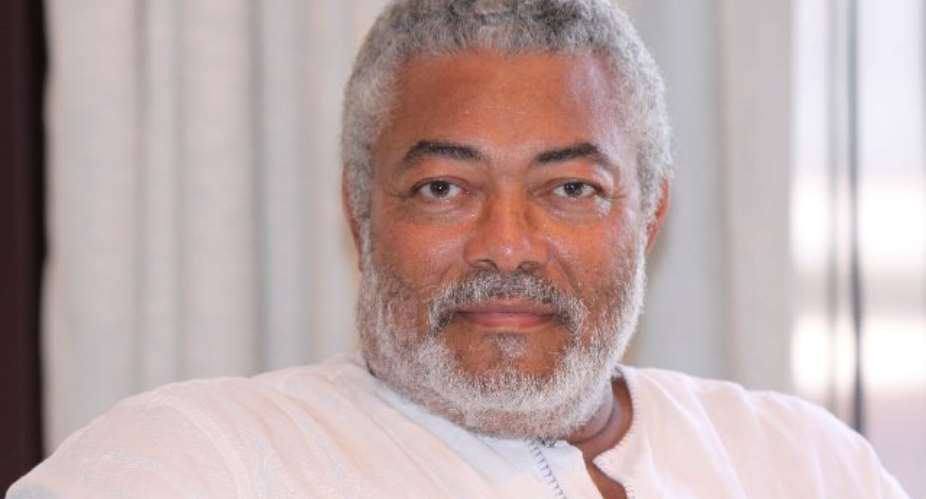
On November 12, 2020, Ghana lost one of the most consequential and controversial figures in its political history. Flight Lieutenant Jerry John Rawlings, former military leader and democratically elected President of the Republic of Ghana, passed away, leaving behind a political legacy that continues to provoke reflection, debate and, sometimes, deep disagreement.
Today, six years after his death, it is worth looking beyond the personality, the political controversies and the turbulent chapters of his leadership to reflect on the ideals that defined much of his political journey: probity, accountability, discipline, social justice and a genuine concern for the ordinary Ghanaian.
Rawlings was not an ordinary political figure. He emerged at a time when Ghana was experiencing serious economic difficulties, institutional weaknesses, corruption and widespread public dissatisfaction with the political establishment.
His message resonated with many ordinary people who felt that the state had become disconnected from their struggles and that the privileges of public office were being enjoyed by a few at the expense of the many; a condition not different from what we are experiencing now
The Quest for Probity and Accountability
Perhaps no two words became more closely associated with Rawlings' political philosophy than “probity and accountability”.
He believed that public office was a responsibility, not a privilege to be exploited. In his view, those entrusted with the management of national resources had a duty to account to the people. Leadership, he argued through his political actions and pronouncements, demanded integrity, discipline and a willingness to place national interest above personal enrichment.
His determination to confront corruption and challenge the abuse of public office became a defining feature of his political identity.
The revolutionary period under his leadership, however, remains one of the most contested periods in Ghana's history. The violence, human rights abuses and summary executions associated with the early years of the revolutionary era cannot be ignored or excused in any honest assessment of his legacy. Accountability must apply to everyone, including those who champion it.
Nevertheless, the central question Rawlings placed before Ghanaian society remains relevant: Can a nation develop when public resources are treated as the personal property of those who govern?
Six years after his passing, that question has not lost its importance.
A Ghana That Remembered the Poor
One of the most enduring aspects of Rawlings' political message was his insistence that Ghana should not become a society in which the wealthy and powerful monopolise opportunities while the poor are left behind.
He spoke to the frustrations of ordinary workers, farmers, market women, fishermen, young people and communities that felt excluded from the benefits of national development.
His political philosophy challenged the notion that the success of a country should be measured only by economic growth, impressive buildings or the wealth accumulated by a privileged minority.
A country, in his view, had a greater responsibility: to create opportunities, protect the vulnerable and ensure that ordinary citizens could live with dignity.
The poor were not supposed to be an afterthought in national development. They were supposed to be at the centre of it.
This was reflected in the emphasis his governments placed on social programmes, rural development, education, primary healthcare and decentralisation. His administration also oversaw the introduction of the District Assemblies system and the implementation of major education reforms.
One may disagree with particular policies or question their implementation, but the underlying principle remains worthy of consideration: development must improve the lives of ordinary people, not simply enrich those who already have advantages.
The Contradictions of a Political Legacy
An honest tribute to Rawlings must also acknowledge the contradictions of his political life.
He was a champion of accountability whose period in power included serious violations of human rights. He spoke about justice while the country experienced episodes of political repression. He advocated discipline and national renewal, yet his methods, particularly during the revolutionary period, left deep wounds in Ghanaian society.
History should neither be rewritten to make him a saint nor distorted to deny the influence he had on Ghana's political development.
His greatest contribution may not lie in the claim that he achieved all the ideals he proclaimed. Rather, it lies in the fact that he forced Ghana to confront difficult questions about leadership, corruption, inequality and the responsibility of government to its citizens.
His legacy must therefore be examined with honesty, not blind admiration or political hostility.
What Would Rawlings Say About Ghana Today?
Six years after his death, Ghana continues to grapple with many of the challenges that featured prominently in his political message.
Corruption remains a major concern. Public confidence in institutions is periodically tested. Economic hardship continues to affect households, and many young Ghanaians struggle to find meaningful employment and opportunities.
The gap between those who enjoy economic privilege and those who struggle to meet their basic needs remains a subject of national concern.
These realities invite an important question: Have we built the Ghana that Rawlings wanted to see?
Have we established a political culture in which public officials genuinely account for their stewardship? Have we created institutions strong enough to hold the powerful accountable? Are public resources being used to improve the lives of ordinary people? Do the poor, the vulnerable and the disadvantaged have a meaningful place in our national development agenda?
These are not questions for one political party or government alone. They are questions for every Ghanaian.
Probity and accountability should not be slogans used against political opponents. They must be principles that apply regardless of political affiliation, position, wealth or influence.
The Unfinished Assignment
Perhaps the most important lesson from Rawlings' political journey is that the struggle for a fairer Ghana cannot be left to one individual or one generation.
A society cannot claim to be democratic simply because it holds elections. Democracy must also deliver justice, equal opportunity, responsible leadership and respect for human dignity.
The poor must have access to quality education and healthcare. Young people must have opportunities to build meaningful lives. Public institutions must serve citizens rather than political interests. And those entrusted with national resources must understand that they are accountable to the people.
These ideals should outlive the personalities who championed them.
Rawlings is gone, but the questions he placed before Ghana remain. His methods and decisions will continue to be debated by historians and future generations.
However, we must not allow political divisions or the passage of time to make us indifferent to the fundamental principles of integrity, social responsibility and justice.
Six Years On: Remembering the Man, Examining the Legacy
On this sixth anniversary of his passing, we remember Jerry John Rawlings not by pretending that he was without fault, but by recognising the enormous influence he had on Ghana's political history and reflecting on the ideals that shaped his public life.
He challenged the powerful. He spoke for those who felt unheard. He demanded accountability from those entrusted with public resources. And he insisted that the ordinary Ghanaian deserved a fair share of the nation's opportunities and wealth.
Whether Ghana has fulfilled that vision remains an open question.
Perhaps the most fitting tribute to his memory is not another round of political praise or condemnation. It is a renewed commitment to the principles that should guide every responsible government: probity, accountability, fairness, discipline and social justice.
A Ghana where public office is a sacred trust, where corruption is not tolerated, where the vulnerable are protected and where poverty does not determine a person's worth or prospects.
That was the aspiration that gave meaning to much of Rawlings' political message.
Six years after his departure, the assignment remains unfinished. Not even close to the touch line.
According to J J Rawlings,
You are either a part of the problem or a part of the solution. There is no middle way.
Most of the current crop of politicians are part of the problem.
May his memory remind us that the true measure of leadership is not the power one exercises, but the difference one makes in the lives of the people.
Rest in peace, Flight Lieutenant, and former President, Jerry John Rawlings.
November 12, 1947 – November 12, 2020.
By: Nana Osei Mensah Bonsu (Migration and Citizenship Consultant)

 2027 Budget: Gov't to improve revenue collection without introducing new taxes –...
 New Economy to help Ghana process more of its resources locally – Ato Forson
 2027 Budget: Government to spend GH¢389.2bn, allocates GH¢100.4bn for projects
 [Full text] Ato Forson presents 2027 budget in Parliament
 2027 Budget: Stability returned in Ghana's economy, Ghanaians can breathe again ...
 2027 Budget: Ghana has emerged from painful economic crisis - Finance Minister
 Government to invest GH¢30bn in New Economy programme in 2027 – Ato Forson
 Ato Forson unveils four-year New Economy plan ahead of Ghana’s 70th independence...
 Ghana recorded 5.2% average growth in 35 years but unemployment remains a challe...
 2027 budget: Reckless spending, weak revenue and expensive debt caused 2022 cris...


