




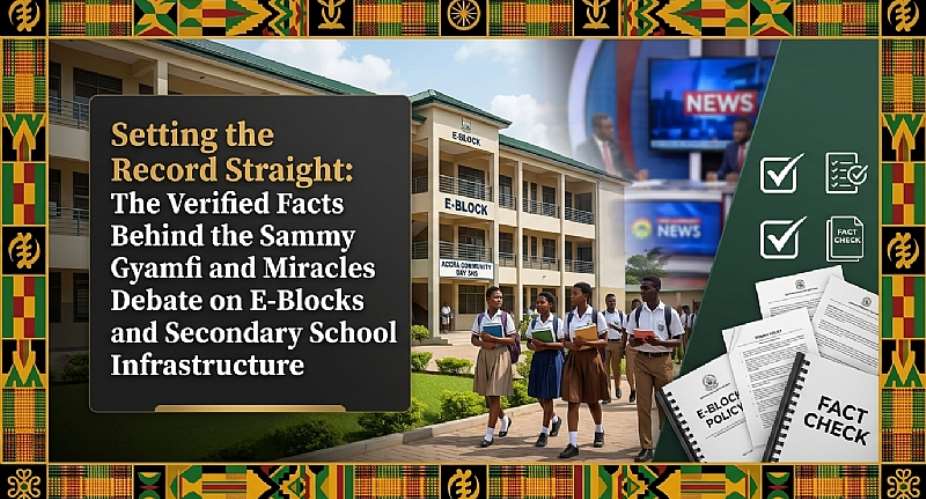
Across Ghanaian radio waves, television studios, and digital platforms, few political exchanges attract sharper public attention than the recurring clashes between Sammy Gyamfi, National Communications Officer of the National Democratic Congress (NDC), and Dennis Miracles Aboagye, a leading communicator for the New Patriotic Party (NPP). At the center of their spirited arguments is a fundamental question for parents, students, and taxpayers: Which administration actually built what in Ghana’s secondary education sector?
While political communicators frequently trade conflicting statistics to score partisan points, official audit records from the Ghana Education Trust Fund (GETFund), the Ministry of Education, and independent verification by Fact-Check Ghana offer an objective, documented account of the facts. Separating political rhetoric from verified infrastructure data is vital for healthy civic discourse and public accountability.
The Core Debate: Political Rhetoric Versus Verified Reality
In various media appearances, Sammy Gyamfi has maintained that the Mahama administration completed between 46 and 50—and at times up to 73—Community Day Senior High Schools, popularly known as E-blocks, before leaving office in January 2017. He has further argued that the Akufo-Addo administration abandoned these projects and failed to construct new secondary schools from scratch despite its campaign pledges.
Conversely, Dennis Miracles Aboagye has countered that the previous administration completed only 29 out of the 200 E-blocks promised in its 2012 manifesto. He has emphasized that many E-blocks were sited far away from town centers without boarding facilities, and that the NPP government went on to complete roughly 30 inherited E-blocks alongside newly built Science, Technology, Engineering, and Mathematics (STEM) and model secondary schools.
Independent scrutiny of official records reveals that both communicators have presented selective or inaccurate figures on key aspects of the debate.
The E-Block Rollout Under the Mahama Administration (2013–2016)
Official GETFund records and World Bank project disclosures provide a clear picture of the E-block initiative launched under former President John Dramani Mahama. While the policy successfully introduced modern 24-unit classroom complexes to expand secondary access, the actual delivery numbers differed from campaign targets and subsequent political claims:
- Total Projects Promised and Initiated. Against a 2012 manifesto promise of 200 Community Day Senior High Schools, the government awarded contracts for 124 E-blocks between 2014 and 2016. Of this total, 101 were financed by GETFund and 23 were funded by the World Bank under the Secondary Education Improvement Project (SEIP).
- Verified Number of Completed Blocks. According to Fact-Check Ghana, only 29 E-blocks were fully completed before the NDC exited office in January 2017. Specifically, GETFund completed 22 blocks while the World Bank completed 7. Claims that 46, 50, or 73 E-blocks were completed prior to 2017 are not supported by official records.
- Key Regional Locations Completed by 2017. Notable E-blocks completed and operationalized during this period include:
- Greater Accra Region: Kwabenya Community Day SHS in the Ga East Municipality.
- Central Region: Atta Mills Community Day SHS at Ekumfi Otuam.
- Eastern Region: Maame Krobo Community Day SHS in Kwahu Afram Plains South and Nyanoa-Kwaobaa Community Day SHS in Upper West Akim.
- Ashanti Region: Adobewora Community Day SHS in the Atwima Mponua District.
- Ahafo and Bono East Regions: Derma Community Day SHS in Tano South and Abease Seventh-Day Adventist Community Day SHS in Pru West.
- Oti Region: Nchumuru Community Day SHS in Krachi Nchumuru and Nkwanta Community Day SHS in Nkwanta.
- Upper West Region: Lambussie Community Day SHS in the Lambussie District.
Continuation of E-Blocks and Boarding Conversions Under the Akufo-Addo Administration (2017–2024)
When the Akufo-Addo administration assumed office in January 2017, it inherited 95 uncompleted E-blocks at varying stages of construction. Contrary to assertions that all inherited blocks were left to rot, official records confirm substantial continuation works alongside structural modifications:
- Inherited E-Blocks Completed. GETFund data confirms that the NPP administration completed 30 additional inherited E-blocks—comprising 14 funded by GETFund and 16 funded by the World Bank. This brought the cumulative number of completed E-blocks nationwide to 59–60.
- Terminated and Stalled Contracts. Official audits show that 27 E-block contracts—most of which had stalled below sub-structural levels for years—were formally terminated in 2018 due to non-performance, leaving roughly 38 outstanding blocks at different stages of execution.
- Addressing Siting and Boarding Deficits. Miracles Aboagye’s observation regarding location reflects a well-documented operational hurdle. Because E-blocks were designed strictly as day institutions without dormitories, several completed schools located kilometers outside town centers suffered low student enrollment. To resolve this under the Free SHS policy, the Ministry of Education constructed boarding facilities at select E-blocks, including Mpaha Community Day SHS in the Savannah Region, enabling them to admit residential students.
New STEM and Model Secondary Schools Built Under the NPP Administration
Sammy Gyamfi’s claim that the Akufo-Addo government failed to build a single new secondary school from scratch—as well as his attribution of the Abomosu STEM school to the previous administration—is refuted by Ministry of Education project records and Computerised Schools Selection and Placement System (CSSPS) admissions data:
- Purpose-Built STEM Senior High Schools. Between 2017 and 2024, the government constructed and operationalized several new flagship STEM Senior High Schools and academies from scratch across multiple regions. Verified locations include:
- Eastern Region: Abomosu STEM Senior High School in the Atiwa West District.
- Ashanti Region: Bosomtwe Girls STEM Senior High School and Bosomtwe STEM Academy in the Bosomtwe District.
- Western North Region: Awaso STEM Senior High School in the Bibiani-Anhwiaso-Bekwai Municipality.
- North East Region: Kpasenkpe STEM Senior High School in the West Mamprusi Municipality.
- Greater Accra Region: Accra STEM Academy at East Legon.
- Broader Secondary and TVET Infrastructure. Beyond standalone STEM schools, the Ministry of Education commissioned 80 completed educational projects across all 16 regions in November 2024, encompassing Model STEM Junior High Schools, Technical and Vocational Education and Training (TVET) centers, and hundreds of classroom, laboratory, and dormitory blocks in locations such as Sagnarigu (Northern Region), Shama (Western Region), and Kodzobi (Volta Region).
Recommendations and Suggestions for Sustainable Education Infrastructure
To shift Ghana’s education discourse from partisan point-scoring to measurable national development, policymakers, civil society, and the media should implement the following reforms:
- Launch a Public Geolocated Infrastructure Portal. The Ministry of Education and GETFund should publish a live, searchable online dashboard listing every school project nationwide, detailing the contractor, contract sum, funding source, exact GPS location, and verified percentage of completion.
- Enforce Proximity and Feasibility Audits Before Siting Schools. Future day schools must only be sited within accessible population hubs supported by reliable public transit. Where rural communities require secondary schools, hostels or dormitories must be integrated into the initial architectural design from day one.
- Legislate Mandatory Project Continuity. Parliament should strengthen public financial management rules to require incoming governments to ring-fence funding for inherited educational projects that have exceeded 50 percent completion before initiating new greenfield contracts.
- Adopt Real-Time Fact-Checking in Political Broadcasts. Television and radio networks hosting political communicators should partner with independent verification bodies like Fact-Check Ghana to display official GETFund and Ministry of Education records during live debates.
The public sparring between Sammy Gyamfi and Dennis Miracles Aboagye highlights an enduring reality in Ghanaian politics: both sides frequently rely on selective numbers to tell an incomplete story. The Mahama administration deserves credit for conceptualizing the Community Day SHS initiative and delivering 29 completed E-blocks while initiating dozens more across underserved districts. Equally, the Akufo-Addo administration deserves recognition for completing 30 inherited E-blocks, retrofitting remote blocks with boarding facilities to boost enrollment, and constructing new flagship STEM secondary schools from scratch across multiple regions.
Ultimately, classrooms belong to Ghanaian students—not political parties. By demanding transparent public data, disciplined project continuity, and evidence-based political debate, citizens can hold every government accountable for building an equitable education system that prepares Ghana’s youth for the future.
✍️By A Concerned Retired Senior Citizen
For and on behalf of all Senior Citizens of the Republic of Ghana 🇬🇭
Teshie-Nungua
[email protected]


 2027 Budget: Gov't to improve revenue collection without introducing new taxes –...
 New Economy to help Ghana process more of its resources locally – Ato Forson
 2027 Budget: Government to spend GH¢389.2bn, allocates GH¢100.4bn for projects
 [Full text] Ato Forson presents 2027 budget in Parliament
 2027 Budget: Stability returned in Ghana's economy, Ghanaians can breathe again ...
 2027 Budget: Ghana has emerged from painful economic crisis - Finance Minister
 Government to invest GH¢30bn in New Economy programme in 2027 – Ato Forson
 Ato Forson unveils four-year New Economy plan ahead of Ghana’s 70th independence...
 Ghana recorded 5.2% average growth in 35 years but unemployment remains a challe...
 2027 budget: Reckless spending, weak revenue and expensive debt caused 2022 cris...


