




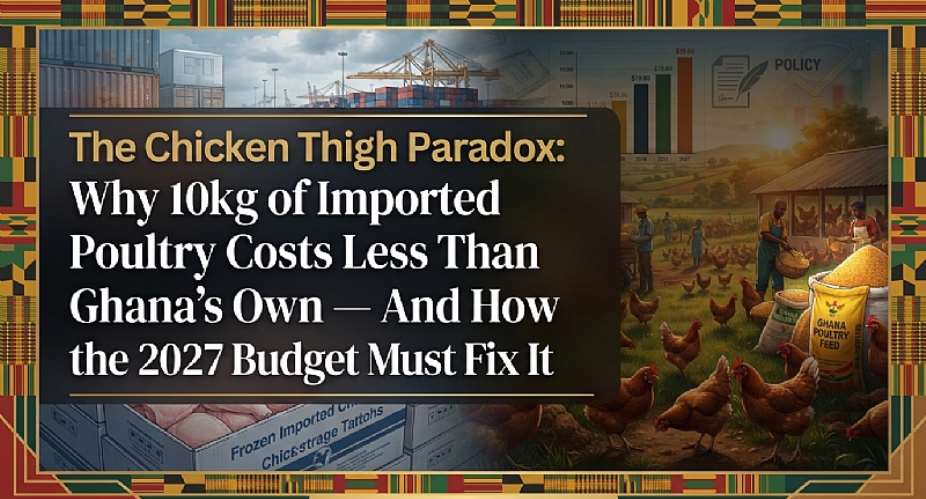
Walk into any cold store in Makola, Kasoa, Kumasi, or Tamale today, and the economics of the Ghanaian dinner table become painfully clear. A 10-kilogram carton of imported frozen chicken thighs sells for a fraction of what it costs to buy 10 kilograms of locally raised, freshly processed chicken thighs. For the average Ghanaian household battling the cost of living, the choice at the market counter feels obvious. Yet, behind that seemingly affordable carton of imported poultry lies a structural crisis costing Ghana billions of cedis in scarce foreign exchange, hollowing out rural livelihoods, and threatening national food sovereignty.
According to the Ghana Statistical Service, Ghana spent a staggering GH¢2.84 billion importing frozen chicken cuts and offal in 2025 alone, making frozen fowl the second-largest food import in the country. While Minister for Food and Agriculture Hon. Eric Opoku recently reported that interventions under the Nkoko Nkitinkiti programme helped push domestic poultry share from 4.6% to 22% by mid-2026, Ghana still faces an annual consumption demand of roughly 400,000 metric tonnes. As Minister for Finance Hon. Dr. Cassiel Ato Baah Forson and his cabinet colleagues prepare the 2027 Budget, closing the price gap between imported and local chicken cuts requires elevating proven Ghanaian industrial models—like Buntaa Farms Limited in Atiwa West—into the national standard for all 261 districts, mobilizing young graduates into modern animal husbandry, and capturing the massive macroeconomic gains waiting on the table.
Regional Poultry Realities: Where Ghana’s Birds Are Raised—And Why Meat Still Lags
Understanding why local chicken thighs remain expensive requires looking at both Ghana’s traditional production belts and newer mega-investments—and noticing one glaring trend across all of them: large-scale capital overwhelmingly favors egg production (layers) over meat production (broilers).
- The Eastern Region’s Industrial Benchmark (Atiwa West / Kwabeng): Earlier baseline surveys often overlooked the emergence of modern industrial poultry infrastructure in the Eastern Region, which holds roughly 18.4% of Ghana’s broiler farms alongside major new commercial estates. The gold standard is Buntaa Farms Limited, situated between Akyem Akrofufu and Akyem Kwabeng in the Atiwa West District. Boasting a mechanized 240,000-bird capacity across three phases, complete with its own on-site feed mill, dedicated water treatment plant, and strict biosecurity block, Buntaa Farms proves that world-class, vertically integrated poultry farming can thrive on Ghanaian soil. Yet, like most mega-farms in Ghana, its primary commercial output is farm-fresh table eggs (layers) rather than frozen broiler cuts—precisely because egg farming avoids the cold-chain and abattoir bottlenecks that cripple local chicken meat.
- The Traditional Commercial Belt (Ashanti and Bono Regions): Historical sector assessments by the Ghana National Association of Poultry Farmers and the Ghana Poultry Project show that the Ashanti and Bono/Ahafo belts (especially Dormaa) still hold the highest concentration of legacy commercial farms. However, industry studies show that nearly 89% of commercial farms in Dormaa also focus on layer birds for eggs rather than broilers for meat. Even with processing facilities coming on stream in hubs like Bechem, farmers in other regions cannot haul live broilers hundreds of miles to a single plant without prohibitive transport costs and bird mortality.
- The Coastal Consumption Corridor (Greater Accra and Central Regions): Greater Accra (21.1%) and Central Region (14.7%) sit next to Ghana’s largest urban consumer markets, yet farms here remain dominated by small- and medium-scale operators squeezed by high peri-urban land costs, erratic power, and a lack of automated parting facilities.
- The Northern Savannah Deficit (Northern, Upper East, Upper West, Savannah, and North East): Livestock data shows that while households in the Northern and Upper East Regions raise nearly half of Ghana’s indigenous guinea fowls and local scavenging breeds, the northern zone accounts for only 2.5% of commercial broiler farms. Ironically, the north is Ghana’s breadbasket for maize and soya—meaning feed grains are grown in the north, trucked south to be milled, and frozen imported chicken is then trucked all the way back north for consumption.
Why Imported 10kg Chicken Thighs Are Cheaper Than Local Cuts
Local farmers are not losing because they lack ambition; they are competing in a distorted global market against five economic realities:
- The "Dark Meat Dumping" Economics of Western Markets: Consumers in the United States, the European Union, and Brazil pay premium prices for white meat (chicken breasts). Foreign processors recover almost all their production costs from breast meat at home, treating thighs, drumsticks, and wings as low-value byproducts exported to West Africa at clearance prices.
- Heavy Foreign Subsidies and Industrial Scale: Exporters in Brazil, the Netherlands, and the US operate with heavy agricultural subsidies, single-digit financing, and fully automated mega-farms that Ghanaian smallholders cannot match.
- The High Cost of Feed and Imported Inputs: Feed accounts for 60% to 70% of a local farmer's production cost. Seasonal deficits in yellow maize and soybean meal—combined with imported day-old chicks, vaccines, and premixes—inflate the farm-gate cost of every bird.
- The Processing and Cold-Chain Bottleneck: As the Greater Accra Poultry Farmers Association emphasized, producing 10kg of local chicken thighs requires slaughtering and parting multiple whole birds. Until Ghana pairs Buntaa-style mechanized farms with automated abattoirs and blast freezers capable of separating cuts and monetizing remaining breasts, feet, and gizzards, investors will continue avoiding broilers.
- Middlemen Markups and Live-Bird Holding Costs: Imported cartons can sit in cold storage for months—sometimes arriving in Ghana over a year old, as Deputy Agriculture Minister Hon. John Dumelo warned. Local farmers, by contrast, manage live broilers that eat into profits every single day past their six-week market weight, while fragmented distribution chains push farm-gate prices of GH¢80 up to GH¢200 in retail markets.
What Ghanaians Need to Know About What They Are Eating
- Freshness and Nutrition Over Artificial Cheapness: Imported frozen thighs travel thousands of miles across oceans, enduring port delays and repeated thawing and refreezing cycles during power outages. Locally raised poultry is slaughtered fresh, free of prolonged chemical preservation, and delivers superior taste and nutritional value.
- Keeping Cedis in Ghanaian Pockets: Buying a 10kg box of imported thighs pays farmers in Brazil, factory workers in Europe, and foreign shipping lines—while starving Ghanaian maize growers, feed millers, and veterinary graduates of work.
Actionable Recommendations for the 2027 Budget: The 261-District "Buntaa Model" & Youth Mobilization
To break import dependency permanently, the 2027 Budget must abandon fragmented backyard handouts and adopt the mechanized, vertically integrated Buntaa Farms blueprint—combining automated housing, on-site feed milling, clean water treatment, and strict biosecurity—as the minimum industrial standard for District Animal Farms across all 261 MMDAs.
1. Replicate the Buntaa Farms Industrial Standard in Every District
- 261 Mechanized District Livestock Enclaves: Direct the Ministries of Food & Agriculture and Local Government to partner with traditional authorities and private investors in every district to establish 240,000-bird-capacity mechanized livestock enclaves. Just like Buntaa Farms in Atiwa West, each district hub must feature automated climate-controlled housing, dedicated water treatment plants, and biosecurity perimeters to cut bird mortality below 3%.
- On-Site District Feed Mills: Equip each District Animal Farm with a captive feed mill linked directly to local maize and soybean outgrowers, eliminating the middleman transport costs that currently drive feed to 70% of production expenses.
- District Automated Abattoirs & Cold Rooms: Upgrade the Buntaa blueprint for broiler meat by attaching a modular automated slaughtering line (300 to 500 birds per hour) and solar-powered blast freezers to every district hub. Cutting birds locally into affordable 1kg, 5kg, and 10kg packs of thighs, wings, and breasts will bring local prices into direct parity with imported cartons.
2. Mobilize Young Graduates into Modern Animal Husbandry
Ghana graduates thousands of trained minds annually from KNUST, University of Ghana, UCC, UDS, Akenten Appiah-Menka University (AAMUSTED), and Agricultural Colleges (Kwadaso, Ohawu, Ejura, Damongo) who remain unemployed while waiting for public-sector postings. The 2027 Budget should turn these mechanized District Animal Farms into graduate-run enterprises:
- The Graduate Livestock Enterprise Fellowship (GLEF): Replace idle National Service postings for animal science, veterinary, agribusiness, and agricultural engineering graduates with a paid, one-year intensive placement managing automated houses, feed mills, and biosecurity systems on District Animal Farms.
- Starter-Pack Equity Grants & "Rent-to-Own" Automated Pens: Graduates who complete the fellowship should receive zero-collateral "rent-to-own" mechanized pens inside the district enclaves, backed by an initial cycle of day-old chicks, vaccines, and milled feed on a revolving input-credit model—repaid automatically at the district processing plant upon bird off-take.
- Youth-Led AgTech & Veterinary Extension Brigades: Fund graduate-led mobile veterinary laboratories and digital farm-monitoring teams in every district to enforce biosecurity and protect farmer investments.
- De-Risking Youth Loans via GIRSAL: Instruct the Bank of Ghana and GIRSAL to guarantee up to 80% of commercial bank loans for youth-led livestock cooperatives at single-digit interest rates.
3. Macro-Fiscal Protections for the 2027 Fiscal Year
- Zero-Rate Taxes on Mechanized Farm & Processing Equipment: Exempt automated poultry cages, feed mill machinery, water treatment systems, slaughtering lines, and blast freezers from import duties and VAT in 2027 to attract private-sector co-investors into every district.
- Mandatory Institutional Off-Take Quotas: Require the Ghana School Feeding Programme, Senior High Schools, public hospitals, and security services to source at least 70% of their chicken and egg needs from the 261 District Animal Farms, backed by ring-fenced Ministry of Finance payment guarantees.
- Strict Port Age Limits & Development Levy on Imports: Enforce FDA and Ghana Standards Authority rules banning frozen poultry older than six months from slaughter at Tema and Takoradi ports, paired with an earmarked Poultry Development Levy on imported cuts to capitalize the 261-district rollout.
The National Payoff: Statistical Benefits to Ghana’s Economy
Elevating the Buntaa Farms 240,000-bird vertically integrated model across Ghana’s 261 districts is not merely an agricultural expense—it is one of the highest-yielding macroeconomic investments the 2027 Budget can make:
- Massive Foreign Exchange Savings: Achieving self-sufficiency in broiler and layer production will save Ghana up to GH¢2.84 billion (over $180 million) annually in hard currency currently drained by frozen chicken imports, directly strengthening the Ghana cedi and easing imported inflation.
- Over 62 Million Birds Per Cycle Nationwide: Scaling a 240,000-bird mechanized capacity across 261 districts creates a national installed capacity of 62.64 million birds per cycle. Even if split evenly between layers and broilers (running 5 to 6 broiler cycles per year), Ghana would generate over 150 million broilers annually—yielding roughly 270,000 to 300,000 metric tonnes of fresh dressed chicken, wiping out the national import deficit.
- Over 150,000 Direct and Indirect Jobs for Youth: Operating 261 integrated estates—each employing farm managers, feed mill technicians, veterinary officers, abattoir workers, and cold-chain logistics staff—will create 25,000 to 35,000 direct skilled jobs for graduates and artisans, plus over 120,000 indirect jobs across retail, transport, and input supply.
- Guaranteed Market for Over 1.2 Million Metric Tonnes of Local Grains: Feeding 62+ million birds annually requires approximately 1.2 to 1.5 million metric tonnes of feed—creating a guaranteed, multi-billion-cedi domestic market for over 200,000 Ghanaian yellow maize and soybean farmers, particularly across the Northern, Savannah, Bono East, and Oti regions.
- Lower Food Inflation & Stronger GDP Growth: Transforming agriculture from rain-fed subsistence into mechanized agro-processing will boost agricultural GDP growth, stabilize household protein prices, and retain billions of cedis inside Ghana’s rural banking and retail ecosystem.
A nation that cannot feed itself cannot truly control its economy. Allowing foreign processors to dump surplus chicken thighs onto the Ghanaian market at artificially depressed prices is a false economy; what consumers save at the cold store today, the nation loses tomorrow through a weaker cedi, rising youth unemployment, and mounting healthcare costs.
Modern facilities like Buntaa Farms in Atiwa West have already proved the blueprint on Ghanaian soil. By adopting that mechanized, vertically integrated model as the national standard across all 261 districts, equipping every hub with automated broiler processing, and placing young graduates at the helm of animal husbandry, Hon. Dr. Cassiel Ato Baah Forson and Hon. Eric Opoku can use the 2027 Budget to make homegrown chicken thighs affordable for every family—turning a GH¢2.84 billion import drain into a generational triumph for Ghanaian industry and food sovereignty.
✍️By A Concerned Retired Senior Citizen
For and on behalf of all Senior Citizens of the Republic of Ghana 🇬🇭
Teshie-Nungua
[email protected]


 2027 Budget: Gov't to improve revenue collection without introducing new taxes –...
 New Economy to help Ghana process more of its resources locally – Ato Forson
 2027 Budget: Government to spend GH¢389.2bn, allocates GH¢100.4bn for projects
 [Full text] Ato Forson presents 2027 budget in Parliament
 2027 Budget: Stability returned in Ghana's economy, Ghanaians can breathe again ...
 2027 Budget: Ghana has emerged from painful economic crisis - Finance Minister
 Government to invest GH¢30bn in New Economy programme in 2027 – Ato Forson
 Ato Forson unveils four-year New Economy plan ahead of Ghana’s 70th independence...
 Ghana recorded 5.2% average growth in 35 years but unemployment remains a challe...
 2027 budget: Reckless spending, weak revenue and expensive debt caused 2022 cris...


