




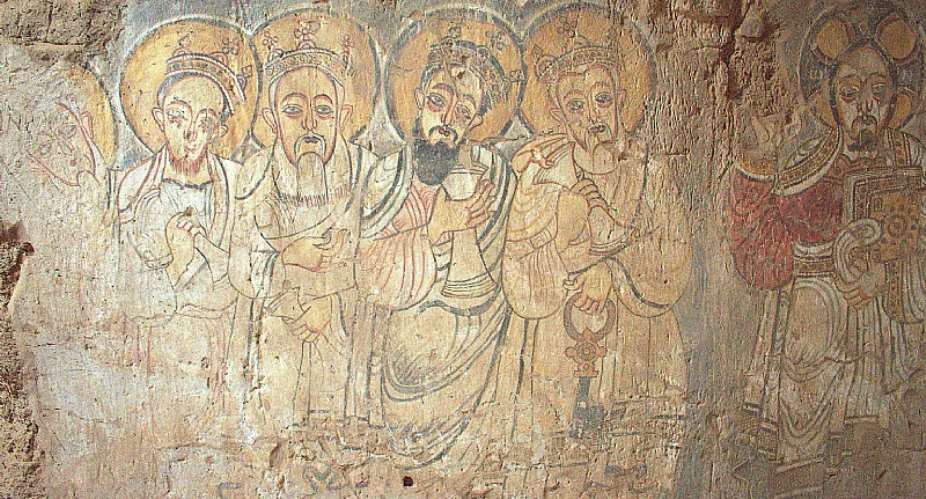
Today, Old Dongola is an abandoned settlement on the banks of the Nile in northern Sudan. Hundreds of years ago, however, this place looked very different.
During the Middle Ages, Old Dongola was the capital of the Kingdom of Makuria, which adopted Christianity in the 6th century. Nearly 700 years after the fall of the kingdom, many medieval buildings have survived beneath the desert, including the remains of churches and monasteries. Their walls still preserve paintings, of archangels or biblical scenes or local rulers and dignitaries.
There have been several studies of these paintings to learn about the religious life, politics and art of medieval Nubians. But, as a team of psychologists, cognitive scientists, archaeologists and heritage managers from European and Sudanese institutions, we decided to ask a different question: how does the culture we come from influence the way we look at them?
Researchers have used eye-tracking to investigate cross-cultural differences in the way we perceive things since the early 2000s, but most studies have been in laboratory settings. Our team wanted to explore how culture shapes the way people engage with visual art in its original historical context.
Our “research laboratory” was a medieval monastery at Kom H in Old Dongola. The team (myself, Marwa Satti, Mohammed Hassan Siedahmed and Tobiasz Trawinski) invited both Sudanese and western participants to the site and gave them eye-tracking devices to wear in the form of special glasses. As they observed the medieval paintings we mapped where their eyes fell, for how long and in which order.
We found that the two groups differed in the way they directed their attention to particular elements of the paintings. Westerners focused more on human figures, particularly faces and bodies, before turning their attention to attributes like objects or clothing or symbols. Sudanese participants initially focused on attributes, later looking more at faces and the surrounding context, suggesting a broader way of viewing the paintings.
We believe a study like this may help us develop more culturally adapted approaches to promoting heritage like this.
What shapes the way we see objects?
When we stand in front of a painting, our natural instinct is to try to understand what's happening in it. As humans we're sensitive to differences in brightness, colour intensity and orientation. These features can guide our eyes.
But looking is also about who we are. Psychology studies suggest our individual characteristics, experiences, goals and cultural background influence how we explore visual scenes.
Another cross-cultural eye-tracking study, for example, showed that American participants tended to focus more strongly on a focal object like an aeroplane in the sky, while Chinese participants often paid greater attention to the context or bigger picture. This may reflect broader cultural tendencies. Individualistic cultures may place more emphasis on individuals while collectivistic cultures on the wider group.
Eye-trackers are equipped with small cameras that record gaze patterns. We gave participants eye-tracking glasses connected to a small computer attached to their bodies. Gaze focus is generally associated with directing attention to a particular element, revealing how visual attention is distributed.
What we know can also shape what we look at. Cultural knowledge can make certain elements of an image more familiar, aesthetically appealing or meaningful, guiding our attention towards them. Religious knowledge, for example, can help us recognise symbols and understand their meaning, potentially influencing which parts of a religious painting we will look at.
Old Dongola provides a unique setting in which to explore these influences. The site is significant to both local communities and western visitors, who may differ not only in their cultural backgrounds but also their familiarity with Christianity.
What we found
Our study included 48 Sudanese living in areas around Old Dongola and 19 participants from western cultural backgrounds. For most, this was their first visit to the monastery. They were aged 18-68, and most had limited to moderate knowledge of Christian Nubian art. However the western group included more participants with higher education and heritage-related backgrounds.
Participants were simply asked to look at the paintings as if they were visiting a museum exhibition. In our analysis, we focused on four elements of the paintings: faces, bodies, attributes (such as a key in the hand of Saint Peter or scrolls in the hands of apostles) and context (such as the setting of biblical events depicted, inscriptions and backgrounds).
The eye-tracking data reveal that Sudanese and western participants ultimately spent a similar amount of time looking at faces, bodies, attributes and context, but they arrived there by taking different visual routes.
At the beginning, Sudanese participants paid more attention to the attributes of the characters in the paintings. They then shifted to faces before exploring the wider context. Western participants, however, first focused more strongly on bodies and then moved towards faces and attributes, skipping an in-depth exploration of the background during the first 20 seconds of viewing.
If we looked only at the total amount of time spent on each element, we might conclude that the two groups looked at the paintings in much the same way. But our analysis showed something more subtle: similar amounts of looking time can emerge through very different viewing strategies.
These differences potentially reflect what people from different backgrounds consider more meaningful or relevant when interpreting images. For example, in post-study interviews, Sudanese participants often commented on attributes representing objects they also encountered in everyday life (like a key). Participants from western cultures familiar with Christian iconography, in contrast, may have been more likely to recognise the biblical figures by their faces.
Why this matters
For many years, archaeology in Africa was dominated by western perspectives. This is changing, with local communities becoming more involved in the research, interpretation and management of their cultural heritage.
Our findings suggest that Sudanese and westerners engage with medieval Nubian paintings in different ways. This insight could be used to develop heritage narratives that are more responsive to different ways of looking.
For example, if particular attributes attract the gaze of visitors from Sudan, a heritage presentation could introduce a painting or display through these elements.
Understanding how people look at heritage can help us move from presenting the past in a single, predetermined way towards creating narratives that recognise the different ways people encounter and make sense of it.
This work was supported by the Excellence Initiative–Research University Programme, Action I.3.10. Archaeooriental Studies implemented by the University of Warsaw and the grant “Kyriakós oíkos? Diachronic conceptualisation of the space and function of Medieval Nubian churches” from the National Science Centre, Poland (grant No. 2021/42/E/HS3/00381).
By Tomasz Michalik, Assistant Professor, University of Szczecin

 2027 Budget: Gov't to improve revenue collection without introducing new taxes –...
 New Economy to help Ghana process more of its resources locally – Ato Forson
 2027 Budget: Government to spend GH¢389.2bn, allocates GH¢100.4bn for projects
 [Full text] Ato Forson presents 2027 budget in Parliament
 2027 Budget: Stability returned in Ghana's economy, Ghanaians can breathe again ...
 2027 Budget: Ghana has emerged from painful economic crisis - Finance Minister
 Government to invest GH¢30bn in New Economy programme in 2027 – Ato Forson
 Ato Forson unveils four-year New Economy plan ahead of Ghana’s 70th independence...
 Ghana recorded 5.2% average growth in 35 years but unemployment remains a challe...
 2027 budget: Reckless spending, weak revenue and expensive debt caused 2022 cris...


