




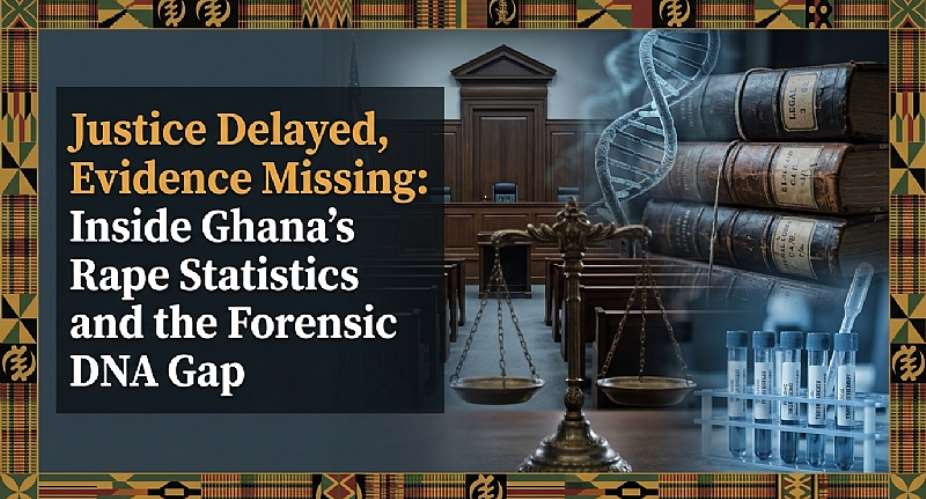
While annual police ledgers record over a thousand sexual offenses each year, hidden medical fees, missing DNA data, and a failure to adopt proven international forensic protocols continue to deny survivors courtroom accountability—here is what the numbers reveal and how Ghana can fix the system.
Every statistic in a police ledger represents a life forever altered, a survivor navigating trauma, and a family demanding accountability. In Ghana, while annual crime reports shed light on the persistent scourge of sexual violence, a critical shadow hangs over how these cases are investigated and prosecuted. Without accessible forensic DNA systems anchored in global investigative standards, the promise of justice often remains out of reach for the most vulnerable.
To understand the true state of sexual assault accountability in the country—and how Ghana compares against international investigative benchmarks—we break down the facts using the core pillars of journalism: the Who, What, Where, When, and Why.
What Is Happening?
Ghana tracks general sexual offense reports annually, yet lacks systematic, publicly available data on forensic DNA testing in sexual assault investigations.
- Annual Rape and Defilement Numbers: According to Ghana Police Service records cited in parliamentary briefings, the nation recorded 297 rape cases and 1,132 defilement cases (sexual offenses involving children under 16) in 2025. This followed 316 rape cases and 1,296 defilement cases registered in 2024.
- Multi-Year Crime Trends: Historical police data compiled by the National Library of Medicine and Statbase shows reported rape cases stood at 514 in 2017, 504 in 2019, 305 in 2020, and 412 in 2021.
- The Forensic Blind Spot: While Ghana is the only West African nation utilizing DNA profiling in criminal investigations through the Forensic DNA Laboratory (FDNAL) of the Ghana Police Service, authorities do not publish annual scorecards showing how many rape cases undergo DNA testing or result in DNA-backed convictions.
Who Is Affected and Who Holds the Data?
The crisis impacts thousands of women and children across the country, while responsibility for tracking and resolving these cases rests with key state institutions.
- Survivors and Families: Women and minors bear the heaviest burden. As noted by UN Women, official police records only reflect reported crimes, meaning thousands of additional survivors suffer in silence due to stigma and fear.
- Law Enforcement and Data Custodians: The Domestic Violence and Victim Support Unit (DOVVSU) and the Statistics and Information Technology Unit (SITU) of the Criminal Investigation Department (CID) compile annual offense data, alongside periodic surveys by the Ghana Statistical Service (GSS).
- Forensic Specialists and Courts: Investigators at the Police Forensic Science Laboratory and prosecutors rely on biological evidence to prove cases beyond a reasonable doubt, yet they operate without dedicated DNA legislation or a national criminal DNA database.
Where Are the Bottlenecks Occurring?
The gap between reporting a crime and securing forensic proof happens across police stations, medical facilities, and laboratories nationwide.
- Hospitals and Clinics: Survivors must obtain medical endorsement forms after an assault. Reports by The World highlight that survivors are frequently asked to pay steep out-of-pocket medical fees—often ranging from hundreds to over a thousand Ghana cedis—just to have their injuries documented.
- Police Stations and Laboratories: Rural and peri-urban stations often lack standard sexual assault evidence collection kits, forcing biological samples to travel long distances to central laboratories in Accra, risking contamination and degradation.
- Communities: Across many towns and villages, informal family settlements and pressure from community leaders prevent cases from ever reaching DOVVSU desks.
When Does Evidence Matter Most?
Timing is the single most decisive factor in sexual assault prosecutions.
- The Critical 72-to-120-Hour Window: Forensic DNA evidence degrades rapidly. While global protocols such as the Sexual Assault Kit Initiative recognize an optimal collection window of up to 72 to 120 hours (3 to 5 days) depending on the sample type, viable DNA drops sharply with every passing hour.
- Delays in Reporting: When financial barriers, transportation costs, or family negotiations delay a survivor from visiting a hospital within those first few days, crucial biological evidence is lost forever.
Why Does This Gap Persist? Benchmarking Against International Best Practices
Comparing Ghana’s current framework with global standards set by the World Health Organization (WHO), the United Nations Office on Drugs and Crime (UNODC), and leading jurisdictions reveals why systemic gaps persist:
- Failure to Adopt Integrated "One-Stop" Medico-Legal Care: Under the World Health Organization guidelines, survivors should receive 24-hour, free, simultaneous medical and forensic care in a single private facility to prevent secondary trauma and protect the chain of custody. In Ghana, fragmented hospital visits and upfront endorsement fees directly violate this survivor-centered model.
- Absence of Statutory DNA Legislation and Offender Databases: International systems like the United States' Combined DNA Index System (CODIS) and South Africa’s Criminal Law (Forensic Procedures) Amendment Act mandate DNA sampling for serious offenses and maintain national databases. According to research published by the National Institutes of Health, South Africa’s database has generated over 20,000 person-to-crime leads and identified more than 4,300 serial sexual offenders. Ghana still lacks a dedicated DNA Act and national database, leaving laboratories unable to link repeat offenders across regions.
- Lack of ISO Laboratory Accreditation and Mandatory Kit Audits: As highlighted in peer-reviewed assessments of forensic science in Ghana, international best practices—such as the U.S. National Institute of Justice standards—require ISO/IEC 17025 laboratory accreditation, strict anti-contamination protocols, and mandatory tracking audits of every sexual assault kit. Without formal accreditation and public audit logs, Ghanaian defense attorneys can more easily challenge DNA admissibility in court.
- Resource Constraints and Drug-Facilitated Assault Blind Spots: Public reviews on Scientect note that high reagent costs restrict testing to select cases. Moreover, unlike UNODC forensic guidelines, routine toxicological screening for "date-rape" substances alongside DNA swabbing remains virtually absent in routine Ghanaian investigations.
Recommendations and Actionable Suggestions
To align Ghana’s justice system with international best practices and bridge the divide between crime statistics and convictions, policymakers and institutions must take decisive action:
- Enact a Comprehensive Ghana Forensic DNA Act: Parliament should pass dedicated legislation regulating DNA collection, retention, privacy safeguards, and the establishment of a National Forensic DNA Database—mirroring proven frameworks in South Africa—to track serial sexual offenders nationwide.
- Adopt WHO-Aligned Free "One-Stop" Care: The Ministry of Health and the National Health Insurance Authority (NHIA) must abolish all medical endorsement fees for rape and defilement survivors and expand integrated, trauma-informed one-stop centers at regional and district hospitals.
- Achieve ISO Accreditation and Publish Annual Audits: The Government of Ghana should fund ISO/IEC 17025 accreditation for the Police Forensic DNA Laboratory and require annual public reporting on DNA tests requested, turnaround times, kit inventories, and conviction outcomes.
- Standardize Chain-of-Custody Training and Kit Distribution: DOVVSU, the Ghana Health Service, and the Judicial Service should implement joint multidisciplinary training—modeled on NIJ and UNODC standards—so frontline nurses, police officers, and prosecutors preserve biological and toxicological evidence without contamination.
- Strengthen Community Anti-Impunity Campaigns: Traditional leaders, religious bodies, and media platforms must actively discourage out-of-court settlements for defilement and rape, educating families to report immediately within the 72-to-120-hour forensic window before bathing or washing clothes.
Numbers alone cannot heal a survivor or deter a perpetrator. While Ghana’s annual rape and defilement figures prove that sexual violence remains an urgent national emergency, failing to adopt proven international forensic standards leaves too many prosecutions reliant on fragile eyewitness testimony alone. True justice requires moving beyond counting victims to legislating, funding, and accrediting modern forensic science. When Ghana aligns its clinics, police stations, and laboratories with global best practices, we send an unmistakable message: survivors will be supported, serial perpetrators will be tracked, and impunity will no longer have a hiding place.
✍️By A Concerned Retired Senior Citizen
For and on behalf of all Senior Citizens of the Republic of Ghana 🇬🇭
Teshie-Nungua
[email protected]


 2027 Budget: Gov't to improve revenue collection without introducing new taxes –...
 New Economy to help Ghana process more of its resources locally – Ato Forson
 2027 Budget: Government to spend GH¢389.2bn, allocates GH¢100.4bn for projects
 [Full text] Ato Forson presents 2027 budget in Parliament
 2027 Budget: Stability returned in Ghana's economy, Ghanaians can breathe again ...
 2027 Budget: Ghana has emerged from painful economic crisis - Finance Minister
 Government to invest GH¢30bn in New Economy programme in 2027 – Ato Forson
 Ato Forson unveils four-year New Economy plan ahead of Ghana’s 70th independence...
 Ghana recorded 5.2% average growth in 35 years but unemployment remains a challe...
 2027 budget: Reckless spending, weak revenue and expensive debt caused 2022 cris...


