




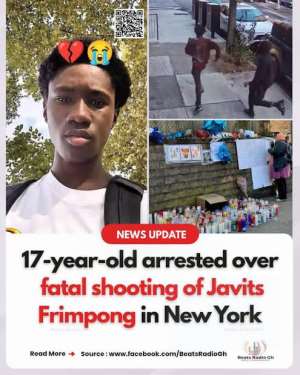
The killing of 15-year-old Ghanaian student Javits Frimpong has shaken families in New York and Ghana alike. While an arrest has been made, key questions remain unanswered, particularly regarding motive, allegations of bullying, and whether systems meant to protect him failed.
On the morning of October 29, a 15-year-old boy left his father's home in the Bronx and walked toward school. He never arrived.
Javits Frimpong was shot in the abdomen near Crotona Place and East 171st Street, about a block from his home, at roughly 9:24 a.m., according to the New York Daily News. He was rushed to hospital and died there. Surveillance footage, as described by PIX11 and Noir Nation, showed him running for his life while he was chased.
The day before, he had marked one year in America. His father, Thomas Frimpong, 60, told the Daily News:
"Yesterday was his one year."
Javits wanted to be a doctor.
On Wednesday, November 11, the NYPD announced an arrest. A 17-year-old was taken from his Bronx home for questioning and charged with murder, manslaughter and criminal possession of a weapon, according to FOX 5 NY, ABC7 and The Guardian.
I welcome that arrest. But a charge is the start of justice, not the end of it, and too many commentators are already treating it as the ending.
What We Know, And What We Do Not
Here is what is confirmed. One 17-year-old is in custody and has been arraigned in Bronx Criminal Court, according to PIX11. The NYPD says two other people are still being sought, and it has not ruled out additional arrests.
Because the suspect is a minor, police have not officially released his name. Some outlets have published a name. I will not repeat it here, for reasons I explain below.
Here is what is not confirmed: the motive.
NYPD Chief of Detectives Joseph Kenny told ABC News that investigators are examining whether bullying played a role, while also pursuing other possibilities. Reporting from GBC Ghana and CBS New York indicates robbery and mistaken identity are among the theories under consideration.
GBC adds that police found no evidence linking Javits to gang activity. That detail matters. It means the boy was not a participant in anything. He was a target, or he was in the wrong place, and either way he was a child on his way to class.
The Bullying Question Deserves Care, Not Headlines
The family says Javits told them he was being bullied at DreamYard Preparatory School. CBS New York reports that his father said two boys had recently been suspended for bullying him.
The family's attorney, Ben Crump, said during Wednesday's press conference that it is too early to determine whether school officials were negligent. The family wants to know when the school learned of the bullying allegations and what actions were taken.
Here is the complication.
amNY reports that police sources say the arrested teenager did not attend Javits's school. So the bullying narrative that has fueled much of the public anger may not connect to the person now in custody. It may connect to the two suspects still at large. It may connect to nothing.
I am not saying it is false. I am saying it remains unproven, and a columnist who ignores that distinction is writing for clicks, not for Javits.
The Counterargument I Take Seriously
Some will argue that the school is the real defendant regardless of what happens in court.
If a student reports harassment, administrators suspend two students, and weeks later that same student is dead, then many will conclude the system failed him.
That argument carries weight. Schools miss warning signs. Parents who express concerns are sometimes told to wait, only for events to escalate.
But another view deserves equal consideration.
We still do not know whether the bullying allegations and the shooting are related. Assigning blame before all the facts emerge can distort an investigation and unfairly damage reputations.
A grieving family has every right to demand answers. A public lacking access to the evidence has no right to issue a verdict.
Both things can be true.
Why I Will Not Print The Suspect's Name
New York generally treats cases involving minors with special caution, and police withheld the suspect's name for that reason.
Online, a name has already spread, along with a level of certainty that nobody has earned.
A 17-year-old charged with murder is entitled to a trial. If the evidence supports the charge, the court will determine that. If social media gets it wrong, the damage cannot be undone.
Justice for Javits does not require abandoning principles that protect others from trial by public opinion.
I want the person responsible held fully accountable. I also want the process conducted properly, because a case weakened by rumor helps no one, least of all this family.
A Ghanaian Grief, A Global One
This is not only an American story.
Javits's mother, Doris Adu Gyamfi, traveled from Ghana on an emergency visa. ABC News reports that New York City Mayor Zohran Mamdani said President Donald Trump approved the visa request so she could attend her son's funeral.
According to amNY, she became so overwhelmed during the family's press conference that she had to be assisted away from the podium.
Javits's funeral is scheduled for November 20 in the Bronx.
Every Ghanaian parent who has ever sent a child abroad for greater opportunities understands that heartbreak. Children are sent with prayers, sacrifices and dreams.
Javits's sister, Millicent, said that while schooling in Ghana could be challenging, her brother loved attending school in New York.
The Bronx's Ghanaian community felt the loss deeply.
Students at DreamYard Preparatory School organized a walkout. Community rallies have demanded "Justice for Javits." Public Advocate Jumaane Williams said those responsible must be removed from the streets and held accountable, according to CBS New York.
What Should Happen Next
Three things should happen.
First, the investigation must be completed thoroughly. Two suspects remain at large. An arrest that satisfies public pressure but fails to establish the full truth is not enough.
Second, New York City's Department of Education should answer questions regarding the bullying allegations publicly and promptly. Detectives told ABC News that they are working with education officials to verify those claims.
Parents in both Ghana and the United States deserve to know what the school knew, when it knew it, and what actions it took.
Third, society should stop reducing these tragedies to statistics.
According to his father, Javits was a quiet and intelligent boy. He was not merely a talking point in a discussion about youth violence.
A Note From Me
I am a student and a writer, and I am close in age to the teenager accused in this case.
That fact unsettles me.
It would be easy to write a column demanding the harshest punishment and end the conversation there.
I believe a more fitting tribute to a boy who hoped to heal people is a justice system that remains careful, patient and fair.
I will continue following this case. If the facts change, I will say so, even if that requires correcting what I have written today.
Sources: ABC7 New York (abc7ny.com), ABC News via ABC11 (abc11.com), CBS New York (cbsnews.com/newyork), FOX 5 NY, Fox News, PIX11, The Guardian, New York Daily News, amNY (amny.com), GBC Ghana Online (gbcghanaonline.com), Pulse Ghana (pulse.com.gh), Noir Nation (noironline.org).


 2027 Budget: Gov't to improve revenue collection without introducing new taxes –...
 New Economy to help Ghana process more of its resources locally – Ato Forson
 2027 Budget: Government to spend GH¢389.2bn, allocates GH¢100.4bn for projects
 [Full text] Ato Forson presents 2027 budget in Parliament
 2027 Budget: Stability returned in Ghana's economy, Ghanaians can breathe again ...
 2027 Budget: Ghana has emerged from painful economic crisis - Finance Minister
 Government to invest GH¢30bn in New Economy programme in 2027 – Ato Forson
 Ato Forson unveils four-year New Economy plan ahead of Ghana’s 70th independence...
 Ghana recorded 5.2% average growth in 35 years but unemployment remains a challe...
 2027 budget: Reckless spending, weak revenue and expensive debt caused 2022 cris...



Comments
You mention that this crime has shaken New York and Ghana. Please understand that it has shaken the U.S. It seems that members of the U.S. media published the minor's name because they deemed it lawful and newsworthy. Grace and peace to their families and communities!
Author's Reply
Thank you, Vanessa. You are right, this has shaken the whole U.S., not just New York and Ghana. Thank you for explaining the U.S. media perspective on the naming.
I chose not to name him because I wanted the case to be judged in court, not on social media. Grace and peace to you too.