




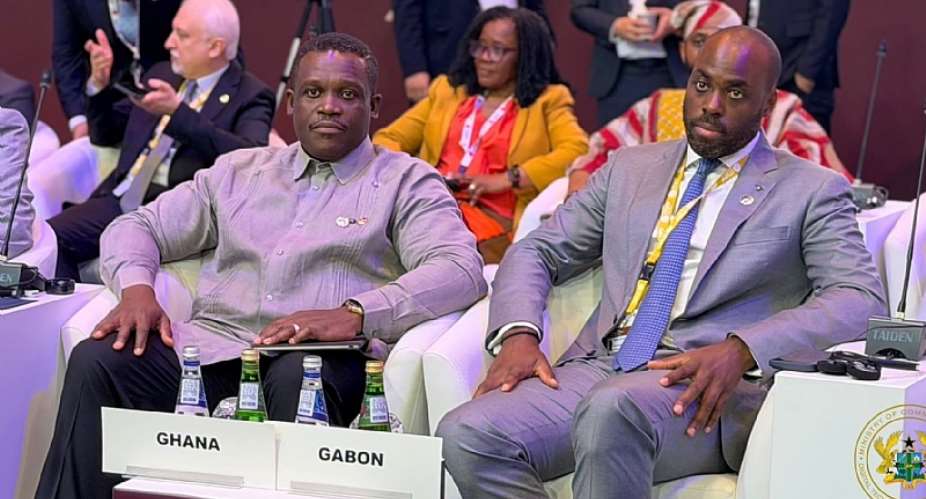
The Minister for Communications, Digital Technology and Innovations, Samuel Nartey George, has called on the International Telecommunication Union (ITU) to adopt a Programme of Action on Resilience to strengthen global telecommunications networks against disruptions.
He said the proposed programme should establish clear responsibilities, implementation timelines and measurable indicators to assess the ability of telecommunications networks to withstand disruptions and restore services.
Mr George made the proposal at a high-level thematic discussion organised by the ITU on the sidelines of the ITU Plenipotentiary Conference (PP-26) in Doha, Qatar, where he outlined four priority areas for building resilient digital infrastructure.
He identified coordinated infrastructure protection, effective regulation, responsible adoption of emerging technologies and stronger cross-border cooperation as essential to safeguarding telecommunications networks.
The Minister said governments and regulators needed to establish regulatory frameworks that encouraged infrastructure sharing, diversified network routes, expedited right-of-way approvals and ensured timely repairs when network disruptions occurred.
He stressed that resilience measures should not be limited to urban centres but must extend to rural communities, adding that telecommunications operators should be held to measurable service restoration obligations.
On the role of emerging technologies, Mr George highlighted the potential of artificial intelligence (AI) in predictive maintenance and threat detection, while digital twins could help test network performance and identify vulnerabilities before disruptions occurred.
He also identified satellite connectivity as a backup for terrestrial networks and solar-powered systems as practical solutions for sustaining telecommunications infrastructure during power outages.
However, he cautioned that the adoption of such technologies must be accompanied by robust cybersecurity and data protection measures, as well as investment in local technical expertise.
The Minister further called for stronger regional and international collaboration to address threats to telecommunications infrastructure, particularly those affecting cross-border connectivity.
He proposed the sharing of risk information, coordinated arrangements for submarine cable repairs, faster clearance procedures for repair vessels and increased financing to enable developing countries to diversify their international connectivity routes.
Mr George said no country could independently address all the risks facing modern telecommunications networks, making international cooperation essential to ensuring continuity of digital services.
He reaffirmed Ghana's readiness to support efforts towards a global resilience framework, emphasising that protecting digital infrastructure was a shared responsibility involving governments, regulators, telecommunications operators and international partners.

 Two Aduman SHS teachers remanded over alleged sodomy case involving two minors
 'What are the technical reasons for the new cedi notes?’ – Oppong Nkrumah questi...
 GES forwards 347 salary arrears cases of 2024 teacher recruits for payment
 No basis for rent increases in Ghana today – Kwakye Ofosu cites reduced building...
 2027 Budget: New Economy is ‘copy and paste’ of 24-hour policy – Amin Adam
 2027 Budget: Ato Forson contradicted himself on borrowing – Amin Adam
 Microsoft says it is 'deeply sorry' after widespread outages cause global chaos
 Microsoft outage causes global chaos
 The Nvidia affair: Are markets about to fall out of love with AI?
 'Too early to discuss presidential bid’ – Dr. Ato Forson


