




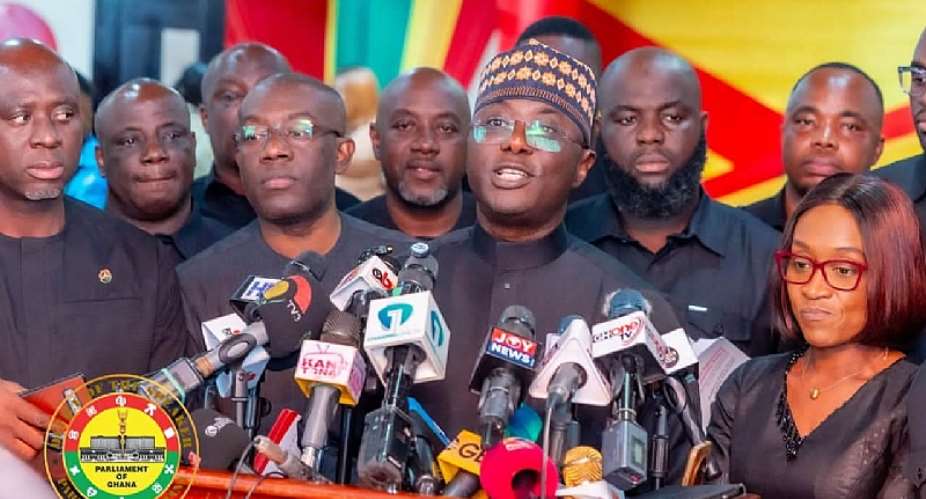
The Ranking Member of Parliament's Finance Committee, Dr Mohammed Amin Adam, has accused the government of repackaging its 24-Hour Economy programme as the New Economy initiative outlined in the 2027 budget.
The Karaga MP said the new programme largely reproduced the structure and interventions of the 24-Hour Economy policy introduced in July 2025, despite the government's insistence that it was a new economic direction.
He made the remarks at a press conference on Friday, November 13, while assessing the 2027 Budget Statement and Economic Policy presented by Finance Minister Dr Cassiel Ato Forson.
Dr Amin Adam said a comparison of the 24-Hour Economy policy booklet and Section Three of the 2027 budget would establish that the two programmes shared substantially similar components.
"But I want you all to look for the 24-hour economy booklet, which was published in July 2025. Go and look at that booklet. Match it against Section Three of the budget, and the conclusion is clear. The New Economy is a rebranding of the failed 24-hour economy," he said.
He argued that several pillars of the New Economy corresponded with the sub-programmes of the 24-Hour Economy policy, including agriculture, textiles, pharmaceuticals, tourism, technology and energy.
According to him, the financing pillar of the New Economy corresponds with Fund24, while commercial agriculture reflects Grow24 and textiles and pharmaceuticals align with Make24.
He also linked tourism to Show24, technology to Aspire24 and energy infrastructure to the energy component of the previous programme.
"This is copy and paste, and this is why we are right to describe it as a new 24-hour economy," he added.
Meanwhile, presenting the budget to Parliament on Thursday, November 12, Dr Ato Forson announced that the government would invest US$10 billion in the four-year programme from 2027 to 2030.
The initiative is intended to transform Ghana's economic structure by expanding local production, increasing value addition, reducing dependence on raw material exports and creating employment opportunities.
The programme is built around eight pillars: macroeconomic stability and affordable finance, commercial agriculture, energy infrastructure, critical minerals value addition, tourism, culture and creative arts, textiles and garments, pharmaceuticals and biomanufacturing, and the technology economy.


 Two Aduman SHS teachers remanded over alleged sodomy case involving two minors
 'What are the technical reasons for the new cedi notes?’ – Oppong Nkrumah questi...
 GES forwards 347 salary arrears cases of 2024 teacher recruits for payment
 No basis for rent increases in Ghana today – Kwakye Ofosu cites reduced building...
 2027 Budget: New Economy is ‘copy and paste’ of 24-hour policy – Amin Adam
 2027 Budget: Ato Forson contradicted himself on borrowing – Amin Adam
 Microsoft says it is 'deeply sorry' after widespread outages cause global chaos
 Microsoft outage causes global chaos
 The Nvidia affair: Are markets about to fall out of love with AI?
 'Too early to discuss presidential bid’ – Dr. Ato Forson


