




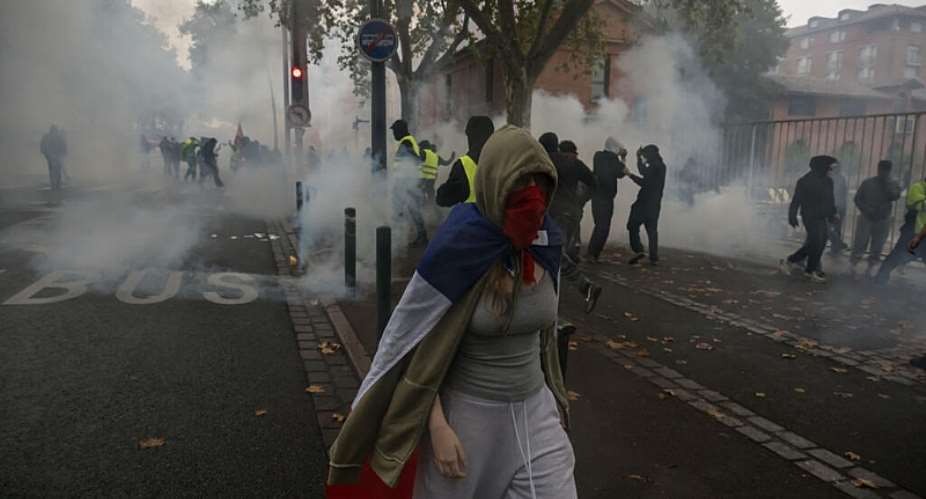
Early in the protest movement that has swept France since September, a tear gas canister fired at close range shattered the jaw of a high-school pupil in a Paris suburb, leaving him largely toothless, unable to speak and eating only through a straw.
It was just one in a long list of grievous injuries that inflamed protests across the country, heightening scrutiny of French police's heavy-handed tactics and formidable weapons arsenal.
While the scrutiny has centred on the stun grenades and rubber bullets that left some students with gouged eyes and severed limbs, activists and health workers are calling for greater focus on the content of the canister that crushed 14-year-old Eden's jaw.
Read more Severe injuries at French student protests draw scrutiny to police tactics
They point to the consequences of police's mass use of tear gas during clashes on the sidelines of otherwise peaceful rallies, challenging the notion that the chemical irritant is a safe method of dispersing protesters.
Mounting reports of tear gas disrupting menstrual cycles and causing acutely painful periods, in particular, have cast a spotlight on a little known impact of the gas, echoing complaints voiced in the US during the Black Lives Matter protest movement.
A 'less-lethal' weapon
Described as a “non-lethal” or “less-lethal” weapon, tear gas typically causes a burning sensation and induces streaming eyes, coughing, tightening of the chest, difficulty breathing and skin irritation. In most cases, effects wear off after about 20 minutes.
However, people react differently to tear gas, with children, pregnant women and the elderly particularly sensitive to its effects. The gas is also much more dangerous to people with respiratory diseases like asthma or emphysema, and those who are immunocompromised.
In guidelines on the use of “less-lethal weapons in law enforcement”, published in 2020, the UN High Commissioner for Human Rights warned that tear gas used in “large doses (....) can cause necrosis of the tissue in the respiratory tract and the digestive system, pulmonary oedema and internal bleeding.”
Experts say more research is urgently needed, particularly regarding the possible impact of tear gas on women's reproductive health.
Amnesty International has been investigating the use of tear gas since 2018, documenting more than 500 cases of its misuse worldwide – some of them in France. It has highlighted a lack regulation regarding its composition and poor training of many officers deploying it.
22,000 canisters in a single day
French police have made massive use of the chemical irritant during the ongoing protest movement sparked by conditions in French schools and exacerbated by the cost-of-living crisis. They fired 22,000 canisters on October 17 alone, many of them long before peaceful protests had given way to some of the worst rioting and looting the country has seen in years.
In video footage taken that day on Place de la République in central Paris, gas canisters could be seen landing among members of an orchestra who were giving a concert on the square in support of protesters. Investigations are under way into the death nearby of a 59-year-old man whose family blamed tear-gas exposure after an autopsy concluded he had died of “acute cardiorespiratory failure”.
Eyewitnesses at multiple protests have accused police of firing tear gas without warning, including in narrow streets where it takes longer for the gas to dissipate, and sometimes in proximity of schools and confined spaces such as the Paris metro. Social media is awash with testimony from protesters and bystanders describing the effects of exposure to tear gas or offering advice on how to protect oneself.
Read more France faces reckoning with public order policing after violent protest weekend
Returning from a march in Paris that drew several hundred thousand people on Thursday, 24-year-old student Zon bemoaned the end of the “insouciance” that she said once characterised protests.
“Now people go with scarves, masks, goggles and eye drops for protection,” she said. “Fear of the police and protesters' anger are growing hand in hand.”
Her friend Val, 23, said several friends had complained about the “pelvic pains and unusually painful periods” they experienced after being exposed to tear gas at other protests. She credited online platforms and independent media with helping to raise awareness of toxic effects that might otherwise have been silenced.
'Periods 10 times more painful'
Lacrymos du sang (tear gas of blood), a collective comprising activists and health workers, has in recent weeks collected thousands of testimonies from protesters and bystanders who reported changes to their menstrual cycles after exposure to tear gas. It plans to release its findings on November 17, but some reports are already visible on its Instagram account.
Maëva, 20, cited “periods 10 times more painful than usual” a day after being teargassed. Camille declared “acute pain and abundant bleeding” after exposure to the gas – just two days after her periods had ended.
Read more Period poverty: Taking on France's menstruation taboo
Johanne Voahangy-Nirina, a midwife who is part of the collective, said the initiative was inspired by a study conducted in Portland in the wake of the Black Lives Matter protests that swept the US in the summer of 2020.
The survey of 2,200 people found that more than half reported cramping, increased bleeding and other health issues after exposure to tear gas, sometimes persisting for days. It was the first published, peer-reviewed study to confirm a link between tear gas and abnormal menstruation.
In separate interviews with Oregon Public Broadcasting, transgender people who were taking testosterone, which typically stops menstruation, told the radio outlet they had seen cramps and bleeding start again after exposure to teargas.
Voahangy-Nirina said Lacrymos du sang hoped to match or surpass the number of people interviewed in the Portland study. They did not expect to receive more than 10,000 testimonies in the space of just a few weeks.
“We were particularly surprised to hear from several women who had taken no part in protests but happened to live, shop or walk their dog nearby and also experience unusually painful periods,” she said. “It suggests stress alone cannot explain the abnormal menstruation, since these women would not have been under the same stress as protesters being teargassed.”
Such findings highlighted the indiscriminate nature of a chemical agent that affects far more people than its intended targets, Voahangy-Nirina added, “including women police officers”.
Encouraging more study – and scrutiny
Research in toxicology has established some effects of the CS compound (2-chlorobenzalmalononitril) found in most types of tear gas, including the ones used by French police, according to Solenne Rougeux Fernandez Garcia, a doctoral researcher in neuroendocrinology at Paris-Saclay University, and a member of Lacrymos du sang.
“CS breaks down into several molecules within the body, one of which is a thyroid endocrine disruptor. If there are already thyroid problems, this will lead to vaginal bleeding outside the menstrual cycle, including among post-menopausal women or prepubescent girls,” she explained in an interview with France Inter radio.
Severe pain during menstruation is believed to be caused by CS directly activating pain receptors, with the intensity of the pain depending on the duration of exposure to tear gas. Protesters stand amid tear gas during a demonstration in Lyon on November 5, 2026.
In social media posts, Lacrymos du sang said answers to its survey also included multiple accounts of miscarriages attributed to tear-gas exposure, though researchers are yet to establish a link. Such concerns, exacerbated by a lack of scientific evidence, cause considerable anguish, said Voahangy-Nirina, noting that many women expressed guilt at having attended a protest.
She hoped the study would encourage medical research to investigate the matter and push the authorities to rethink the mass use of tear gas.
Read more Wounded French protesters to sue interior minister over police brutality
A lawmaker for the left-wing France unbowed (LFI) party has asked the government to suspend use of tear gas pending more research into its effects. In a 2017 report, France's human rights ombudsman had already warned that the use of tear gas “can endanger health and must not be trivialised”. Critics say it has only increased since.
The interior ministry last month suspended use of a type of stun grenade that ripped off the hand of a teenage pupil in the city of Lens. But it has refused to revise its use of other “less-lethal” weapons.
“Our aim is not to scare people away from protesting – it's a fundamental right,” said Voahangy-Nirina. “It's up to the government to ensure they can do so without fearing it could compromise their health.”


 Seven companies shortlisted for Keta Port development – Mahama
 Mahama allocates GH¢100m to complete abandoned Nsawam remand prison block in 202...
 GJA Awards: Afenyo-Markin calls for repeal of laws criminalising false publicati...
 30th GJA Awards: Asempa FM’s Philip Osei Bonsu adjudged Journalist of the Year
 30th GJA Awards: Mahama allocates GH¢10m to Media Development Fund in 2027 budge...
 AMA offers GH¢1,000 Christmas packages to traders complying with trading rules
 Accra Airport concourse linking Terminals 2 and 3 reaches 20% completion – Kwaky...
 Oxygen City project starts in Ho, additional GH¢500m earmarked for district hous...
 “It’s 2 o’clock, why don’t you want us to sleep?” – Elderly man confronts church...
 Woyome enters race for NDC National Vice Chairmanship


