




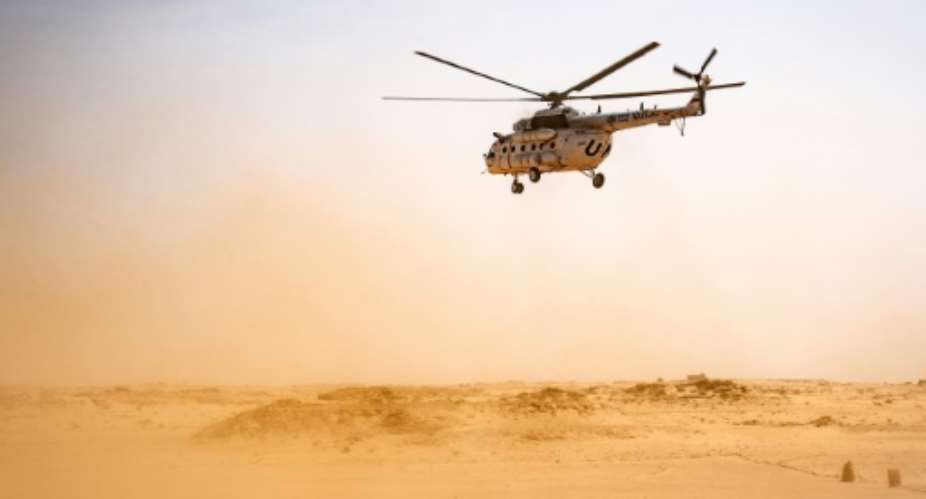
For the first time in more than three decades, the UN Security Council has failed to renew the mandate for its peacekeeping mission in North Africa's disputed Western Sahara.
The vast mineral-rich desert territory, home to significant phosphate reserves and fishing resources, was a Spanish colony until 1975.
It is largely controlled by Morocco but has been claimed for decades by the Algeria-backed Polisario Front, and remains on the UN list of non-self-governing territories.
- Why are the peacekeepers leaving?
Morocco considers Western Sahara part of its territory and has proposed autonomy under Moroccan sovereignty, while the Polisario seeks full independence.
The UN mission, MINURSO, was created in 1991 to organise a self-determination referendum that has never taken place.
Its mandate expired on October 31 after Russia and the United States vetoed rival Security Council resolutions.
Washington proposed extending the mission while effectively dropping the referendum option and making Morocco's autonomy plan the basis for future talks.
Eleven of 15 council members supported that approach, but Russia rejected it as one-sided.
Instead, Moscow sought to renew MINURSO unchanged, only for Washington to block the move.
"Washington has been enthusiastic about imposing a solution, but it's explicitly biased in this conflict," said Jacob Mundy, a Western Sahara expert and professor at US-based Colgate University.
The US recognised Western Sahara as Moroccan in 2020 when Rabat normalised ties with Israel under a deal backed by President Donald Trump.
- A win for Morocco?
Morocco backed the US proposal but also saw a smaller victory in Russia's veto, which effectively ended MINURSO's mandate.
Rabat welcomed the mission's end as "an important step toward the definitive closure" of the issue at the UN, adding its initial functions were now "outdated".
"For Morocco, the veto was the second-best option," said Riccardo Fabiani, senior analyst at the International Crisis Group.
Moroccan Foreign Minister Nasser Bourita met Russian counterpart Sergei Lavrov in Moscow two days before the vote, and later admitted Rabat had not tried to stop Russia from using its veto.
Rabat sees MINURSO's exit as "the end of UN scrutiny... and another step towards normalising Moroccan control over the territory", Fabiani explained.
Morocco "was going to win either way", added Hamish Kinnear of UK-based consultancy Verisk Maplecroft.
"If the US-drafted resolution passed, Morocco's plan would have been established as the only framework for a political solution -- effectively ruling out the possibility of a UN-facilitated referendum," he explained.
UN peacekeepers were first deployed with the consent of both Morocco and Polisario, but "what Morocco is saying now is it no longer consents to MINURSO", Mundy said.
- What do other sides say?
The Polisario said it would hold Morocco "fully responsible for any serious repercussions" for regional security following the council's vote.
Algeria, Morocco's regional rival and host to thousands of Sahrawi refugees, said Russia's veto was "inevitable", arguing the US proposal's "excessive partiality" sought to "legitimise a situation of occupation".
For Morocco, UN efforts have long stalled, with Bourita recently saying the kingdom was "free to choose the path and framework it wants".
Rabat's autonomy plan has already gained growing support from countries including France, Britain and Spain.
Last year, the Security Council gave the plan unprecedented backing, calling it the "most feasible" solution.
But for many analysts, the issue is still far from over.
- What's next?
The UN has already begun winding down MINURSO, and said this month the liquidation process should be completed "as soon as possible".
The organisation stressed, however, that the mission's departure does not affect the Sahrawi people's "inalienable right to self-determination".
Morocco promptly said it was "coordinating and supporting" the mission's exit.
"Morocco is now betting to continue to normalise its control over Western Sahara while trying to remove it from the UN list of non-self-governing territories," analyst Fabiani said.
But the end of MINURSO could also remove a long-standing buffer between Morocco and the Polisario.
Without peacekeepers on the ground, Kinnear said Morocco would have "greater latitude to conduct operations against the Polisario".
The kingdom has reiterated its commitment to a ceasefire despite repeated Polisario violations since 2020. But tensions with Algeria have remained high since Algiers severed diplomatic ties in 2021.
Last month, Algeria said it was deploying troops to Niger to protect energy assets, which many saw as an unusual break from its traditional non-intervention policy.
"That was no coincidence," Mundy said. "I think it's a signal."
"Algeria feels surrounded -- with Libyan instability driven by the Emirates on one side and Morocco being closely allied with Israel on the other," he added.
Kinnear said direct clashes between Morocco and Algeria were unlikely, but "Rabat will have to weigh Algiers' increasingly assertive foreign policy in the context of Western Sahara".


 Foreign Ministry interdicts two officers, terminates 10 illegally issued Service...
 Outspoken Ghanaian politician and founder of URP Kofi Wayo dies
 Seven companies shortlisted for Keta Port development – Mahama
 Mahama allocates GH¢100m to complete abandoned Nsawam remand prison block in 202...
 GJA Awards: Afenyo-Markin calls for repeal of laws criminalising false publicati...
 30th GJA Awards: Asempa FM’s Philip Osei Bonsu adjudged Journalist of the Year
 30th GJA Awards: Mahama allocates GH¢10m to Media Development Fund in 2027 budge...
 AMA offers GH¢1,000 Christmas packages to traders complying with trading rules
 Accra Airport concourse linking Terminals 2 and 3 reaches 20% completion – Kwaky...
 Oxygen City project starts in Ho, additional GH¢500m earmarked for district hous...


