




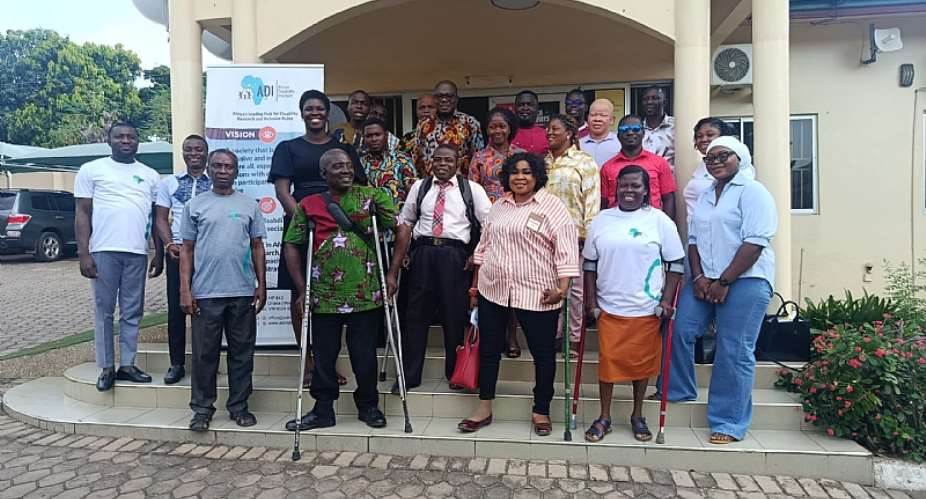
The Programmes Director of the Africa Disability Institute (ADI), Mr Charles Nyante, has urged journalists in the Volta Region to abandon pity and charity-based narratives about disability and adopt reporting practices that uphold the dignity, rights and abilities of persons with disabilities.
Speaking at the Volta Regional Media Capacity Building Workshop on Disability-Inclusive Reporting in Ho, Mr Nyante expressed appreciation to the Ghana Journalists Association (GJA), Volta Region, for partnering with ADI to organise the engagement. He also acknowledged the Ghana Federation of Disability Organisations, its member organisations and the media practitioners who participated.
He said their presence reflected a shared commitment to building a society in which everyone, irrespective of disability, could contribute meaningfully to national development.
Mr Nyante described the media as a powerful institution capable of shaping public opinion, influencing policy decisions and determining how society understands and responds to social issues.
He explained that reporting on disability goes beyond sharing information, as it also shapes public perceptions of persons with disabilities, influences how their abilities are recognised and determines how their challenges, rights and aspirations are understood.
However, he observed that disability coverage often relies on stereotypes, sensationalism, pity and charity-based narratives, with persons with disabilities frequently presented as people in need of assistance rather than as professionals, entrepreneurs, leaders, innovators and contributors to economic growth.
He stressed that disability should not be viewed solely as an individual condition, but also in the context of environmental, institutional, social and attitudinal barriers that restrict participation.
Journalists, he said, must therefore look beyond physical impairments and personal circumstances to investigate the policies, systems and practices that either promote or hinder the inclusion of persons with disabilities.
Mr Nyante explained that when a qualified person with a disability is denied employment because of an inaccessible workplace or discriminatory recruitment practices, the issue extends beyond disability to economic justice, equal opportunity, human rights and institutional accountability.
Similarly, he said, the media had a responsibility to expose inequalities when entrepreneurs with disabilities are denied access to financial services, business support and other economic opportunities.
The workshop, held on the theme, “Effective Media Reporting on Disabilities: Promoting Economic Justice and Inclusion through Responsible Journalism,” forms part of a project jointly implemented by the Ghana Federation of Disability Organisations as the lead applicant, in partnership with the Mental Health Society of Ghana and ADI as co-applicants.
The project seeks to strengthen the capacity of organisations of persons with disabilities, promote evidence-based advocacy, influence inclusive policies and enhance their participation in governance and national development.
On practical reporting, Mr Nyante encouraged journalists to engage persons with disabilities directly instead of relying on guides or other individuals to speak on their behalf.
Using a participant who attended the workshop with a guide as an example, he explained that journalists should direct their questions to the individual concerned, who was capable of providing the required responses.
He also urged media practitioners to seek consent before conducting interviews and respect the privacy of persons with disabilities.
He emphasised that the choice of language was particularly important, warning that the words journalists use could shape public perceptions, promote or undermine an individual's image, and either uphold or damage their dignity.
Mr Nyante cautioned against stigmatising language and negative portrayals, noting that such practices could encourage discrimination. He urged journalists to prioritise the rights and dignity of persons with disabilities by using respectful, positive and person-first terminology.
He further reminded journalists that every individual had a name that should take precedence over descriptions of their physical characteristics or condition.
Questioning whether journalists would want to be identified primarily by their eyes, eyesight or complexion, he said the same consideration should be extended to persons with disabilities.
He maintained that disability reporting must remain fair and respectful, without stigmatising individuals, portraying them as victims or reducing them to objects of pity.
The ADI Programmes Director called on journalists to use their platforms to advance advocacy by highlighting the abilities, contributions and rights of persons with disabilities while holding institutions accountable for providing accessible workplaces, inclusive policies and equal opportunities.
He said persons with disabilities possessed valuable skills, knowledge, intelligence and lived experiences that could contribute significantly to national development if given the opportunity to participate fully in society.
Mr Nyante concluded by urging media organisations to translate the lessons from the workshop into practical changes in their newsrooms, radio and television programmes, and online and social media platforms.
He encouraged journalists to report with persons with disabilities rather than merely reporting about them, amplify their voices and maintain sustained collaboration with organisations of persons with disabilities beyond the workshop.


 Seven companies shortlisted for Keta Port development – Mahama
 Mahama allocates GH¢100m to complete abandoned Nsawam remand prison block in 202...
 GJA Awards: Afenyo-Markin calls for repeal of laws criminalising false publicati...
 30th GJA Awards: Asempa FM’s Philip Osei Bonsu adjudged Journalist of the Year
 30th GJA Awards: Mahama allocates GH¢10m to Media Development Fund in 2027 budge...
 AMA offers GH¢1,000 Christmas packages to traders complying with trading rules
 Accra Airport concourse linking Terminals 2 and 3 reaches 20% completion – Kwaky...
 Oxygen City project starts in Ho, additional GH¢500m earmarked for district hous...
 “It’s 2 o’clock, why don’t you want us to sleep?” – Elderly man confronts church...
 Woyome enters race for NDC National Vice Chairmanship


