




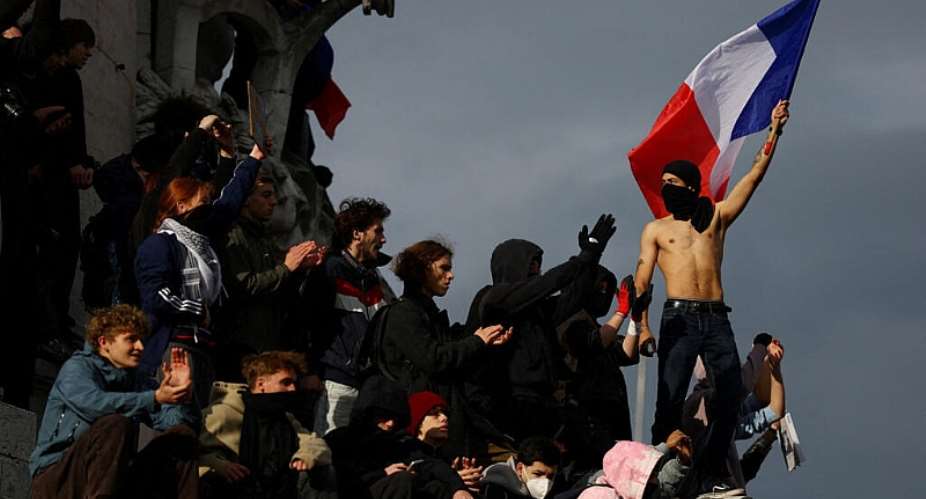
The fourth consecutive Saturday of nationwide demonstrations comes two days after a general strike to complain about government policies.
France's Interior Ministry said more than 600,000 people took to the streets on Thursday while the CGT, one of France's leading unions, said nearly 1.6 million people participated in more than 200 demonstrations nationwide.
Interior Minister Laurent Nuñez said 70,000 police officers and gendarmes would be deployed across the country on 7 November in order to prevent the looting and vandalism that marred demonstrations on 17 October.
"If there are any rioters or looters... we'll be ready and waiting for them," he added.
Yellow Vests set to defy ban
On Saturday, the Yellow Vests movement said it planned a separate rally at the Place de la Concorde in central Paris near the lower house of parliament and presidential palace, despite a ban by authorities on demonstrations in the area.
"We are calling for mass disobedience," said Benjamin Ball, a member of the Yellow Vests' coordinating committee.
The movement, which gained traction eight years ago with huge grassroots protests against Emmanuel Macron's government over planned fuel-tax hikes, has called for its banned rally to go ahead.
After top government ministers admitted they were caught out by the scale of the 17 October protests, authorities insist they are determined to prevent a repeat of the violence.
The larger police presence has helped to reduce the violence in subsequent rallies.
Investigations into police response
However, the police response to the first wave of high school pupil protests and the response in the Saturday demonstrations has faced criticism for being heavy-handed.
Nuñez told French MPs on the National Assembly's law committee last month that the national police inspectorate had launched 18 inquiries into police conduct during the demonstrations.
France mobilises 70,000 police and gendarmes for Saturday protests
On Friday, the international news agency AFP urged protection for its journalists after it reported several instances of alleged police brutality against its journalists.
Press freedom watchdog Reporters Without Borders said it had recorded 40 cases of journalists being obstructed in their coverage of the demonstrations by members of the security forces, including 21 cases involving physical violence.
Lecornu to meet trade unions
France's Prime Minister Sébastien Lecornu is due to discuss wages and purchasing power with representatives of trade unions and employers' organisations on Monday.
"The only thing that will bring the protests to an end is a response to the demands that have been put forward for several weeks by workers, civil servants, young people and pensioners," an inter-union coalition said on Friday.
The unions are calling for an increase in the minimum wage, which has not received any discretionary boost since 2012, across-the-board wage raises, tax reforms and better learning conditions for young people.
But the calls come in the teeth of grim economic realities as well as political uncertainties.
France, the European Union's second-largest economy, is under pressure to rein in public debt, giving the government little leeway to satisfy the protesters' demands. Voters will also choose a new president next April.
“We need to give every single child here in this country a proper future,” said Garance Blaise, a 21-year-old university student taking part in a march in Paris on Thursday.
“We don't know whether we'll get a job or not," she added. "And our parents, they know that and they agree with us and they also have things to ask for,” she added. “So I think the movement is already global, it is already all over Europe, and it's not just students. It's the whole population.”
French PM warns against student violence as public sector strike kicks off
Corinne Cucchini, from the Private Healthcare Federal Union, joined the Paris demonstration to denounce staff shortages and a lack of equipment at the private hospital in Paris where she works. “Our demands focus on raising wages and the working conditions,” she said.
“There is a sense of absolute frustration at the government's failure to operate,” said Paul Smith, an associate professor of French history and politics at the University of Nottingham in England.
“Whoever wins the presidential election is going to have a stack of problems to cope with. It's very difficult to see exactly where things go,” he said.
(With newswires)


 NPP has elected weak national executives—Adjei Baffour Acquah
 Ofori-Atta describes late CLOGSAG leader Bampoe Addo as fearless negotiator
 Ghana lost $6.5bn in mining revenue in 2025 – IFS
 Obuasi SHTS case: 'If we don’t get any positive response, we’ll stage another de...
 NMC to question midwife over controversial TikTok livestream
 ‘You champion reparation but cannot pay your own workers’ – Osahen Afenyo-Markin...
 Akim Oda MP questions government’s handling of DHIMS2 shutdown over $64,000 debt
 DHIMS restored, fully operational – Health Ministry
 Mahama discusses financial health with UNSGSA Queen Máxima
 Ghana to fully fund its own vaccines by 2030 as President Mahama announces Gavi ...


