




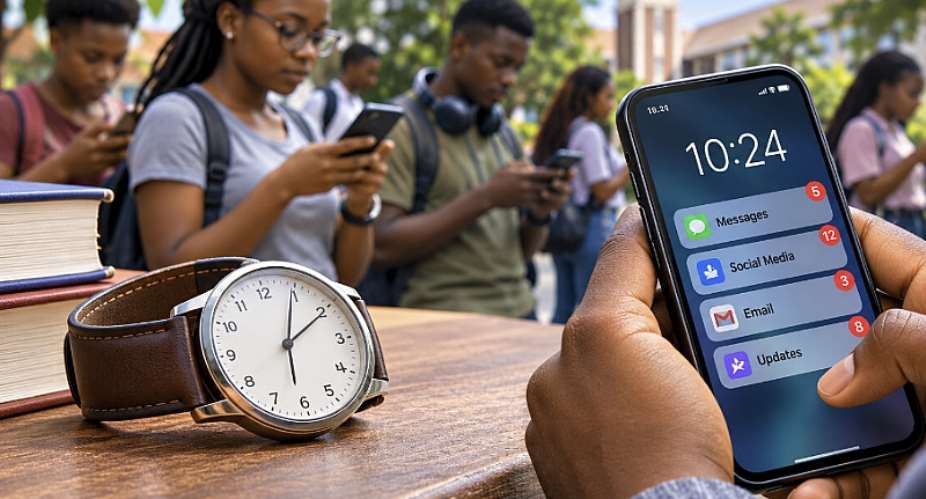
There is a striking change across our tertiary institutions: the wristwatch has almost disappeared from people’s wrists. Take a casual look around lecture halls, offices, administrative blocks or campus gathering points, and the observation becomes difficult to ignore. Students, lecturers, administrative staff and other members of the university community increasingly rely on their mobile phones to check the time. What appears to be a harmless shift in personal preference, however, raises a deeper concern about our collective relationship with time, attention and productivity.
The explanation is familiar: “Everything I need is already on my phone. Why should I bother wearing a watch?” It sounds reasonable. Smartphones provide the time, calendars, reminders and virtually everything else we need. Yet beneath this convenience lies a troubling contradiction: the device we depend on to keep track of time may also be contributing to how much of it we waste.
Consider the familiar experience of picking up a phone simply to check the time. A notification appears. A quick glance becomes a response to a message, an email or an invitation into social media. Before we realise it, several minutes have disappeared. What began as a five-second attempt to check the time has become an unnecessary excursion into digital distraction. We reach for our phones to establish how much time remains, only to surrender some of that very time.
For students, the implications are particularly concerning. Near-exclusive dependence on mobile phones for timekeeping appears to reinforce a worrying culture of poor time consciousness and diminished personal responsibility. Students whose phones run out of battery or become inaccessible may suddenly find themselves asking colleagues or passers-by for the time, even during lectures or other scheduled academic activities. Time awareness increasingly depends on a device rather than an established personal habit.
Punctuality, preparation and effective time management are essential attributes of academic maturity. When time is something we consult only occasionally, rather than consciously respect and manage, we risk cultivating habits that undermine academic discipline and personal responsibility.
The consequences are not limited to students. Imagine a lecturer in the middle of an engaging lecture who pauses to check the time on a mobile phone. A notification appears, and a brief check becomes an engagement with messages or emails. The flow of instruction is interrupted, concentration is compromised, and students may equally lose the thread of the lesson.
Similarly, an administrative staff member preparing an important document, processing records or writing a report may pause to check the time, only to become distracted by unrelated notifications. Returning to the original task requires regaining concentration and recovering lost momentum.
These interruptions may appear insignificant individually, but their cumulative effects can be substantial. Fragmented attention, delayed task completion, reduced concentration and potentially compromised work quality are challenges no institution striving for productivity and excellence should overlook.
Of course, wearing a wristwatch does not automatically make anyone punctual, disciplined or productive. Nor does checking time on a phone necessarily lead to distraction. Modern smartwatches also present similar concerns, with notifications and connected features capable of interrupting attention. However, their smaller interfaces and more limited engagement possibilities may, in many circumstances, make them less absorbing than smartphones. The point is not that wristwatches, particularly smartwatches, are entirely distraction-free, but that conventional timekeeping can offer a simpler, potentially less distracting alternative to reaching for a mobile phone.
The question, therefore, is not whether smartphones can tell us the time. It is whether our dependence on them is making us less conscious of its value.
Perhaps it is time we reconsidered the wristwatch; not as an outdated accessory, but as a simple instrument of discipline in an age of distraction.
After all, knowing the time is one thing. Respecting it is another. And losing it while attempting to check it may be the most ironic waste of all.

 NPP has elected weak national executives—Adjei Baffour Acquah
 Ofori-Atta describes late CLOGSAG leader Bampoe Addo as fearless negotiator
 Ghana lost $6.5bn in mining revenue in 2025 – IFS
 Obuasi SHTS case: 'If we don’t get any positive response, we’ll stage another de...
 NMC to question midwife over controversial TikTok livestream
 ‘You champion reparation but cannot pay your own workers’ – Osahen Afenyo-Markin...
 Akim Oda MP questions government’s handling of DHIMS2 shutdown over $64,000 debt
 DHIMS restored, fully operational – Health Ministry
 Mahama discusses financial health with UNSGSA Queen Máxima
 Ghana to fully fund its own vaccines by 2030 as President Mahama announces Gavi ...


