




Until ordinary people acquire a genuine stake in the relationships negotiated on their behalf, global cooperation will remain an elaborate exercise in mutual flattery.
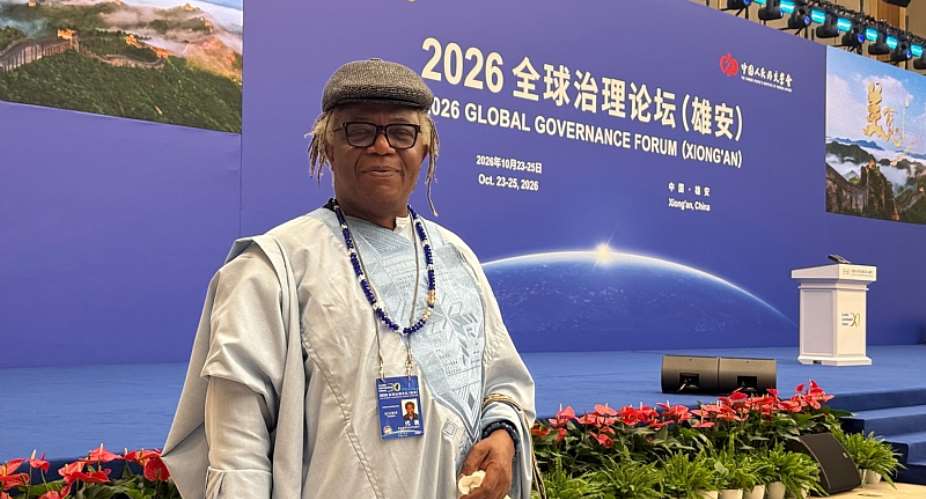
The urgent need for more people-to-people relationships was perhaps the most important conclusion I carried away from Xiong’an, China, where, between 22 and 26 October 2026, I attended the Global Governance Forum, my first visit to that remarkable country and its fascinating people.
The question before the gathering was both timely and consequential: how do we reform the institutions through which the world is governed?
It was fitting that the conversation should take place in China, a country whose extraordinary rise has fundamentally altered the strategic arithmetic of the international system.
However, as the discussions unfolded and I watched the proceedings, another question increasingly occupied my thoughts. It’s a question that I suspect would be most uncomfortable for the self-appointed custodians of the existing unjust and terribly skewed international order: For whom, precisely, are we building this new world?
We know the familiar choreography of diplomacy. Presidents, ministers, diplomats, development economists and assorted custodians of international respectability assemble in expensive conference halls. They exchange pleasantries, deliver carefully calibrated speeches, sign declarations, pose for photographs and depart with the solemn assurance that history has witnessed another milestone in international cooperation.
However, somewhere between the conference hall and the marketplace, the ordinary people disappear.
The United Nations Charter begins with these magnificent words, “We the peoples”. Yet, somewhere between 1945 and the present, the peoples were quietly displaced by their governments, the governments by their bureaucracies, and the bureaucracies by a professional diplomatic class that has perfected the art of discussing humanity without meaningfully engaging it.
This is not simply a public relations problem. It is a structural defect.
The post-war international architecture was conceived in a particular historical and geopolitical setting. Its institutions reflected the distribution of power that emerged from the ruins of the Second World War. For decades, Western governments presented their preferences as universal principles, their strategic interests as international obligations and their dominance as the ordained natural order of things.
China, Russia, Iran, and an increasingly assertive Global South are now challenging that arrangement.
Multipolarity is an important development. However, we should resist the temptation to confuse the redistribution of geopolitical power with the democratization of international relations. Replacing one hegemon with several competing centers of power does not automatically emancipate those historically excluded from decision-making.
A change of landlord does not necessarily amount to a change of house.
The real test of a reformed international order will therefore not be how many new powers occupy the commanding heights, but whether the ordinary people whose lives are affected by its decisions acquire a meaningful voice in shaping them.
The question arises why a diplomat's knowledge should automatically outrank that of a market woman, a farmer, an engineer, or a teacher when decisions affect their livelihoods. While the diplomat understands the language of the agreement, the trader understands where it collides with the border post. While the economist calculates projected benefits, the community beside the proposed road knows whether the road actually improved its circumstances.
A serious system of governance would recognize that these are complementary forms of knowledge.
My own intellectual journey to this conclusion has been neither particularly comfortable nor entirely flattering to the movement that shaped me. I was raised intellectually on Pan-Africanism. Nkrumah, Garvey, Sankara and Fanon were not merely historical figures whose names I deployed for rhetorical effect. They were intellectual companions whose arguments helped shape my understanding of Africa’s place in the world.
I believed, and continue to believe, in the necessity of African unity, economic sovereignty and the liberation of the continent from the structures of external dependency. Nkrumah’s insistence on continental political unity was not sentimental romanticism. It was strategic realism. Fragmented African states negotiating individually with vastly larger economic powers will invariably bargain from positions of weakness.
But somewhere along the way, we acquired a rather unfortunate habit of confusing the performance of Pan-Africanism with its practice.
We became extraordinarily proficient at organizing conferences, issuing declarations and delivering magnificent denunciations of imperialism. We proclaimed African unity while African traders still encountered bureaucratic obstruction at our borders. We denounced economic extraction while some of our own governments negotiated contracts that reproduced the very arrangements we claimed to oppose.
We built a solidarity of summits, a movement of microphones and an impressive vocabulary of liberation.
But how much of it translated into the everyday lives of ordinary Africans?
I began to appreciate the distinction between the performance and the substance of international solidarity when I stepped away from the conference circuit and paid closer attention to the relationships being constructed on the ground.
In Accra’s Makola Market, Chinese fabric dealers and Ghanaian traders conduct their business through the ordinary, sometimes complicated, negotiations of commercial life. They bargain, disagree, establish trust, occasionally quarrel, and return the following morning because both sides have an interest in keeping the relationship alive.
No ambassador is required to supervise every transaction. No communiqué is necessary to authorize a handshake.
In Kasoa, I love to walk around and watch Ghanaian and Chinese engineers work together on the new ECOWAS expressway towards Winneba. It never fails to fascinate me as I watch the workers share technical knowledge, work routines, and the everyday experiences of people building something tangible. They eat, drink, joke, and banter together. Wonderful.
Such encounters may appear insignificant beside the grand architecture of international diplomacy. I would argue the opposite.
They are diplomacy in its most elemental form.
States negotiate transactions; people build relationships. Currency fluctuations, political disagreements, and changes of government may disrupt transactions. Human relationships, when properly nurtured, can survive all three.
This is why people-to-people exchange must stop being treated as a decorative addition to foreign policy. It should become one of its principal foundations.
The history of South-South cooperation offers an important starting point. The Bandung Conference of 1955 made a powerful assertion: formerly colonized societies could imagine an international order beyond the tutelage of established Western powers. Its intellectual and political legacy informed the Non-Aligned Movement and the Group of 77, among other expressions of collective Global South diplomacy.
The establishment of the Forum on China-Africa Cooperation in 2000 added another important institutional framework to this evolving relationship.
While institutions can facilitate friendship, provide resources, and create development opportunities, they cannot manufacture it. Ultimately, relationships acquire durability through human contact.
This is where African philosophy of Ubuntu offers something valuable to the discussion.
Ubuntu, often expressed through the proposition that I am because we are, reminds us that human existence is fundamentally relational. My Yoruba people's epistemological philosophy, with its insistence on communal responsibility and reciprocal obligation, offers its own understanding of the relationship between individual flourishing and collective well-being.
These old traditions are not interchangeable, and should not be reduced to convenient conference slogans. Their significance lies in the challenge they present to an international system excessively preoccupied with the accumulation and exercise of power.
They are the main reason why President Xi Jinping’s vision of Shared Humanity resonates easily with Africans.
What would international cooperation look like if the prosperity of one society were not dependent on the subordination of another? What obligations do nations owe one another in a world where climate change, pandemics, war, hunger and economic instability recognize no national boundaries?
International cooperation is not charity; it acknowledges mutual interest and shared vulnerability. It does not mean romanticizing the Afro-Chinese, or any other, relationship, for that matter, or assuming that every initiative undertaken in the name of South-South cooperation is necessarily equitable.
Sentiment must never become an excuse for intellectual laziness.
We must ask difficult questions about contract transparency, technology transfer, local employment, environmental protection, and the distribution of economic benefits. Ask who owns the knowledge generated through joint research. Who controls the technology introduced under bilateral agreements? Are African engineers and technicians being trained to manage and eventually operate the infrastructure being constructed? Can local businesses participate meaningfully in the supply chains? Are communities consulted before development projects transform their environments?
These are not expressions of hostility but are the elementary and legitimate questions of a serious partnership.
Chinese traders and professionals should not be treated as convenient representatives of an abstract geopolitical adversary.
Africans, Arabs, Europeans, and Chinese are human beings with individual ambitions, prejudices, talents, disagreements, and aspirations.
Genuine engagement lets people meet one another beyond the stereotypes manufactured by distant political establishments.
As I pointed out during my presentation, a relationship without respect is doomed to fail. A relationship in which one party erroneously believes it brought the light of civilization to the world cannot endure. Respect must operate in both directions. An African government must be able to question an arrangement without being accused of ingratitude. A Chinese businessman must be able to conduct legitimate commercial activity without being subjected to suspicion merely because of his nationality.
Friendship without the freedom to disagree is not friendship; it’s hypocritical patronage wearing the costume of fraternity.
If we are serious about reforming global governance, we must begin by making people-to-people exchange an institutional priority, not an occasional diplomatic ornament.
First, governments must consult affected communities before concluding agreements and commencing projects. Consultation after decisions have already been taken is not participation; it is theatre.
Second, scholarships, professional exchanges, joint research programs and vocational training must create enduring networks through which knowledge travels in both directions. The assumption that expertise moves exclusively from the developed world to the developing world is a colonial inheritance that ought to have been retired long ago.
Third, access to international exchange must extend beyond politicians, diplomats, academics, and the wealthy. The artisan, the farmer, the small-business owner, the vocational student, and the ordinary worker must have opportunities to participate for it to be meaningful.
A relationship confined to people with diplomatic passports and the financial means to travel will inevitably reproduce the exclusions it claims to overcome.
Accountability must not only become more transparent, but also routine. The objectives of bilateral projects, the obligations of participating institutions and the communities expected to benefit should be publicly accessible.
International cooperation should be assessed not merely by the number of agreements signed by diplomats, ministers and presidents, or the volume of trade recorded, or the kilometers of rail or road infrastructure completed, but by the skills transferred, livelihoods improved, and economic opportunities created that directly and positively impact ordinary people’s lives.
I would add one further consideration. We should begin measuring what we claim to value. We count trade volumes, investment flows, and infrastructure projects. Why should we not also pay attention to the growth of educational networks, professional associations, joint research institutions, cultural exchanges and lasting personal relationships?
Trust is an asset, even if conventional economic accounting has not yet found a satisfactory way to price it.
Africa, in particular, must approach the emerging multipolar world with confidence rather than supplication. Our relationships with China, Russia and other centers of power should be guided by African interests, not by inherited loyalties or the geopolitical anxieties of others. We must neither assume that every Western initiative is benevolent nor imagine that every non-Western overture is automatically emancipatory.
Friendship is welcome. Cooperation is desirable. Solidarity is essential. But none requires the surrender of independent judgment.
Nkrumah urged Africans to seek the political kingdom first. I would suggest that the political kingdom without the human kingdom is little more than a kingdom of flags, with nobody holding the flagpole.
The experience of Xiong’an reinforced my conviction that the future of global governance will not be determined exclusively by smooth-talking diplomats and politicians who negotiate its institutional arrangements. Its legitimacy will depend on whether ordinary people, whose lives are affected, recognize themselves in the outcomes of signed communiques.
It has become imperative that a new international order worthy of the name must be constructed with, and not for, the people. It must carry along the student in an African village who shares a virtual classroom with someone from a faraway continent. It must include the Chinese engineer who learns alongside a foreign colleague even when languages are difficult, and the Arab trader who struggles to build a business across cultural boundaries; all of them must feel involved.
These are the most important builders of a new world order.
We have spent far too many decades perfecting the language of cooperation while neglecting its human foundations. We have convened enough summits, issued enough declarations and congratulated ourselves sufficiently on the eloquence of our communiqués.
It is time to move from talking to building.
I left Xiong’an with a renewed appreciation of the possibilities of international cooperation, but also with a conviction that the most consequential diplomacy may be taking place far away from the conference halls. This people-to-people relationship is happening in markets, workshops, universities, construction sites, and communities, where people discover, through the ordinary business of living and working together, that the supposed foreigner is also a human being with whom a common future can be negotiated.
Our task is not merely to reform the institutions of global governance. It is to restore the people to the center of the enterprise.
The student, the trader, the nurse, and the engineer have held the relationship together all along.
It is time the rest of us noticed.
©️ Ọ̀dọ̀fin Fẹ́mi Akọ́mọláfẹ́ (1st Dan, Ọ̀dọ̀fin I of Kasoa)


 Barred Nigerian presidential hopeful vows to stay in race
 Israel's Eisenkot claims 'progress' in coalition talks as opposition eases on ul...
 Soldiers allegedly shoot sand and stone tipper truck drivers in Afienya
 Minority demands answers over nationwide shutdown of health information systems
 Wontumi’s bail application delayed as JUSAG strike disrupts court proceedings
 President Mahama, Boeing agree roadmap for establishing Ghana’s national airline
 Passports director interdicted over alleged $50,000 sale of service passports
 "There is no substantive Chief in Gomoa Ekwamkrom" – Nana Ekwam X dismisses rumo...
 Questions raised over impartiality of committee investigating passport scandal
 'Don't take metaphorical NPP serious, they should be apologising to Ghanaians' –...


