




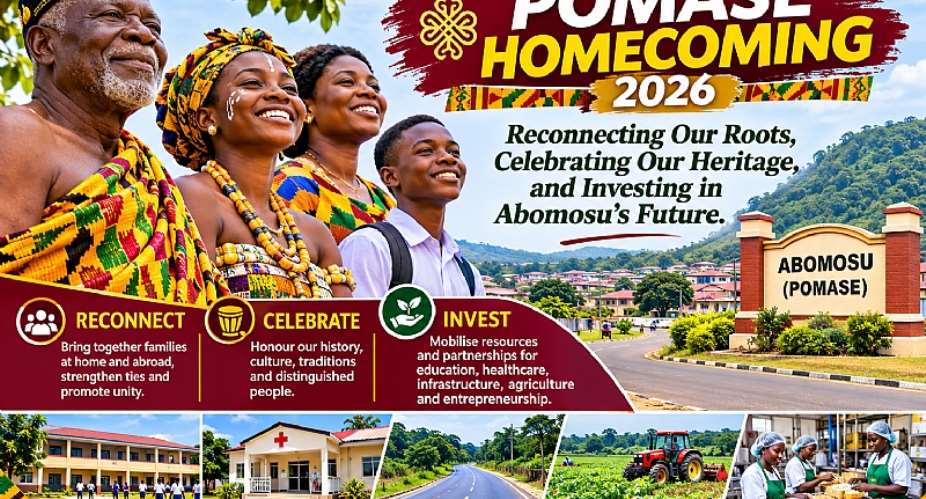
Homecoming celebrations have become an important feature of community life in Ghana, providing opportunities for families, friends and citizens living elsewhere to reconnect with their hometowns. Beyond the festivities, these gatherings can serve as powerful platforms for cultural preservation, social unity and local development.
Abomosu, affectionately known as Pomase, is preparing to hold its Homecoming celebration from 24th to 27th December 2026. The event presents an opportunity for the town to reflect on its heritage, strengthen relationships among its people and explore practical ways of advancing community development.
Like many Ghanaian communities, Abomosu has sons and daughters living across the country and abroad. Many have acquired valuable education, professional experience, entrepreneurial skills and business connections. Yet the potential of these human and financial resources to support hometown development often remains largely untapped.
Pomase Homecoming 2026 could help bridge this gap by bringing residents and the diaspora together around three important objectives: reconnection, cultural celebration and investment.
Reconnecting families and generations is essential to preserving community identity. As young people migrate in search of education and employment, maintaining relationships with their hometowns becomes increasingly important. Homecoming provides an opportunity to renew family ties, share experiences and introduce younger generations to their ancestral roots.
Equally important is the preservation of cultural heritage. Traditional practices, local history, music, food and communal values represent an inheritance that must be passed from one generation to another. Cultural activities during the celebration can strengthen community pride while encouraging young people to appreciate their identity.
However, the greatest opportunity lies in transforming the spirit of homecoming into sustainable development.
Abomosu, like many communities in Ghana, stands to benefit from greater investment in education, healthcare, infrastructure, agriculture, entrepreneurship and youth employment. These priorities require more than occasional donations. They demand coordinated planning, partnerships, transparent resource mobilisation and sustained commitment.
The proposed Investment and Development Durbar, scheduled as part of the homecoming activities, could provide a useful platform for discussing community priorities and identifying practical development initiatives.
One possibility worth considering is the establishment of a structured community development fund through which residents, professionals, businesses and diaspora members could contribute towards carefully selected projects. Such an initiative would require credible leadership, financial accountability and regular public reporting to earn and maintain community trust.
The homecoming could also stimulate local economic activity by creating opportunities for traders, food vendors, artisans, farmers and small businesses. More importantly, it could encourage long-term partnerships that support enterprise development and employment.
Nevertheless, the success of Pomase Homecoming should not be measured solely by attendance, entertainment or the amount of money raised. Its lasting value will depend on whether the celebration produces stronger relationships, realistic development commitments and measurable improvements in community life.
For this reason, the organisers and community stakeholders should consider developing a post-homecoming action plan that identifies priority projects, responsible institutions, funding arrangements and implementation timelines.
A homecoming should not end when the music stops and visitors return to their destinations. Its real significance should be reflected in the progress the community makes afterwards.
Pomase Homecoming 2026 therefore offers Abomosu an opportunity to demonstrate how cultural identity, collective responsibility and diaspora engagement can become instruments of local development.
Ultimately, the future of Abomosu will depend not only on the resources available to the community, but also on the willingness of its people to work together towards a shared vision.
Returning to our roots is important. Preserving our heritage is essential. But investing in the future of our hometown is the lasting responsibility of every generation.
That should be the enduring legacy of Pomase Homecoming 2026


 Barred Nigerian presidential hopeful vows to stay in race
 Israel's Eisenkot claims 'progress' in coalition talks as opposition eases on ul...
 Soldiers allegedly shoot sand and stone tipper truck drivers in Afienya
 Minority demands answers over nationwide shutdown of health information systems
 Wontumi’s bail application delayed as JUSAG strike disrupts court proceedings
 President Mahama, Boeing agree roadmap for establishing Ghana’s national airline
 Passports director interdicted over alleged $50,000 sale of service passports
 "There is no substantive Chief in Gomoa Ekwamkrom" – Nana Ekwam X dismisses rumo...
 Questions raised over impartiality of committee investigating passport scandal
 'Don't take metaphorical NPP serious, they should be apologising to Ghanaians' –...


