




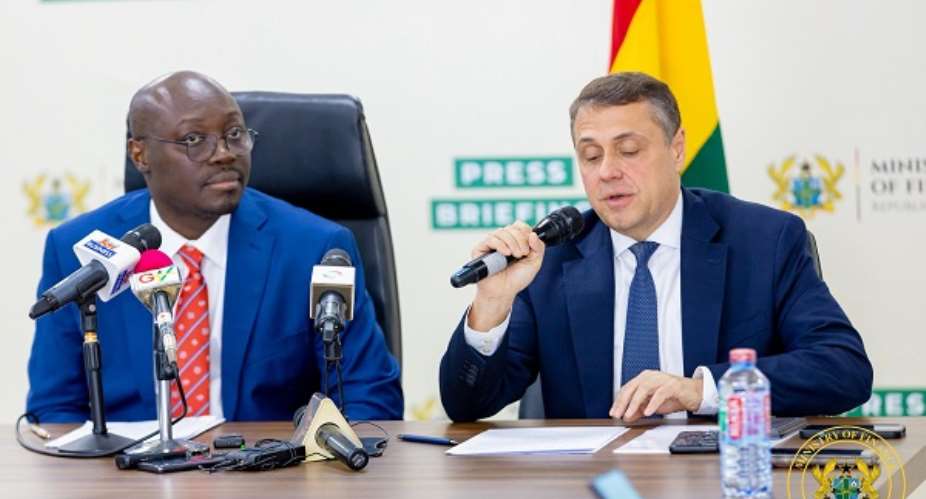
Ghana’s economic recovery is gathering momentum, with growth expected to reach 5.7% in 2026, inflation dropping below the Bank of Ghana’s target range and public debt remaining at relatively low levels, the International Monetary Fund (IMF) has said.
The Fund’s assessment follows a staff-level agreement with the government on the first review of Ghana’s 36-month Policy Coordination Instrument (PCI), marking another phase of engagement after the country completed its $3 billion Extended Credit Facility programme.
An IMF delegation led by mission chief Ruben Atoyan held discussions with Ghanaian authorities in Accra from October 22 to November 4, during which it reviewed the country’s economic performance and progress on policy reforms.
Mr Atoyan said the latest developments pointed to a strengthening economic environment, declaring that “Macroeconomic stability is becoming entrenched.”
Ghana’s economy expanded by 6.2% in the first half of 2026, largely driven by investment. The IMF projects that growth will moderate to 5.7% by the close of the year.
Inflation also continued its downward trajectory, falling to 5.5% in October, below the Bank of Ghana’s target range of 6% to 10%.
The Fund linked the improved economic outlook to stronger fiscal management and the significant reduction in public debt in recent years.
“The fiscal position is strong, with the primary surplus on track to meet the end-year program target, and public debt remains low following rapid declines in recent years.”
According to the IMF, the progress has strengthened Ghana’s capacity to absorb external shocks, including economic disruptions associated with the ongoing conflict in the Middle East.
It further described the country’s implementation of the PCI as broadly satisfactory, noting that most of the quantitative targets set under the programme had been achieved.
“Performance under the PCI has been broadly satisfactory. Most quantitative targets under this review are met.”
The review comes after Ghana completed its Extended Credit Facility arrangement, with the IMF Executive Board concluding the sixth and final review on July 27, 2026.
Although the country no longer benefits from financial disbursements under the programme, the PCI allows the Fund to continue monitoring Ghana’s economic policies and reform commitments without providing additional financing.
Declining reserves remain a concern
Despite the positive economic indicators, the IMF has expressed concern about the recent decline in Ghana’s foreign exchange reserves.
In response, the government has transferred foreign exchange intermediation responsibilities from the Bank of Ghana to GoldBod and increased the gold sale requirement imposed on large-scale mining companies.
The Fund considers these interventions, together with greater exchange rate flexibility, necessary steps towards rebuilding the country’s reserve buffers.
On the implementation of structural reforms, the IMF acknowledged progress made through Parliament’s approval of a new Cocoa Board Act and the continuation of quarterly electricity tariff reviews.
However, it identified the publication of the audit report on the Electricity Company of Ghana’s collection accounts as an outstanding commitment.
IMF endorses 2027 Budget direction
The IMF has also welcomed the broad framework of Ghana’s 2027 Budget, which seeks to achieve a primary surplus of 0.5% of Gross Domestic Product (GDP).
It believes the proposed fiscal position could create room for investment, job creation and infrastructure development, but has warned the government against weaknesses in expenditure management.
“The 2027 Budget is built on strong foundations.”
The Fund has urged the authorities to ensure that public projects undergo thorough appraisal, procurement processes remain competitive and expenditure controls are strictly enforced.
It also warned that Ghana’s economic recovery could face setbacks from volatile commodity prices, shifts in global financial conditions and refinancing pressures associated with domestic debt.
Potential challenges in the energy, cocoa and gold sectors were also identified as risks that could place additional demands on government finances.
To preserve the gains achieved, the IMF has called on the government to rebuild foreign exchange reserves, sustain prudent monetary policies and strengthen governance and institutional reforms.
The staff-level agreement reached on the first review of the PCI is subject to approval by IMF Management and the Fund’s Executive Board before it becomes final.

 "There is no substantive Chief in Gomoa Ekwamkrom" – Nana Ekwam X dismisses rumo...
 NPA boss cautions public against approaching overturned fuel tankers
 NAIMOS arrests four over suspected illegal sand-winning at Afienya
 Questions raised over impartiality of committee investigating passport scandal
 'Pedestrian may not survive speeding beyond 50' — NRSA boss defends 50km/h speed...
 Edwin Nii Lantey Vanderpuye declares bid for NDC national chairmanship
 'Don't take metaphorical NPP serious, they should be apologising to Ghanaians' –...
 IMF says Ghana’s economic recovery is strengthening, projects 5.7% growth in 202...
 Only 61% of Ghanaian children have birth certificates – UNICEF reveals
 Contraflow: “No Aayalolo bus has been involved in any accident" — Ayariga


