




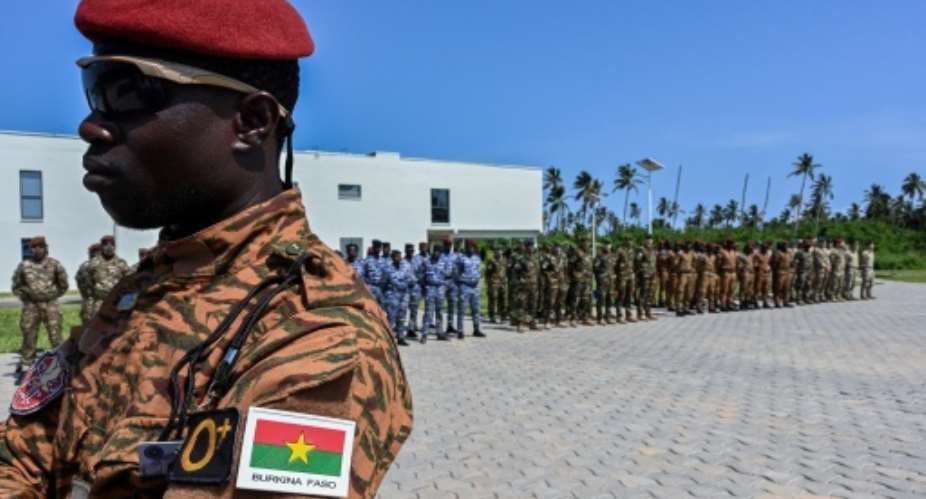
While Burkina Faso has not seen a large-scale jihadist attack since late June, analysts and data suggest the calm is deceptive: attacks are less deadly but their frequency remains high.
Ruled by a junta led by Captain Ibrahim Traore since a September 2022 coup, Burkina Faso is battling the Sahel branches of the Islamic State group and Al-Qaeda across large swathes of the west African country.
AFP looks at what is behind the apparent lull:
Fewer deaths but no fewer attacks
Having peaked at 612 deaths in June alone, the violence has decreased in intensity, with 195 people killed in July, 231 in August and 29 in September, according to figures from the ACLED conflict monitor.
The number of attacks, however, remains constant, with most claimed by the Group for the Support of Islam and Muslims (JNIM). The strikes are concentrated in the north, targeting the army and its supporting civilian volunteer force.
But civilians are not spared, either. Human Rights Watch said that JNIM fighters had killed at least 27 people in two attacks in Yatenga province in September.
"If we go by JNIM's statements, insurgent violence keeps taking root in northern Burkina Faso, particularly in the regions of Bankui, Kuilse, Liptako and Soum," Abdel Nasser Elyessa, of the International Counterterrorism Academy near Abidjan, said.
Shift towards Mali
The apparent lull is down to operational factors and not due to a decline in the jihadists' military capabilities, which have "recently increased even further through prisoner exchanges and ransom revenues", Sahel specialist Hasret Kargin told AFP.
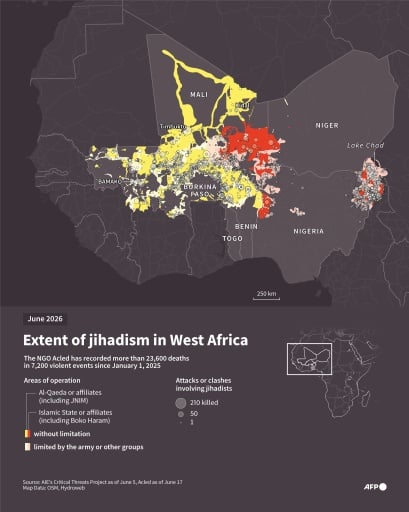 Map of jihadist operations in west Africa. By Valentin RAKOVSKY, Sabrina BLANCHARD, Clara DUBAN (AFP)
He highlighted clashes between the JNIM and its rival, the Islamic State - Sahel Province (ISSP) group in northern Burkina -- some of the deadliest of recent years -- which required men, weapons and time.
"Added to this is the partial shift of JNIM's focus to operations in Mali," where it has carried out attacks on an unprecedented scale in recent months and gathered significant resources, Kargin said.
He also pointed to the rainy season making motorised movement and large-scale deployments more difficult.
It also renders some fighters "unavailable" because they must tend to their fields, Nasser Elyessa said.
Army response?
A coordinated military response of air strikes and troops on the ground has also helped "foil certain" jihadist operations, Kargin said.
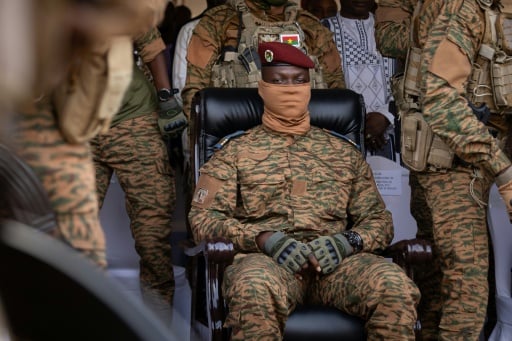 Burkina Faso's junta leader Captain Ibrahim Traore came to power in a 2022 coup. By - (AFP/File)
A Burkinabe officer said that "the fighting forces are now adopting a proactive posture on the front line and taking the initiative in tracking down terrorists".
According to Burkina Faso's state AIB news agency, a JNIM "terrorist leader" accused of several attacks against the army and civilian volunteer militia was killed late last month.
It also said that "15 terrorists" were killed at the end of July in a northern forest near the Malian border.
"With the proliferation of Rapid Intervention Battalions, territorial coverage has improved and the army has returned to certain localities that had been neglected," a Burkinabe political analyst said, speaking on condition of anonymity.
Prime Minister Rimtalba Jean Emmanuel Ouedraogo declared recently that security was "improving very significantly and consistently".
More than 74 percent of the national territory is now under state control, he said late last month.
"In the weeks and months to come, you will witness the advances of our brave fighters as they reconquer every last square centimetre of Burkina's territory," the premier said in an interview with Russia's state-controlled broadcaster RT, on the sidelines of a Russia-Africa summit in Moscow.
But it remains difficult to independently verify the figures in a country where "journalists no longer dare to broach topics related to the war" for fear of "imprisonment, or even forced disappearance", Nasser Elyessa said.

 Israeli president picks Netanyahu's rival Eisenkot to try to form government
 NPP has elected weak national executives—Adjei Baffour Acquah
 Ofori-Atta describes late CLOGSAG leader Bampoe Addo as fearless negotiator
 Ghana lost $6.5bn in mining revenue in 2025 – IFS
 Obuasi SHTS case: 'If we don’t get any positive response, we’ll stage another de...
 NMC to question midwife over controversial TikTok livestream
 Akim Oda MP questions government’s handling of DHIMS2 shutdown over $64,000 debt
 DHIMS restored, fully operational – Health Ministry
 Mahama discusses financial health with UNSGSA Queen Máxima
 Ghana to fully fund its own vaccines by 2030 as President Mahama announces Gavi ...


