




America has spoken, but the political conversation is far from over. The midterm elections have opened a new chapter in American politics, and the Democratic Party must now confront a question that could determine its future: Who should lead the party into the 2028 presidential election? Elections are not merely contests to determine which political party occupies the corridors of power. They are also opportunities for citizens to express dissatisfaction, demand accountability and remind politicians that political authority belongs to the people. The Democrats must therefore resist the temptation to interpret electoral victories or setbacks simply as endorsements of particular personalities. They must look beyond the immediate results and ask what American voters are saying about the direction of their country. One thing should be clear: the Democratic Party cannot afford to live in the past. It must recognize emerging political leaders, listen to younger generations and develop a programme that speaks to the everyday concerns of ordinary Americans. There is an old saying that one does not put new wine into old wineskins. Perhaps this is the moment for the Democrats to take that lesson seriously.
The Midterm Elections: A Message That Must not be Ignored
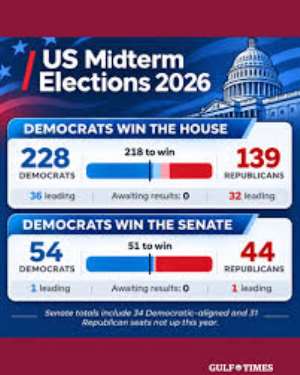
The 2026 midterm elections have produced a significant political setback for President Donald Trump and the Republican Party. Democrats have won control of both chambers of Congress, ending unified Republican control and setting the stage for a very different political environment during the final two years of Trump's presidency. But perhaps the most interesting aspect of the elections is not simply which party won. It is the composition of the coalition that made the victory possible.
Young Americans, Hispanic voters, Black voters, moderates and sections of the electorate that had moved towards Trump in 2024 have contributed to the Democratic resurgence.
According to the Associated Press Voter Poll, approximately 7 in 10 voters under 30 supported Democratic House candidates. Hispanic voters also moved substantially towards the Democrats, while Black voters maintained strong Democratic support. These developments deserve careful examination.
For years, American elections have been analyzed through the familiar lenses of race, religion, gender and geographical identity. These factors remain relevant, but the 2026 elections demonstrate that voting behaviour is also shaped by economic circumstances, political leadership, public trust and the perceived ability of governments to deliver.
People may identify with a particular racial or religious community, but when the cost of living becomes unbearable, healthcare becomes unaffordable and their economic future looks uncertain, their priorities can change. A voter who supported Trump in 2024 could vote for a Democratic candidate in 2026. Equally, a Democrat who feels betrayed by the party's policies could stay away from the polls or support another candidate. This is democracy at work.
The Democrats must understand that the votes they received were not necessarily permanent political gifts. They were, in many instances, expressions of confidence that the party could offer a better alternative.
There is a lesson here for political parties everywhere, including those in Africa. Voters are not the property of political organizations. They are citizens exercising their constitutional rights. The Democratic Party must not mistake an electoral victory for an unconditional endorsement of its leadership.
Jon Ossoff: A New Voice in American Politics?
One politician who deserves particular attention is Jon Ossoff. Ossoff has emerged as one of the most interesting Democratic voices in contemporary American politics. At 39, he represents a generation of politicians who are increasingly comfortable challenging established political power. His successful re-election campaign in Georgia is particularly significant. He defeated Republican Mike Collins, securing a decisive victory in a state that Donald Trump carried in the 2024 presidential election.
But it was his election-night speech that deserves closer attention. Ossoff did not merely celebrate his victory. He used the occasion to make a broader argument about the condition of American democracy. He spoke about corruption, political incompetence, the influence of wealthy interests, the dangers of excessive corporate money in politics and the need to restore moral principles to public life. He also warned that the challenge facing America was not simply to contain one president's excesses. The country needed to confront the deeper problems that had weakened its political institutions. One of the most important ideas in his speech was that the moment should be an opening for reform, not merely a return to the political arrangements of the past. That distinction is important.
A political party can win an election by mobilizing public anger against its opponents. But it cannot build a lasting political movement on anger alone. Ossoff's message about the influence of big money, corporate interests and the concentration of political power should resonate with ordinary Americans who increasingly feel that their political system serves the interests of a privileged few. He also advocated American leadership for peace and human rights, alongside healthcare guarantees for Americans.
On Jon Ossoff for U.S. Senate, there are issues that go beyond party politics. Ossoff must demonstrate that he can translate compelling speeches into practical policies. Presidential leadership requires more than the ability to criticize an incumbent. It requires sound judgment, administrative competence, international understanding and the capacity to unite a deeply divided country. Nevertheless, his emergence deserves serious consideration in the Democratic Party's 2028 leadership conversation.
Raphael Warnock: Another Georgian worth Watching
Another name that should not be overlooked is Raphael Warnock. Warnock, like Ossoff, represents Georgia in the United States Senate. Although he was not on the ballot in the 2026 midterm elections, his political influence and public profile make him an important figure in discussions about the party's future. His background as a Baptist pastor gives him a distinctive voice in American public life. He has demonstrated an ability to speak about economic justice, human dignity, poverty, healthcare and the moral responsibilities of political leadership.
The Democratic Party needs politicians who can communicate with Americans across different communities without reducing every political disagreement to racial or ideological confrontation. Warnock has the potential to contribute to that conversation. The question is not whether either Ossoff or Warnock should automatically become the presidential nominee. Rather, it is whether the party is prepared to give emerging leaders a fair opportunity to compete. A healthy political party should not be frightened by new faces.
Should the Democrats Choose Kamala Harris Again?
This is perhaps the most contentious question facing the Democratic Party. Kamala Harris remains a significant figure in Democratic politics. She has national recognition, political experience, an established network and a substantial following within important sections of the Democratic electorate. There are those who believe she deserves another opportunity. But I would urge the Democrats to exercise caution.
The question should not be whether Harris is entitled to another opportunity. Nobody is entitled to a presidential nomination. The question should be whether she represents the best possible choice for the America of 2028. The party must be honest about the 2024 election. Harris lost to Donald Trump. That defeat should not be treated as an unfortunate historical accident that can simply be corrected by presenting the same candidate again.
There is a difference between respecting someone's contribution to a political movement and assuming that the person must lead that movement into the future. The Democrats should not confuse familiarity with electability. The 2028 presidential election will take place in a different political environment. The issues confronting Americans may be different, the international situation may have changed, and the electorate may demand a different kind of leadership. Why should the party prematurely close its doors to new possibilities?
Harris should be free to compete if she wishes. But she should compete on equal terms with other aspirants. There should be no coronation. The party must allow Americans to assess the candidates on their ideas, records, leadership qualities and capacity to unite the country. The Democratic Party's future should not be determined by nostalgia.
The Democrats Must Understand the Changing American Electorate
One of the most important lessons from the 2026 elections is that political loyalties are not necessarily permanent.
Consider the movement among Hispanic voters. In 2024, Trump made significant gains among Hispanic voters, challenging the assumption that this community would automatically support Democratic candidates. In the 2026 midterms, however, Hispanic voters moved substantially back towards the Democrats. The Associated Press Voter Poll found that approximately 6 in 10 Hispanic voters supported Democratic House candidates. Young voters also demonstrated that they were prepared to reconsider their political choices.
This should make political strategists uncomfortable with simplistic assumptions about voting behaviour. A young American may be concerned about immigration but also worry about employment, housing, university fees and healthcare. A Hispanic voter may have conservative religious values but still support a candidate whose economic policies appear more beneficial. A Black voter may identify with the Democratic Party but still expect accountability from its leadership. Likewise, a white working-class voter may support a Republican candidate because of cultural or economic considerations but reject that candidate when government policies fail to improve household circumstances. The point is that voters are individuals with multiple interests and concerns. The Democrats must resist the temptation to regard particular communities as their permanent electoral property. They must earn their support.
This is particularly important when considering the gender divide. Women and men do not necessarily approach political questions in the same way. Issues such as reproductive rights, employment, family responsibilities, public safety and economic opportunities can influence their voting decisions differently. The party must listen to both groups.
It must also understand the religious dimension of American politics. Christians, Muslims, Jews and people who do not identify with any religion are entitled to expect political leadership that respects their freedom and dignity. The challenge is to build a political coalition around common national interests without demanding that citizens abandon their personal identities.
The Economy: The Democrats Must Put Ordinary Americans First
If there is one subject that should dominate the Democratic Party's 2028 agenda, it is the economy. People do not eat political speeches. They do not pay their electricity bills with party manifestoes. They do not take their children to hospital with promises of a brighter future. They need jobs, affordable housing, decent wages, accessible healthcare and an economic environment in which hard work can provide a reasonable standard of living.
A Pew Research Center survey conducted in October 2026 found that 84% of registered voters considered the economy very important to their midterm vote. Healthcare, the future of democracy and education were also major concerns. The Democrats must therefore develop an economic programme that speaks directly to the circumstances of ordinary Americans. It is not enough to promise economic growth. The party must explain how that growth will translate into improved living conditions.
- How will it address the rising cost of housing?
- How will it make food affordable?
- How will it improve wages without destroying employment opportunities?
- How will it ensure that ordinary workers benefit from technological advances and the expansion of artificial intelligence?
- What will it do about the concentration of wealth in the hands of a small group of individuals and corporations?
These are the questions that matter. Ossoff's criticism of corporate money and concentrated economic power deserves attention in this context. The Democrats should be prepared to examine the relationship between political financing, corporate influence and public policy. No democracy should allow wealthy interests to exercise disproportionate influence over decisions that affect millions of citizens.
The party must also avoid the mistake of presenting economic policy as an ideological contest between capitalism and socialism. Americans need practical solutions, not political labels. A business-friendly economy can coexist with strong worker protections, fair taxation and social investment. The objective should be prosperity that is widely shared.
Can the Democrats Offer a Credible Healthcare Alternative?
Healthcare remains another major challenge. The United States is one of the world's wealthiest countries, yet millions of Americans continue to worry about the cost of medical treatment, prescription drugs and health insurance. It is difficult to explain why a person who works hard throughout the year should fear financial ruin because of an unexpected illness.
The 2026 election evidence is instructive. A KFF analysis published on November 4 found that healthcare costs were among the leading affordability concerns. Approximately 6 in 10 voters said they were very concerned about the cost of healthcare. The Democratic Party also enjoyed a substantial advantage over Republicans on the question of which party could better handle healthcare.
This is an opportunity the Democrats should not squander. They must present a healthcare policy that is financially sustainable and accessible to ordinary Americans. They should examine prescription drug prices, insurance costs, hospital charges and the financial difficulties faced by families caring for elderly relatives. They should also address the growing problem of addiction, particularly the devastating effects of fentanyl and other dangerous drugs. This is not simply a law-enforcement issue. It is also a public health and social welfare issue. Families affected by addiction need treatment facilities, rehabilitation programmes, mental health support and effective prevention strategies.
The Democrats should not make promises they cannot finance. But neither should they accept a system in which access to quality healthcare depends excessively on a person's wealth. A wealthy country must be able to protect the health and dignity of its citizens.
The Middle East: Can the Democrats Help Restore Peace?
The Middle East presents one of the most difficult tests of American foreign policy. For decades, successive American administrations have spoken about peace while the region has experienced repeated wars, military confrontations, civilian casualties and humanitarian crises. The Israeli-Palestinian conflict remains unresolved, and the wider confrontation involving Iran has added another dangerous dimension to regional instability.
The 2026 midterm campaign itself demonstrated how important the international situation had become to American voters. A Gallup survey published on October 29 found that 47% of registered voters considered the situation in Iran extremely important to their vote. The Israeli-Palestinian situation was also a significant concern. The Democrats must develop a foreign policy that goes beyond partisan criticism of Republican decisions.
What would a Democratic administration do differently?
- It must recognize that lasting peace cannot be achieved through military superiority alone.
- It must support the protection of civilians, regardless of their nationality or religion.
- It must promote a credible diplomatic process that addresses the legitimate security concerns of Israel and the legitimate aspirations of Palestinians for dignity, self-determination and statehood.
- It must work with regional and international partners to prevent further escalation involving Iran and other countries.
American influence is considerable. It should be used to encourage negotiations, protect humanitarian access and support a sustainable political settlement. The Democrats must also be prepared to examine America's own role in regional conflicts. It is not enough to condemn the actions of adversaries while refusing to scrutinize the consequences of American military and diplomatic decisions. The world needs American leadership, but leadership should mean more than the ability to deploy military power. It should mean the ability to bring adversaries to the negotiating table.
If America is to remain a respected global leader, it must demonstrate that its commitment to human rights is consistent and not determined solely by political convenience.
China, Foreign Aid and America's Military Presence Abroad
Another important question concerns America's position in the changing global order. China is a major economic and strategic competitor. Its influence in international trade, technology, infrastructure development and global diplomacy continues to shape the future of international relations. The Democrats must determine how America can compete without turning every disagreement into a confrontation. Competition does not necessarily require hostility.
The United States should protect its national security, defend its economic interests and maintain its technological advantages. But it must also recognize that international cooperation is essential in dealing with climate change, public health, trade and other global challenges.
Foreign aid is another issue that deserves serious examination. American taxpayers have a legitimate right to ask how their money is spent abroad. Aid programmes must be transparent, properly monitored and evaluated against measurable objectives. However, foreign assistance should not be viewed merely as money leaving American shores. When properly designed, it can promote stability, prevent humanitarian disasters, strengthen international partnerships and create opportunities for American businesses.
The same applies to America's military bases around the world. The country should periodically examine whether its overseas military commitments serve clearly defined strategic objectives and whether the costs are justified. Military presence should not become an end in itself.
The Democrats must offer Americans a foreign policy that balances national security with diplomacy, international cooperation and responsible public expenditure. The objective should not be to make America weaker. It should be to make American leadership more effective, respected and sustainable.
Accountability, the Epstein Files and the Credibility of American Institutions
Perhaps one of the most important messages emerging from the recent elections is the demand for accountability. American citizens expect their leaders to obey the law, respect public institutions and answer legitimate questions about the exercise of power.
The Epstein files and the wider questions surrounding the investigation into Jeffrey Epstein have become part of a broader public debate about transparency, privilege and the treatment of powerful individuals. The Democrats should approach such matters with seriousness and restraint. They must demand transparency where the public interest requires it, but they must also respect due process. Allegations should not be treated as proof of wrongdoing, and no individual should be condemned merely because of political association. The same standard must apply to everyone, regardless of party affiliation, wealth or social standing. This is where Ossoff's emphasis on corruption and the influence of wealthy interests becomes particularly relevant.
A political party cannot convincingly campaign against corruption while protecting its own members from scrutiny. Nor can it demand accountability from an opposing administration while refusing to examine questionable conduct within its own ranks. The Democrats must demonstrate that accountability is a principle, not a political weapon. Their control of Congress gives them an opportunity to exercise oversight responsibly. Investigations should be evidence-based, transparent and focused on the public interest. They must resist the temptation to turn every congressional hearing into a theatrical performance. Americans need institutions that work, not politicians who merely perform for television cameras.
The Democrats Must not Become the Republicans they Criticize
There is a danger that political victory can create the same arrogance that voters previously rejected. The Democrats must be careful. Having secured control of Congress, they have an opportunity to demonstrate that democratic institutions can provide effective checks and balances. But they must not confuse oversight with revenge. They should investigate credible allegations of wrongdoing, examine government expenditure, scrutinize executive decisions and protect the independence of public institutions. At the same time, they must be willing to negotiate where national interests require cooperation.
The United States cannot function effectively if every disagreement becomes an existential political battle. The Democrats should remember that they are not simply elected to oppose Donald Trump. They are elected to represent Americans, including those who voted for Republican candidates. That is a responsibility they must take seriously. A party that wins power but fails to improve people's lives will eventually face the same electoral consequences as the party it replaced.
The 2028 Presidential Race Must be About Ideas, not Personalities
The Democrats now have an opportunity to rethink how they select their presidential candidate. The party should resist the temptation to allow a small group of influential individuals, wealthy donors or party insiders to determine who the nominee becomes. A genuinely competitive primary process would be healthy. Kamala Harris should be allowed to participate if she wishes. Jon Ossoff, Raphael Warnock and other emerging political figures should also be given the opportunity to present their credentials. Other potential contenders, including Gavin Newsom and Wes Moore, deserve consideration. The party should also listen to younger progressive voices such as Alexandria Ocasio-Cortez, Dr. Abdul El-Sayed et al.
The Washington Post's August 2026 assessment of potential Democratic presidential contenders identified several of these politicians as possible candidates, while acknowledging that the field remained unsettled. The party should organize meaningful debates in which candidates are challenged on the economy, healthcare, immigration, foreign policy, national security, institutional reform and the future of American democracy. Candidates should explain what they intend to do, how they intend to do it and how they intend to finance their proposals. The selection process should reward competence, integrity, vision and the ability to unite the country. It should not reward political entitlement.
The Democrats must also consider the importance of the vice-presidential candidate. The two candidates should complement each other in experience, political outlook and leadership strengths. A presidential ticket should represent a coherent national vision, not merely an arrangement designed to satisfy competing factions within the party. The American people deserve a choice, not a political arrangement negotiated behind closed doors.
What Lessons Should African Politicians Learn?
I have followed American politics with considerable interest, not because I am a Democrat or a Republican, but because developments in the United States offer useful lessons for democracies everywhere. In my own country, Ghana, I have never believed that political loyalty should override independent judgment. I have always maintained that a citizen must be free to vote according to conscience rather than party instructions. The American midterm elections demonstrate why this is important.
Political parties do not own their supporters. A voter who supported the NPP in one election can vote for the NDC in another. An NDC supporter can become dissatisfied and vote for an independent candidate. Equally, a person who has never supported either party can decide to participate because a particular candidate offers a convincing alternative. This is not betrayal. It is democracy. African politicians must stop treating electoral victories as permission to govern without accountability. They must understand that citizens are not political subjects.
Members of Parliament, for example, are elected representatives. They are not masters of their constituents. They owe the people regular communication, accountability and an explanation of their decisions. The same applies to presidents, ministers and other public officials. Public office is a responsibility, not a personal entitlement.
The speeches of American politicians such as Ossoff (which have shaped my thinking) are also worth studying because they raise questions about the relationship between political power, money and national resources. When a small group of individuals exercises disproportionate influence over public policy, democracy becomes vulnerable.
This is a challenge that African countries understand all too well. Our continent has witnessed situations in which public resources are diverted, institutions are weakened and political connections become more important than competence. We must therefore pay attention to the broader message emerging from American politics: the fight against corruption must be institutional, not selective.
No political party should be allowed to monopolize the language of accountability. If corruption is wrong under one administration, it must also be wrong under another. If abuse of power is unacceptable when committed by political opponents, it must equally be unacceptable when committed by political allies. That is the foundation of credible democratic governance.
America and the World: Leadership Carries Responsibility
There is another reason why the 2028 presidential election matters. The United States is not an ordinary country in international affairs. Its economic decisions, foreign policy, military commitments and diplomatic relationships have consequences far beyond its borders. When America experiences economic instability, other economies feel the effects. When America becomes involved in international conflicts, the consequences can extend across continents. When America provides leadership in scientific research, technological development and international cooperation, the benefits can also be widely shared.
This is why I believe that American politics should concern the rest of the world. I have often argued that when America is happy, the world is happier. This is not an endorsement of every American policy. It is an acknowledgement of the country's enormous influence on international affairs. The world needs an America that understands the importance of peace, respects international institutions, supports democratic values and recognizes that military power alone cannot guarantee global stability. It needs an America that can compete with China without unnecessarily provoking conflict. It needs an America that can work with African countries as partners rather than treating the continent merely as a recipient of aid or a battleground for geopolitical competition. It needs an America that understands that peace in the Middle East, stability in Africa and economic cooperation across the world are matters of shared interest.
The Democrats must therefore approach 2028 with a global perspective. The next Democratic presidential candidate must be able to speak not only to Americans but also to a world that expects responsible American leadership.
My Final Thoughts: Give New Leaders an Opportunity
The Democratic Party has received an important opportunity following the 2026 midterm elections. It has demonstrated that it can rebuild electoral support across different sections of American society. It has also seen new political voices emerge, including Jon Ossoff, whose re-election and election-night message have attracted considerable attention.
But the party must not become complacent. Winning the midterms is not the same as winning the presidency. Nor does defeating the Republicans in congressional elections automatically establish who should lead the Democrats in 2028. The party must undertake serious introspection. It must ask why some voters moved away from it in 2024, why others returned in 2026 and what it must do to retain their confidence.
It must address the economy, healthcare, education, immigration, corruption and foreign policy. It must give younger leaders an opportunity to demonstrate their capabilities. It must also be willing to scrutinize its own established leadership. And, above all, it must recognize that the American people are bigger than any political party.
I would not rule out Kamala Harris. But I would not automatically choose her either. I would like to see Jon Ossoff, Raphael Warnock and other emerging leaders given the opportunity to make their case. Let the candidates debate. Let the American people listen. Let the best candidate emerge through a fair and competitive process. There should be no automatic entitlement to the Democratic presidential nomination. The party must remember that political movements survive not because of the individuals who once led them but because of their ability to renew themselves.
The Democrats should not simply seek to restore what existed before. They should seek to build something better. And perhaps that is the greatest lesson of the 2026 midterm elections: people are prepared to change their political choices when they believe another option offers a better future.
No political party owns the people. No politician is indispensable. And no electoral victory should ever be mistaken for a permanent license to govern. America has spoken. The Democrats must listen. But more importantly, politicians in Ghana and across the length and breadth of Africa must learn from the Americans.
FUSEINI ABDULAI BRAIMAH
+233208292575 / +233550558008
[email protected]


 'There are no offices for Council of State members, you carry your office in you...
 Galamsey: 'Extremists can infiltrate northern Ghana' — UDS Professor warns
 IMF reaches staff-level agreement with Ghana on first review of 36-month program...
 Don’t treat Obuasi SHTS sexual abuse claims as business as usual—NAPO
 45 tonnes of cocaine were brought in by two Gulfstream jets in 2023 under Akufo-...
 22 drug seizures under Mahama means NACOC operations improved, intelligence now ...
 'NPP withdrawal of NACOC from port inspection teams in 2018 was major cause' – A...
 'NPP not morally qualified to lecture NDC on cocaine issues' — Akwatia MP hits b...
 Former Head of Civil Service explains why corruption is high in civil service
 SA evacuation: 'Some got GH¢2,000 instead of GH¢5,000; where is their money?' – ...


