




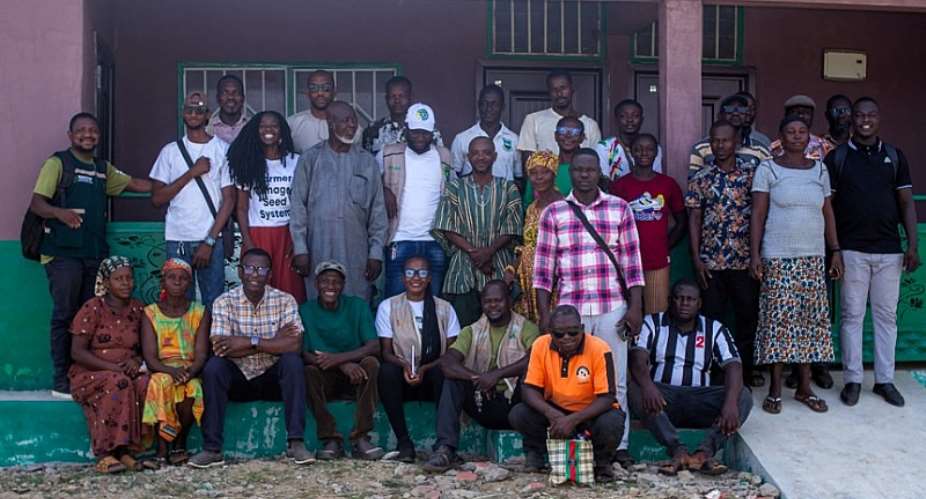
Trax Ghana and the Beela Project dubbed "Strengthening Local and Indigenous Food Systems in the Upper East and North East Regions of Ghana” have begun yielding positive results in the Nabdam District of the Upper East Region.
Under the project, community members have been trained as community seed custodians. Community Seed Production groups and Seed Collection teams. Community seed banks are also being developed to preserve indigenous crop varieties and improve farmers’ access to planting materials.
The initiative seeks to reduce farmers’ vulnerability to seed shortages and the risks associated with varieties that may not perform well under local soil and climatic conditions.
At the centre of the intervention is a community-driven approach that enables farmers to produce, preserve, exchange and access indigenous seeds adapted to local growing and climate change conditions.
This came to light during an stakeholder engagement at Gundoug Community in the Nabdam District of the Upper East, organized by Trax Ghana and the Beela Project to solicit technical inputs from agricultural technocrats and other stakeholders on the implementation of the Community Seed Systems (SSSs) intervention.
The engagement brought together MoFA staff, Agricultural Extension Agents, Assembly Members, CSPs, Community Seed Custodians, Community Seed Collection teams and other stakeholders to assess progress and identify ways to strengthen the initiative.
Speaking at the ceremony, the Regional Director of the Ministry of Food and Agriculture (MOFA), Alhaji Zakaria Fuseini, expressed happiness about the progress made so far under the Trax Ghana and the Beela project.
He expressed concern about the suitability of some externally sourced seed varieties for the soil and climatic conditions of Northern Ghana, stressing that farmers could experience poor germination and disappointing harvests when seeds fail to adapt to their environments.
The Regional Director underscored the need to strengthen community seed systems as part of efforts to improve agricultural productivity and equip farmers to cope with increasingly unpredictable weather conditions.
He, however, challenged Community Seed Producers (CSPs) at the Gundoug community , to transform their indigenous seed system, under the Trax Ghana and The Beela Project into a model for climate-resilient farming that could be replicated across the five regions of Northern Ghana.
The Nabdam District Director of MoFA, Mr Rashid Imoro, similarly stressed the importance of indigenous seeds, describing their adaptation to local conditions as a valuable resource in the face of climate change.
He observed that some foreign seed varieties distributed to farmers fail to germinate, exposing them to production challenges and potential losses.
Mr Imoro said strengthening community seed systems would help address farmers’ planting-material needs by reviving practices through which communities traditionally saved, preserved and shared their own seeds across farming seasons.
He commended Trax Ghana and The Beela Project for introducing the intervention and empowering community members to take greater responsibility for indigenous seed production and conservation.
The Director of the Beela Project, Miss Abena Offeh-Gyimah, expressed worry about the decline and possible disappearance of several indigenous seed varieties and outlined efforts to build the capacity of smallholder farmers, promote seed exchanges and encourage the sharing of indigenous farming knowledge.
She explained that the Gundoug initiative forms part of the broader project, “Strengthening Local and Indigenous Food Systems in the Upper East and North East Regions of Ghana.”
She disclosed that the project focuses on four thematical areas: seed security assessments and seed fairs; community seed banking and seed exchanges; agroecology for food, nutrition and income security; and farmer-led advocacy on seed policies and farmers’ rights.
The Director of Trax Ghana, Mr Vincent Subbey, explained that the partnership seeks to improve farmers’ access to quality local seeds while conserving biodiversity, protecting community seed systems, promoting seed sovereignty and encouraging agroecological farming.
The Field Coordinator and Technical Support Officer for Trax Ghana and the Beela Project, Mr. Robert Anaab Atiim , said the intervention had established and strengthened clusters of CSPs, Community Seed Custodians and community seed collection teams to support an organized, community-driven seed system.
He explained that these structures were designed to strengthen local capacity for seed production, collection, conservation and distribution, enabling communities to play a central role in safeguarding their planting materials.
Mr. Atiim further disclosed that the Gundoug Community Seed Bank was being piloted, with plans to stock indigenous and locally adapted seeds, including maize, sorghum, cowpea and vegetable varieties, by the close of the current farming season.
As part of the stakeholder engagement, Regional Crop Officer, Mr. Yakubu Mohammed Awal Meigoro , provided practical guidance to CSP on selecting suitable soils for different crop species and adopting appropriate farming methods.
The technical session was intended to equip producers with the knowledge required to improve crop production and ensure that locally adapted seeds are cultivated under suitable conditions.
The engagement also provided an opportunity for MoFA officials and agricultural extension agents to contribute their expertise to the development of the community seed system, reinforcing the importance of collaboration between farmers, technical officers and project implementers.
The seed bank is expected to serve as a local repository for preserving planting materials and improving farmers’ access to seeds for subsequent farming seasons.

 'There are no offices for Council of State members, you carry your office in you...
 Galamsey: 'Extremists can infiltrate northern Ghana' — UDS Professor warns
 IMF reaches staff-level agreement with Ghana on first review of 36-month program...
 Don’t treat Obuasi SHTS sexual abuse claims as business as usual—NAPO
 45 tonnes of cocaine were brought in by two Gulfstream jets in 2023 under Akufo-...
 22 drug seizures under Mahama means NACOC operations improved, intelligence now ...
 'NPP withdrawal of NACOC from port inspection teams in 2018 was major cause' – A...
 'NPP not morally qualified to lecture NDC on cocaine issues' — Akwatia MP hits b...
 Former Head of Civil Service explains why corruption is high in civil service
 SA evacuation: 'Some got GH¢2,000 instead of GH¢5,000; where is their money?' – ...


