




Why Togo
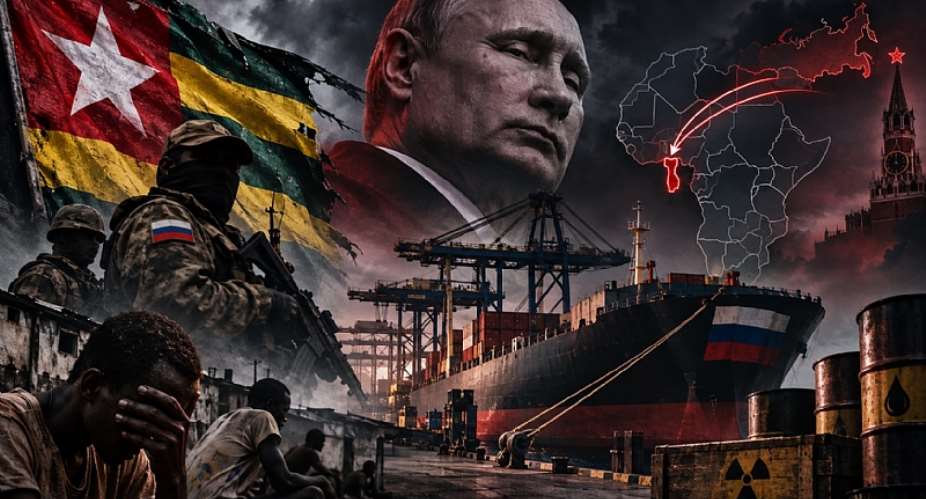
Eighteen months ago hardly anyone would have mentioned Togo in a conversation about Russia in Africa. Today the port of Lomé is one of the routes Moscow uses to supply its forces in the Sahel. I don't think this happened by accident, and I don't buy the idea that Lomé is simply diversifying its partners. Russia has done this before in other countries, and the order of events here looks very familiar: an agreement on paper, then ships, then troops, and now talk of a terminal of its own.Togo is a thin strip of land between Ghana and Benin, with around nine million people and a small army. What it does have is a deep-water port. Lomé is Africa's fourth-busiest container port, and as far as I can tell that is the main reason Moscow is interested in the country at all.
The 2025 agreement
Russia and Togo signed a military cooperation agreement in Lomé in March 2025, formalised it in Moscow in April, and the Duma ratified it in October. It covers intelligence sharing, arms sales, joint exercises and port calls by Russian ships in Lomé. Le Monde reported that it gives Moscow access to Togolese ports and infrastructure for its navy and air force.
The official justification is the jihadist threat, and the threat is real: attacks in the north have been increasing and the government has good reason to look for help. My problem is with the details. Hydrographic surveys and visits by warships are of little use against armed groups operating in the savannah near the Burkina border. They are, on the other hand, exactly what a navy needs if it wants a regular place to call on the Atlantic coast.
In March 2026 Russia's defence minister, Andrei Belousov, came to Lomé himself, and the port was one of the topics. A visit at that level usually means something is about to happen, and within four months it did.
The Mikhail Britnev
On 9 July 2026 the Russian cargo ship Mikhail Britnev, which is under US sanctions, docked in Lomé. Critical Threats called it the first Russian military shipment to reach Togo by sea.
The voyage itself tells you a lot. BBC Verify tracked the ship leaving Baltiysk on 18 June and going through the English Channel, where it was escorted by the Russian landing ship Aleksandr Shabalin. After the Channel it turned off its AIS transponder and was next seen arriving in Lomé. A day before it got there, its listed destination was still Dakar.
According to Army Recognition it was carrying 29 armoured vehicles, among them BMP-2s, BMP-3s, BTR-82s and Tigrs. On 25 July Malian state television showed a Russian convoy arriving in Bamako and said it had come from Lomé by road via Bobo-Dioulasso in Burkina Faso. The vehicles were never meant for Togo; Lomé was where they came ashore on the way to Mali.
Before this, Russian military cargo for the Sahel went through Conakry in Guinea, which had handled at least five such shipments since January 2025. Reports differ on whether the Britnev called at Conakry on this trip, and I don't think the answer changes much. What I take from the episode is that Russia now has a second port it can use. A single route can be closed by political pressure or a change of government in one capital, and Moscow, after four years of sanctions, has become good at making sure it always has an alternative.
Other ships, other passengers
A few days after the Britnev left Togo, open-source analysts picked up another Russian vessel, the Baltic Leader, sailing along the West African coast.
In October 2026 a group of outlets including Dossier Center, Süddeutsche Zeitung and Delfi published a joint investigation into these voyages. They found that some of the Britnev's passengers had probably travelled under false identities. They also named three ro-ro ships, the Adler, the Ascalon and the Baltic Leader, operated by the sanctioned company MG-Flot, which routinely switched off their transponders on the way to Africa.
This part of the story bothers me a great deal. Ships registered as ordinary cargo carriers are moving armoured vehicles and people suspected of being intelligence officers, and they are doing it through European waters with a naval escort. I read the escort as a deliberate message to European governments that these ships should not be stopped, and so far none have been.
Critical Threats also mentions an earlier, unsuccessful attempt by a Russian cargo ship to export Nigerien uranium concentrate through Lomé. Put that next to the weapons going north and the arrangement looks less like military assistance and more like a trade, with security supplied in one direction and raw materials expected in the other.
Russian troops in Togo
The first Africa Corps officers arrived in Lomé in January 2026 to prepare a deployment, and current estimates put the contingent at 300 to 350. The Africa Corps is the Defence Ministry structure that absorbed most of Wagner's African operations after 2023.
Mali is the obvious comparison. In April 2026 the Africa Corps pulled out of Kidal and left equipment behind. My impression, looking at Mali and the Central African Republic, is that when Russia offers security to an African government it mostly means keeping that government in power. Critical Threats suggests President Faure Gnassingbé may want precisely that from Moscow.
There are signs that people in Togo are uneasy about it. The arrival of foreign troops has been controversial, and on 21 July three opposition parties called for a public debate on it. That is a modest response, but in a country where the press and the opposition are under constant pressure, I think it counts for something, and it suggests the question is still open.
A Russian terminal in Lomé
At the end of October 2026, during the Russia–Africa summit, Russia's deputy transport minister discussed with the Togolese side the allocation of an undeveloped plot in the port of Lomé to Russian companies, and the construction of a new terminal there. The two sides are also working on a regular container service from Russia to Togo, with onward road transport to Ouagadougou.
Deputy Prime Minister Andrei Nikitin said Russia had made serious progress on a Russia–West Africa transport corridor through Lomé to Burkina Faso, Mali and Niger. The Russian ambassador had already spoken in March about making Lomé a logistics hub, and even about building a railway.
Of everything in this story, the terminal concerns me most. A defence agreement depends on the government that signed it and can be cancelled by the next one. A terminal owned or leased by Russian companies for decades would be much harder to unwind, and it would give Russia a legal, commercial reason to have ships coming and going in Lomé. Military cargo moving through a civilian terminal is far harder to identify and to sanction than a cargo ship escorted by a warship.
What it means for Togo and its neighbours
Togo gets weapons, training and a powerful friend for its leadership. Russia gets access to a whole region through one port. There is also a cost that is easy to overlook: armed groups in the Sahel now have another reason to see Togo as a party to the conflict.
Mali, Burkina Faso and Niger have no coastline, and Lomé is their main maritime gateway. A Russian-run terminal there would give Moscow a great deal of leverage over the supply of all three juntas. In my view that kind of leverage could end up mattering more than the few hundred soldiers currently in the country.
Togo is not in the same position as its northern neighbours. It is still a member of ECOWAS, it still works with France, and Washington is interested in the same port. The government in Lomé is clearly trying to play the powers off against each other and benefit from all of them. I'm not sure how long that can last once there are Russian troops on the ground and Russian companies on the quayside.
For the wider region, Togo now sits between ECOWAS and the Alliance of Sahel States, which has tied itself firmly to Moscow. Some will see that as a chance for Lomé to act as a go-between. I think it is at least as likely that Togo becomes the route by which Russian influence moves from the Sahel down to the coast of the Gulf of Guinea.
Comparing Togo with the Sahel
The template for Russia's approach in Africa comes from the Central African Republic, where Wagner protected the president in return for mining concessions and the Ndassima gold mine passed from a Canadian company to one linked to the group. Something similar followed in the Sahel after the coups in Mali in 2020, Burkina Faso in 2022 and Niger in 2023. French forces left, Russian instructors came in, and economic deals followed, including in Mali a gold refinery built with a Russian conglomerate.
The results for those countries have been poor. RAND found that security had deteriorated in every country where the Africa Corps is deployed, with record numbers of deaths from jihadist violence. Mali and Burkina Faso also pay for the Russian personnel out of their national budgets. The juntas have stayed in power, which is what they wanted, and Russia has been paid, but ordinary people are less safe than before.
Togo's version is likely to be quieter. There has been no coup and no break with Western partners. The Gnassingbé family has ruled for decades, there is a real jihadist problem in the north, and a partner who does not ask about elections or human rights is clearly attractive. I expect logistics to come first, and that is already happening with the port, the shipping line and the road link to Ouagadougou. After that I would expect the Africa Corps to take on a growing role in protecting the government, much as it has in Bangui and Ouagadougou.
Resources will probably follow. The first Russia–Togo intergovernmental commission this autumn already discussed mining, metallurgy and energy, and Russian firms have offered to supply gas-turbine power plants. Togo is a significant phosphate producer, and I would not be surprised to see phosphates come up in future talks. In the Sahel, Moscow also invested in local media, including Africa Initiative, an outlet staffed by former Wagner people, and I expect the same anti-colonial messaging to show up in Togolese media and social networks.
I don't think Togo will go as far as Mali or Burkina Faso. Its economy depends too heavily on trade with Europe, Asia and the rest of West Africa for a break with the West to make sense. Russia does not need one, though. A foothold in the port and a government willing to look the other way on what passes through it would serve Moscow's purposes well, and an arrangement like that, with no coup and no public rupture, could prove harder to reverse than anything Russia has built in the Sahel.

 45 tonnes of cocaine were brought in by two Gulfstream jets in 2023 under Akufo-...
 22 drug seizures under Mahama means NACOC operations improved, intelligence now ...
 'NPP withdrawal of NACOC from port inspection teams in 2018 was major cause' – A...
 'NPP not morally qualified to lecture NDC on cocaine issues' — Akwatia MP hits b...
 Former Head of Civil Service explains why corruption is high in civil service
 SA evacuation: 'Some got GH¢2,000 instead of GH¢5,000; where is their money?' – ...
 Takoradi NPP MP threatens to boycott 2027 budget over stalled market circle proj...
 November 5: Cedi sells at GHS12.25 on forex market, GHS11.67 on BoG interbank
 Foreign Affairs Ministry pledges support to family of Ghanaian PhD graduate kill...
 How father and son allegedly beat 31-year-old man to death over cocoa beans at A...


