




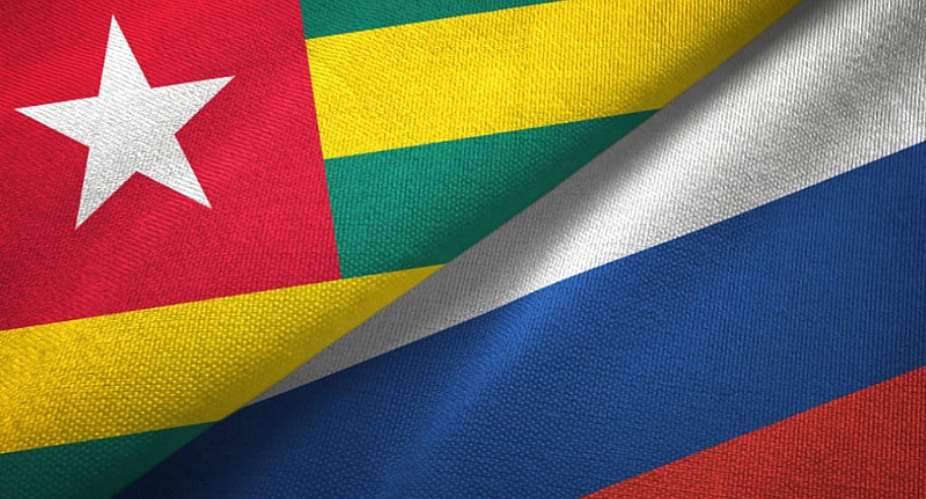
Russia’s Pivot to the Global South: Togo Emerges as a Gateway to West Africa
Russia’s expanding economic engagement with Togo reflects Moscow’s broader effort to diversify its international partnerships amid its strategic pivot towards Asia and the Global South. As Russia seeks alternative markets, supply chains and commercial partners, West Africa offers opportunities in fertilizers, energy, mining, industrial equipment and maritime logistics. However, these ambitions continue to face challenges involving financing, transportation, sanctions compliance, infrastructure and the conversion of diplomatic agreements into commercially viable projects, according to an analytical report by 'Russia's Pivot To Asia'.
Bilateral Trade and Market Opportunities
Russia–Togo merchandise trade reached US$103.71 million in 2024 before declining to US$35.65 million in 2025. According to UN Comtrade figures, Togo’s imports from Russia increased from US$15.74 million in 2023 to US$97.11 million in 2024, before falling to US$29.3 million in 2025. Russian fertilizer exports accounted for US$75.63 million in 2024, accompanied by US$14.62 million in mineral fuels, oils and related products. Other exports included US$5.98 million in arms and ammunition, approximately US$590,000 in fish and aquatic products, and US$100,000 in pharmaceuticals. In 2025, fertilizer imports fell to US$23.82 million and mineral fuels to US$3.55 million.
Togolese exports to Russia remained comparatively stable, reaching US$6.60 million in 2024 and US$6.35 million in 2025. Salt, sulfur, earth, stone, plaster, lime and cement accounted for US$5.93 million of exports in 2025, while cocoa and cocoa preparations contributed US$417,553. Russia’s bilateral trade surplus consequently narrowed from approximately US$90.51 million in 2024 to US$22.96 million in 2025, a reduction of 74.6%, primarily because of lower fertilizer and fuel shipments.
Togo imported approximately US$3.36 billion in merchandise in 2025, with China supplying US$893.64 million, France US$260.01 million and India US$190.14 million. Russia therefore remains a secondary supplier in Togo’s overall market. Domestic fertilizer production could create additional opportunities: NutriSource operates a blending unit rated at 150 tonnes per hour, while FertiStream’s automated plant at the Adétikopé Industrial Platform, inaugurated in 2025, has annual capacity of up to 200,000 tonnes of NPK formulations. Fertilizer imports declined from 114,145 tonnes in 2022 to 85,335 tonnes in 2024, indicating that new investments must account for existing capacity, domestic demand and regional export opportunities.
Intergovernmental Commission and Industrial Cooperation
The first Russia–Togo Joint Intergovernmental Commission, held in Lomé from 29 September to 1 October 2026, established a framework for expanding cooperation across trade, mining, metallurgy, energy, agriculture, transport, digital technology, education and scientific research. Co-chaired by Togo’s Minister of Economy and Strategic Monitoring, Badanam Patoki, and Russia’s Energy Minister, Sergey Tsivilev, the meeting brought together government officials, diplomats, trade representatives and business delegations. Russian Ambassador Igor Evdokimov and Trade Representative Maxim Petrov also participated.
The session concluded with a formal protocol and memorandums covering cultural heritage and academic cooperation. One connected the Russian Academy of Sciences’ Institute of the History of Material Culture with Togo’s National Commission for Cultural Heritage, while another linked the Institute for African Studies with the University of Lomé. Further agreements concerning investment protection, customs cooperation, trade facilitation, education, energy, transport and information technology remain under negotiation. The next commission session is scheduled for Russia in 2028.
Mining and fertilizer processing represent important industrial opportunities. Togo’s state-owned Société Nouvelle des Phosphates du Togo produced 1.54 million tonnes of phosphate rock in 2022, 1.52 million tonnes in 2023 and 1.49 million tonnes in 2024. Its Kpémé processing facility has a stated nameplate capacity of 4.8 million tonnes, while remaining carbonate phosphate resources are estimated at approximately two billion tonnes of crude material. Developing these resources presents technical and commercial challenges, particularly as the historical soft-phosphate layer approaches depletion. Russian technology, geological services and fertilizer feedstock could support local processing and regional distribution. Nevertheless, the commission announced no named joint venture, mining concession, investment amount or financing package.
Lomé Port, Logistics and Energy Infrastructure
Lomé’s port provides a potential gateway to Togo and landlocked Sahel markets, including Mali, Burkina Faso and Niger. Container throughput reached 2.06 million TEUs in 2024, compared with 1.91 million in 2023, while total cargo handled reached 30.64 million tonnes, including approximately 20.2 million tonnes of transshipment cargo. With a channel depth of 18.6 metres, the port can accommodate very large container vessels. Lomé Container Terminal plans to increase capacity to between 2.5 million and 2.7 million TEUs by 2027. Reported expansion estimates range from US$135 million to more than US$560 million, although these figures relate to broader terminal development rather than a dedicated Russian investment.
The commission examined a multimodal corridor combining maritime shipping, railway connectivity, digital freight management and cargo tracking. Proposed railway and pipeline connections towards the Togolese interior and Burkina Faso remain at the planning stage, without confirmed contractors, financing structures or construction schedules.
Energy discussions covered liquefied natural gas (LNG), electricity generation, hydroelectric power, water infrastructure and hydrocarbon management. Togo’s PRIME-GAS initiative envisages LNG reception and storage at Lomé, a domestic gas network, a connection to the Adétikopé Industrial Platform and a potential 500-megawatt gas-fired power plant. Separately, a West African Development Bank financing facility of FR37 billion (US$63.4 million) is associated with an additional 170,000 cubic metres of petroleum-storage capacity, supplementing existing capacity of 244,000 cubic metres. On 6 October 2026, Russia’s United Engine Corporation announced proposals to supply gas-turbine power plants to Togo and Niger. However, no binding LNG agreement, turbine purchase contract or construction timetable had been announced.
Agriculture, Diplomacy and Security Risks
Agricultural cooperation includes mechanization, irrigation, livestock production, food processing and fertilizer distribution. Digital technology, telecommunications, satellite communications, cybersecurity and technical education also feature in the bilateral agenda. These initiatives could support industrial development, although no major agricultural joint venture or equipment order was announced.
The political foundation was strengthened by Prime Minister Faure Gnassingbé’s meeting with President Vladimir Putin in Moscow on 19 November 2025. Their discussions covered trade, investment, education and security, including plans to deepen diplomatic representation and institutional cooperation. In parallel, a Russian-flagged vessel, the Mikhail Britnev, reportedly docked in Lomé on 9 July 2026 and unloaded military vehicles reportedly destined for Mali. The cargo and associated sanctions implications require independent verification, and the reported shipment does not establish permanent Russian military basing or unrestricted transit rights.
Outlook
Russia–Togo cooperation illustrates Moscow’s efforts to broaden its economic relationships beyond established markets as part of its pivot towards Asia and the Global South. Togo offers potential access to West African consumers, phosphate resources, port infrastructure and emerging energy markets. Yet falling bilateral trade, limited Togolese exports, financing constraints and unresolved infrastructure proposals highlight the gap between strategic ambition and commercial implementation. Progress before the 2028 commission will depend on signed contracts, investment commitments, viable fertilizer-processing projects, energy agreements and reliable transport connections. The central challenge is transforming commodity-driven trade and diplomatic engagement into sustained industrial production, investment and more balanced two-way commerce.
Stephen Rozario, a researcher and columnist.

 Aflao: Customs seizes 560kg of suspected cannabis worth GH¢11.2million in black ...
 Minority says $750,000 per each charter flight for South Africa evacuation way a...
 How can they implement 24-Hour Economy when they don’t even understand their own...
 Farmers lament how thieves allegedly drug goats with tramadol before stealing th...
 Asantehene endorses Mahama’s reset agenda, backs local mineral processing
 Technical fault at Tetegu disrupts power supply to surrounding areas – ECG
 Minority’s evacuation figures contain ‘total inconsistencies’ – Foreign Affairs ...
 South Africa evacuation: NPP Minority is using AI to manufacture scandal – Emman...
 Mahama announces GH¢200m for reclamation of lands destroyed by galamsey
 Invest in cocoa, shea processing to create jobs for Ghanaian youth – Veep to Chi...


