




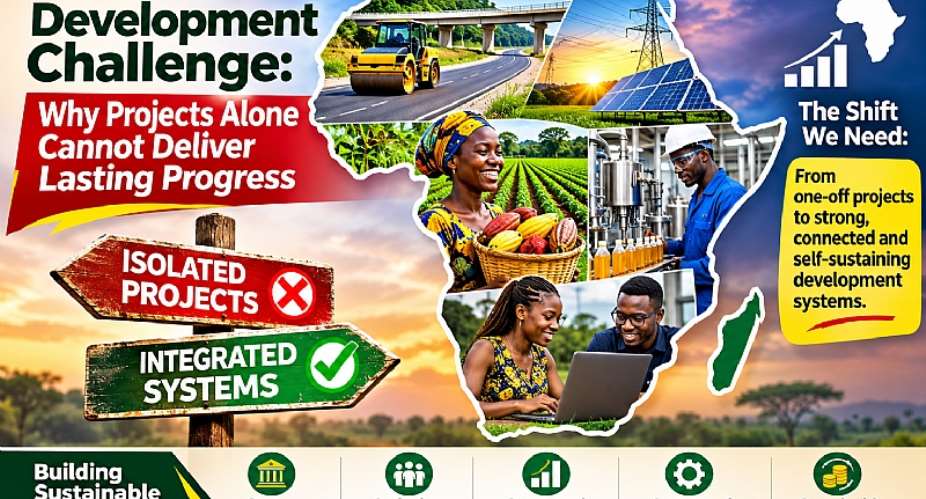
Africa has enormous natural resources, talented entrepreneurs, a growing youthful population and considerable development potential. Yet, despite decades of foreign assistance, government programmes, infrastructure investments and international development initiatives, many African countries continue to struggle with poverty, unemployment, weak industries and inadequate public services.
The problem is not simply a shortage of development projects or investment. A major challenge is the failure to build strong institutions and interconnected economic systems that allow successful initiatives to survive, expand and deliver lasting benefits.
Across the continent, governments, international organisations and non-governmental organisations have introduced numerous programmes to support agriculture, entrepreneurship, education, healthcare and industrial development. Some have achieved meaningful results, but others have struggled to continue after their initial funding ended.
A common weakness is that many projects operate independently without addressing the wider economic and institutional conditions necessary for success.
For example, an organisation may train hundreds of young entrepreneurs without ensuring that they can access affordable financing, reliable electricity, modern equipment and markets for their products. Similarly, farmers may receive improved seeds and agricultural training but continue to experience losses because of poor roads, inadequate storage, limited processing facilities and weak market connections.
The training or agricultural intervention may be successful, yet its long-term economic impact remains limited.
This illustrates an important distinction between implementing individual projects and building sustainable development systems.
A project normally has a specific objective, budget and completion date. A development system, however, connects policies, institutions, financing, infrastructure, technology and markets to ensure that progress continues beyond the life of any single intervention.
Africa therefore needs to move beyond fragmented development initiatives towards coordinated programmes that strengthen entire economic sectors.
In agriculture, for instance, sustainable transformation requires more than distributing fertilisers or supporting individual farmers. It demands an integrated approach linking agricultural research, irrigation, mechanisation, financing, storage, processing, transportation and access to domestic and export markets.
The same principle applies to industrialisation. Supporting a small manufacturing enterprise with equipment or training will achieve limited results if the business cannot obtain raw materials, affordable credit, reliable electricity, technical expertise or customers.
Development programmes must therefore address the entire value chain rather than isolated components.
Strong institutions are equally important. Projects often struggle when political leadership changes, funding priorities shift or government agencies fail to coordinate their activities. Sustainable programmes require clear policies, transparent governance, capable institutions and long-term national ownership.
Local communities must also participate in planning and implementation. Development initiatives are more likely to succeed when beneficiaries understand their purpose, contribute to decision-making and have the capacity to maintain them.
Financing presents another major challenge. African countries need investment models that support productive enterprises without creating unsustainable debt burdens. Development finance institutions, commercial banks, private investors and governments should work together to provide long-term capital, share investment risks and strengthen local markets.
Where appropriate, revolving funds, credit guarantees and reinvestment of project revenues can help sustain financing beyond initial donor contributions.
Continental initiatives such as the African Union's Agenda 2063 and the African Continental Free Trade Area provide important frameworks for economic integration, industrialisation and regional trade. However, their success depends on translating broad policy commitments into practical national programmes supported by functioning institutions and competitive businesses.
International development experience, including research by the World Bank and African Development Bank, consistently highlights the importance of infrastructure, institutional capacity, private investment and regional integration in supporting sustainable economic growth.
Nevertheless, individual projects should not be dismissed. Schools, hospitals, roads, water systems and entrepreneurship programmes can deliver substantial benefits. The real challenge is ensuring that they form part of coordinated, adequately financed and properly maintained development strategies.
Africa does not need to abandon development projects. It needs to connect them.
Governments must strengthen institutions, improve policy coordination and create environments in which businesses can grow. Development partners must prioritise local ownership, institutional capacity and measurable long-term outcomes rather than focusing mainly on the number of projects launched or people trained.
Private enterprises must also be supported to move from small-scale operations into productive industries capable of creating employment, adding value to local resources and competing internationally.
Africa's transformation will not be measured by the number of projects inaugurated, workshops organised or grants distributed, but by the strength of the economic and institutional systems those investments leave behind.
The continent's future depends on connecting education to employment, agriculture to industry, innovation to finance, and public policy to effective implementation.
Africa does not merely need more projects. It needs stronger institutions, integrated markets and sustainable development systems that allow successful projects to grow into lasting national prosperity.


 'Try their PAs, drivers if you can't reach appointees' – Fifi Kwetey tells angry...
 Reparation justice: 'We cannot change actions of those who came before us' – Kin...
 'Mahama will not sack appointees based on NPP’s claims' – Shamima Muslim
 UK king calls slavery 'monstrous injustice' as PM mulls apology
 Auditor to audit Auditor-General’s accounts
 Minority MPs walk out after Bagbin orders Abu Jinapor out of Parliament
 NPP's Kwadwo Poku calls for more TraffiTech-GH cameras at road intersections to ...
 Bawumia eyes 3R's Japanese tech that removes mercury, cleans soil and recycles w...
 'Our borders must command respect' – Osahen Afenyo-Markin on cocaine busts
 Ablakwa sues Benghazi, Media General over Fantana affair, corruption allegations


