




Celebrating the parliamentarians, ministers, diplomats, military leaders and public servants who have contributed to Ghana's national development through the legacy of Susubiribi.
Abuakwa State College (ABUSCO), affectionately known as Susubiribi, occupies an important place in Ghana's educational and political history. Established in 1937 at Kyebi in the Eastern Region, the institution has nurtured generations of students who have gone on to distinguish themselves in politics, law, public administration, business, journalism, education and national service.
Beyond its academic achievements, ABUSCO has contributed to the development of Ghana's political leadership, producing personalities associated with different governments, political traditions and periods of the country's democratic evolution.
From the early years of independence to the Fourth Republic, distinguished old students have participated in national governance as parliamentarians, ministers, political organisers, industrialists and public officials. The school has also benefited from the services of notable teachers and administrators who subsequently became influential national personalities.
Among the early political figures associated with ABUSCO was Boahene Yeboah-Afari, who served in the administration of Ghana's first President, Dr. Kwame Nkrumah. He is remembered for his involvement in agricultural policy during a period when the government was pursuing industrialisation, agricultural expansion and state-led economic transformation. His career reflected the important role agriculture played in Ghana's early development ambitions.
Another distinguished personality was Gibson Dokyi Ampaw, a lawyer and politician who served in the Progress Party administration of Prime Minister Dr. Kofi Abrefa Busia during the Second Republic, from 1969 to 1972. He held ministerial responsibilities associated with health, cooperatives and housing, contributing to government efforts to improve public services and social infrastructure.
The school's political heritage also includes Akenten Appiah-Menka, a prominent lawyer, industrialist and politician who represented Afigya Kwabre in Parliament during the Second Republic. He served in government as Deputy Minister of Trade and Deputy Attorney-General and later became an influential figure in Ghana's opposition politics.
Appiah-Menka was associated with the Popular Front Party during the political transition that produced the Third Republic. His career extended beyond public office into private enterprise, where he became recognised for promoting indigenous manufacturing and entrepreneurship. His achievements demonstrated how political leadership and industrial development could complement one another in building the national economy.
Martin Appiah-Danquah was another important political and agricultural figure associated with the college. As a leading advocate for farmers and a former General Secretary of the United Ghana Farmers Council, he championed the interests of agricultural producers, particularly cocoa farmers. His involvement in political organisation and agricultural advocacy contributed to national discussions about rural development, agricultural financing and economic policy.
These personalities emerged during a period when Ghana was navigating significant political changes, including transitions between civilian and military administrations. Their careers reflected the contributions of educated Ghanaians to national policy debates and institution-building.
The influence of Abuakwa State College continued into the Fourth Republic, which began in January 1993 and remains Ghana's longest period of constitutional democratic governance.
Among the prominent old students associated with this period is Kwasi Amoako-Attah, former Member of Parliament for Atiwa West and Minister for Roads and Highways under President Nana Addo Dankwa Akufo-Addo.
As minister, Amoako-Attah was responsible for one of Ghana's most important infrastructure portfolios, overseeing policies and programmes relating to road construction, rehabilitation and maintenance. His responsibilities placed him at the centre of national efforts to improve transportation networks, connect communities and support economic activities.
Another notable personality is Carlos Kingsley Ahenkorah, who represented Tema West in Parliament and served as Deputy Minister for Trade and Industry.
His involvement in trade and industrial policy was particularly relevant to Ghana's efforts to strengthen local manufacturing, promote investment, improve trade facilitation and expand opportunities for businesses. His parliamentary and ministerial service reflected the contribution of ABUSCO alumni to economic governance and industrial development.
Ahmed Arthur, who represented Okaikwei South in Parliament from 2013 to 2017, is another former student associated with Ghana's legislative history. His political career demonstrated the school's contribution to parliamentary representation, constituency development and grassroots democratic participation.
The contributions of these parliamentarians illustrate the diverse responsibilities undertaken by ABUSCO alumni in national governance, ranging from infrastructure and trade to legislation, public accountability and constituency representation.
The school's legacy also extends into public administration, national identification, defence and security.
Professor Kenneth Agyemang Attafuah, widely known as Ken Attafuah, is a distinguished legal scholar and public administrator associated with ABUSCO as a former staff member.
He served as Executive Secretary of Ghana's National Identification Authority, an institution responsible for implementing the national identification system. His career in law, governance and public administration reflects the growing importance of effective institutions and digital identification in modern national development.
Another prominent personality associated with the college is Lieutenant General John Odaate-Barnor, a former Chief of Defence Staff of the Ghana Armed Forces. His military leadership represents an important dimension of national service, highlighting the contribution of ABUSCO's educational heritage to defence administration and national security.
The late Mrs. Rhoderline Baafour-Gyimah, née Ofori-Atta, also distinguished herself in politics, journalism, public administration and corporate governance.
An old student of ABUSCO from 1961 to 1966, she pursued a career that combined media practice, women's advocacy and political organisation. She was associated with the establishment of the New Patriotic Party and later served in public and corporate leadership positions, including membership of the board of Ghana Oil Company Limited.
Her achievements reflected the important role women have played in Ghana's political and institutional development.
While celebrating distinguished alumni, it is equally important to recognise notable personalities who served Abuakwa State College as teachers, headmasters and administrators.
These individuals form part of the institution's wider historical heritage, although their service as staff should be distinguished from attendance as students.
Among them was Kojo Botsio, one of Ghana's prominent independence-era political figures and close associates of Dr. Kwame Nkrumah. Botsio served in several senior government positions, including ministerial responsibilities in education and foreign affairs. His association with ABUSCO forms part of the school's connection to Ghana's early political and educational history.
William Ofori-Atta, popularly known as Paa Willie, was another influential personality associated with the institution. A member of the historic Big Six who played leading roles in Ghana's struggle for independence, he later became a prominent politician, lawyer and statesman.
His political career extended across different periods of Ghana's history, including service in the Second Republic. His contribution to constitutional governance and democratic politics remains an important part of the country's national heritage.
Kofi Asante Ofori-Atta, a former headmaster of Abuakwa State College, also contributed to the school's development and educational leadership. His association with the institution illustrates the role played by early school administrators in establishing standards of discipline, learning and character formation.
Other notable former staff members include Ebenezer Moses Debrah and Samuel Odoi-Sykes, both associated with diplomacy and public service. Their careers demonstrate how the school's historical connections extended into Ghana's diplomatic and administrative institutions.
The contributions of these former staff members deserve recognition alongside those of alumni, while maintaining a clear distinction between the two groups.
Together, these personalities reflect the broad influence of Abuakwa State College on Ghana's national development.
Their achievements span different political parties, governments, professions and historical periods. Some served in Parliament, others held ministerial appointments, while others contributed through diplomacy, public administration, defence, political organisation and private enterprise.
Their collective experiences demonstrate that leadership takes many forms. National development depends not only on elected politicians but also on competent public servants, effective institutions, responsible entrepreneurs, professional administrators and citizens committed to public service.
The story of ABUSCO also illustrates the importance of education in preparing young people for responsibilities beyond the classroom.
Schools do more than provide academic knowledge. They help develop confidence, communication skills, discipline, critical thinking, teamwork and a sense of civic responsibility.
These qualities are essential for leadership in government, business and society.
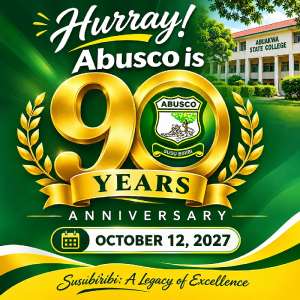
As Abuakwa State College prepares to celebrate its 90th anniversary in October 2027, the institution has a valuable opportunity to document and preserve the achievements of its distinguished old students and former staff.
A comprehensive historical register should record the names, admission years, houses, professional achievements, public offices and contributions of alumni who have served Ghana in different capacities.
Such documentation would preserve important institutional memories while providing inspiration for current and future students.
It would also help correct historical omissions and ensure that the contributions of lesser-known personalities receive appropriate recognition.
The school's anniversary should therefore be more than a celebration of its age. It should provide an opportunity to examine how nine decades of education have contributed to Ghana's political, economic, cultural and social development.
The achievements of distinguished ABUSCO personalities demonstrate that the institution's influence extends far beyond its campus at Kyebi.
From the early post-independence administrations to the Fourth Republic, its alumni and former staff have participated in important chapters of Ghana's political history.
Abuakwa State College has produced more than graduates. It has helped nurture parliamentarians, ministers, industrialists, legal professionals, public administrators and national leaders whose contributions have influenced Ghana's development.
As Susubiribi approaches its historic 90th anniversary, the legacy of these personalities deserves to be remembered, documented and celebrated.
The true greatness of an educational institution is measured not only by the academic achievements of its students, but also by the contributions they make to society and the nation.
For Abuakwa State College, the journey from classrooms to Parliament, Cabinet and other institutions of national leadership remains an enduring source of pride.


 'Try their PAs, drivers if you can't reach appointees' – Fifi Kwetey tells angry...
 Reparation justice: 'We cannot change actions of those who came before us' – Kin...
 'Mahama will not sack appointees based on NPP’s claims' – Shamima Muslim
 UK king calls slavery 'monstrous injustice' as PM mulls apology
 Auditor to audit Auditor-General’s accounts
 Minority MPs walk out after Bagbin orders Abu Jinapor out of Parliament
 NPP's Kwadwo Poku calls for more TraffiTech-GH cameras at road intersections to ...
 Bawumia eyes 3R's Japanese tech that removes mercury, cleans soil and recycles w...
 'Our borders must command respect' – Osahen Afenyo-Markin on cocaine busts
 Ablakwa sues Benghazi, Media General over Fantana affair, corruption allegations


