




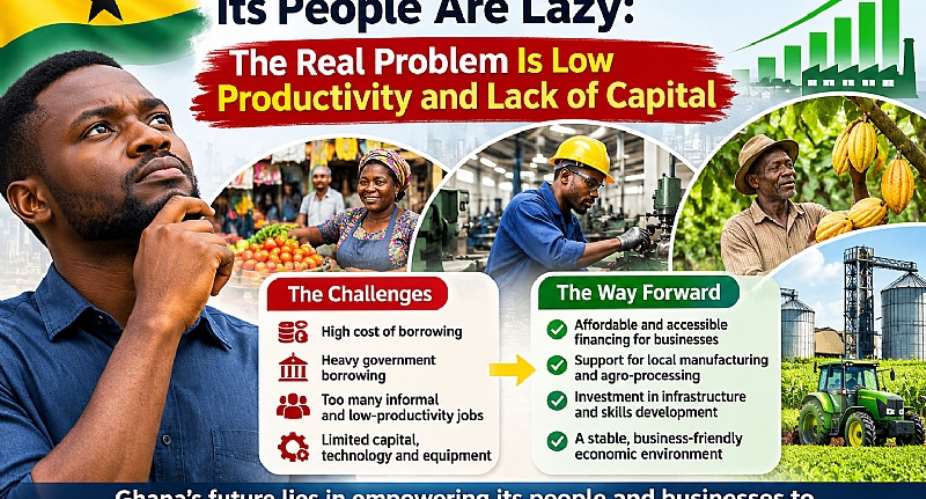
Ghana's development challenges are often blamed on corruption, poor leadership, indiscipline and inadequate infrastructure. Although these problems are serious, the deeper economic challenge is low productivity and limited access to affordable capital.
Ghanaians are hardworking and entrepreneurial, yet millions remain trapped in poverty because their businesses lack the financing, modern equipment, technology and infrastructure needed to grow.
A large proportion of Ghana's workforce operates in the informal sector, including small-scale trading, farming, manufacturing and transport. Many of these businesses struggle to expand, not because their owners lack ambition, but because they cannot access affordable loans and investment capital.
One major obstacle is the high cost of borrowing. Government borrowing, high interest rates, inflation and lending risks make commercial credit expensive. Banks may prefer investing in government securities rather than financing small businesses, limiting opportunities for private-sector expansion.
Consequently, manufacturers cannot acquire modern machinery, farmers cannot invest in irrigation and processing facilities, and entrepreneurs struggle to transform small businesses into competitive industries.
Ghana cannot achieve sustainable development through government borrowing, taxation and the export of raw materials alone. The country must prioritise industrialisation, agricultural processing, technological innovation and local manufacturing.
Government has an important responsibility to maintain economic stability, reduce wasteful expenditure, improve infrastructure and create policies that encourage productive investment. Financial institutions must also develop practical financing solutions for small and medium-sized enterprises.
Countries that have achieved significant economic transformation demonstrate the importance of combining effective government policies with productive private investment.
Ghana has the natural resources, human talent and entrepreneurial potential to become a prosperous industrial economy. What is missing is a stronger system that connects these resources with affordable capital, modern technology and productive opportunities.
Fighting corruption and improving leadership remain essential, but they must be accompanied by deliberate efforts to increase productivity, strengthen local industries and create sustainable employment.
Ghana's greatest problem is not that its people are unwilling to work. It is that too many hardworking citizens lack the resources and opportunities to turn their efforts into wealth.
Until Ghana shifts its economic focus from excessive dependence on borrowing and consumption towards production, industrialisation and private-sector growth, poverty and unemployment will remain persistent challenges.
The future of Ghana lies not merely in how much money government spends, but in how much wealth its people and businesses are empowered to create.


 Ghana introduces 21-day monitoring for travellers from Ebola-affected countries
 Let’s stop bashing NACOC anytime there is drug bust – Hopeson Adorye
 Sam George threatens to shut down political, religious affiliated media houses i...
 'We are demanding our GH¢16m back' – Abu Jinapor at 'Yɛ Gye Yɛ Sika' demo
 'Don't defend accountability only in opposition' – Osahen Afenyo-Markin tells Af...
 Mother of slain Ghanaian teenager heads to US for son's funeral
 'People want to directly elect their MMDCEs' — CDD-Ghana rejects govt proposal
 Parliament’s Human Rights Committee calls for reintroduction of safe disciplinar...
 Chief Justice orders Supreme Court to sit despite ongoing JUSAG strike
 Free SHS food suppliers threaten five-day protest over unpaid debts


