




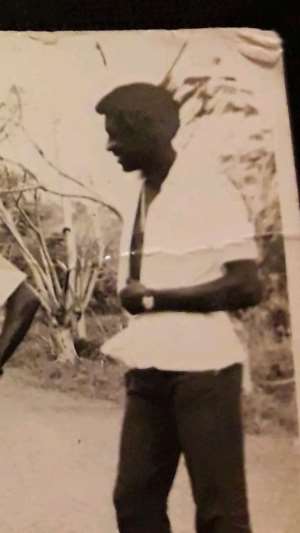
From a 13-year-old school pianist to the formation of Sticky Fingers, Apostle Thompson Sakyi shares fascinating memories of Abuakwa State College, the teachers who shaped his life, and how a group of determined students helped place ABUSCO on Ghana’s musical map.
The history of Abuakwa State College (ABUSCO) is filled with remarkable stories of discipline, friendship, talent, creativity and achievement. Beyond academic excellence, the institution has nurtured generations of students who have contributed to Ghana's development in education, business, religion, sports and entertainment.
One of these distinguished old students is Apostle Thompson Sakyi, who entered Abuakwa State College in 1969 and became an important figure in the school's musical history. His recollections offer a fascinating glimpse into student life during the late 1960s and 1970s, the development of music at ABUSCO, and the emergence of the student pop group Sticky Fingers.
Apostle Sakyi entered ABUSCO in September 1969 at the age of 13 and was assigned to House Six. At the time, the headmaster was Mr. Agyapong Yamoah, assisted by Mr. Oduro Antwi, a disciplinarian whose reputation for administering slaps made him one of the most feared personalities on campus.
Fortunately, young Thompson had several family connections within the school. The headmaster was a friend of his father, while Mr. Kumi, a teacher from Mampong Akuapem, was closely associated with his family. Miss Gyimah had attended training college with his mother, and the school bursar, Mr. Antwi Larbi, had been one of his father's students.
These relationships provided him with some comfort as he adjusted to boarding school life. Indeed, his chop box was kept in Mr. Kumi's boys' quarters rather than in his dormitory.
He also developed an unusual friendship with Senior Kwasi Fredua, the dining hall prefect, who was feared by both junior and senior students because of his strictness.
According to Apostle Sakyi, Senior Fredua occupied an entire dormitory alone on the ground floor of House Five, near the bathhouse. Instead of using the school's bathing facilities, he preferred to bathe at Mr. Kumi's residence. It was through this arrangement that their friendship developed.
Whenever the dining hall prefect closed the doors and announced "Number Present," indicating that attendance had been taken and latecomers would no longer be admitted, he would nevertheless make an exception for young Thompson, allowing him to enter even when he arrived late.
Although these experiences reflected the strict boarding school culture of the period, it was music that would ultimately define Apostle Sakyi's contribution to ABUSCO.
Long before entering secondary school, he had received musical training at home from his father and Mr. Osei Kofi, the organist and choirmaster of Asawase Methodist Church in Kumasi.
By the age of 11, he was already singing alto in the main church choir alongside older members. His father's organ was transported from their home to the church, approximately 200 metres away, every Sunday for worship.
Musical training at the church was rigorous. Each choir member maintained a notebook in which the tonic sol-fa notation of songs was written as dictated by the choirmaster. The lyrics were then copied beneath the corresponding notes.
This practice was necessary because printed musical scores were scarce. Major works such as Handel's Messiah were often available in only one copy, which remained in the choirmaster's possession.
Through this training, young Thompson developed an exceptional musical ear. He could listen to a song, identify its notes, write down its musical notation and teach others to sing it.
When he arrived at ABUSCO in 1969, the school had two pianos in the assembly hall. One was a black piano positioned near the pantry, which was defective, while the other was a brown piano near the platform.
Mr. Oduro Antwi normally played the piano during morning assemblies and church services. The sports master could also play, while a senior student named Ofei occasionally entertained students with popular music on Saturdays.
Young Thompson initially played only during afternoon recreational periods, particularly when he was surrounded by fellow students.
Among the songs he performed were humorous compositions associated with the school's "Homos" entertainment activities, including the memorable refrain:
"Homo is an elephant, the biggest of all creation. Thousand balls of kenkey will never satisfy a Homo."
Another popular song was "Yɛyɛ Homos, yɛwe nkusinam."
Unknown to him, his performances had attracted the attention of the entertainment prefect, Senior C. S. Buabeng, who also drove Mr. Oduro Antwi's car.
One Sunday evening, shortly after supper, while students were gathered in the assembly hall for church service, Senior Buabeng called out Thompson's name and instructed him to report to the assistant headmaster.
The young student was terrified.
In those days, being summoned by Mr. Oduro Antwi was rarely considered good news. Thompson naturally feared that he was about to receive one of the assistant headmaster's notorious slaps.
Instead, the encounter became a turning point in his life.
Senior Buabeng drove him to Mr. Oduro Antwi's bungalow, directly opposite House Six. The assistant headmaster, who had been bathing, came out and asked whether he was the student who played the piano.
When Thompson answered in the affirmative, he was asked which hymns he could perform.
The young musician quickly wrote down a selection of hymns he knew. Mr. Oduro Antwi approved the list but indicated that he would personally play one particular hymn.
It turned out that the assistant headmaster was scheduled to preach that evening and wanted Thompson to provide the musical accompaniment.
The service went successfully, and from that moment, the Form One student became the school's regular pianist.
He subsequently played at morning assemblies, church services, Speech and Prize-Giving ceremonies and other important school functions. His responsibilities extended beyond the campus to programmes at the Okyenhene's Palace and the community centre.
For a student who had entered ABUSCO only months earlier, this was an extraordinary responsibility and recognition of his talent.
Music also became a major attraction during the school's entertainment programmes, particularly the popular Homos nights, when songs were accompanied by piano performances.
During Speech and Prize-Giving celebrations, Thompson accompanied the school choir in performances of the school anthem, Susubiribi. He worked with the sports master, Mr. Boakye, popularly known as Okyeniba, to arrange the choir's harmonies.
Although music was not initially offered as an academic subject at ABUSCO, the growing interest in musical activities eventually encouraged the school to introduce formal music instruction.
According to Apostle Sakyi, Mr. Kwame Ampene arrived in September 1970 as the school's music teacher.
Mr. Ampene became a mentor and father figure to the young pianist. He occupied the bungalow opposite House Six, previously used by Mr. Oduro Antwi.
Recognising Thompson's talent, Mr. Ampene encouraged him to study music formally. However, Thompson declined, partly because he would have been the only student in his class pursuing the subject.
Nevertheless, he continued to work closely with the music master, helping to develop the school's musical activities.
Mr. Ampene subsequently trained other talented students, including Adjei Peprah and Ofosu Koranteng, popularly known as Lactogen, who later assisted Thompson in musical performances. Ofosu Koranteng has since passed away.
The early 1970s also brought changes to the school's administration. Mr. Agyapong Yamoah retired, Mr. Oduro Antwi departed, and Mr. Allotey became headmaster, with Mr. Tetteh serving as his assistant.
Under this administration, musical activities continued to flourish.
One of the most memorable achievements of the period was the recording of songs by the ABUSCO school choir.
Apostle Sakyi recalls that around 1972, the choir travelled to the National Film Industries studios in Accra to record two songs, Abena Donkor and Agya Koo Nimo, including the memorable lyrics "Y'ahu wo oo, ɔmanfo ahu wo oo, papabi."
The recording session lasted almost an entire day because the students had to repeat their performances several times before achieving the desired quality.
During the session, a bass guitarist from the popular Ghanaian band Ogyatanaa, who happened to be at the studio, assisted the students.
The choir also undertook recordings at Ambassador Records in Kumasi.
These recordings became an important part of the school's musical heritage. According to Apostle Sakyi, the songs were regularly used as signature tunes for the Saturday morning children's programme Mmofra Kyepen, giving ABUSCO's music an audience beyond the school community.
After completing Form Five in June 1974, Thompson continued to maintain contact with his former schoolmates, particularly those who shared his passion for popular music.
During the long vacation of 1975, while staying in Kumasi, he received a message from Sony Osei Bonsu, a fellow musician and bass guitarist, inviting him to travel to Accra to participate in the Ananse Krom Students' Pop Chain competition.
The musicians had previously performed together during school entertainment programmes.
Apostle Sakyi vividly remembers one occasion when Sawaba Sounds visited ABUSCO for a programme attended by students from other secondary schools, including O'Reilly? No—rather, in his recollection, OPASS, GHANASS and OKUASS.
On that occasion, Thompson played keyboards, Sony handled bass guitar, Ametewe played lead guitar, Ohene Edwin was on drums, and Mantey Alan Cash provided vocals.
Among the songs they performed was Synthetic World, a popular composition associated with the soul music era.
The experience demonstrated that ABUSCO students possessed the talent and confidence to perform alongside established entertainment groups.
When Sony proposed entering the 1975 competition, Thompson readily accepted and travelled to Accra.
He met Sony, Ametewe and Mantey Alan Cash, but their original drummer, Ohene Edwin, was unable to join them. They therefore recruited another drummer.
The group faced considerable challenges. They had limited money, no proper rehearsal facility and little access to musical instruments.
Thompson stayed in the boys' quarters of Ametewe's family residence near Star Hotel, while Sony lived nearby in Cantonments.
The musicians regularly gathered at Ametewe's residence to rehearse, sometimes practising their arrangements vocally because they lacked a complete set of instruments.
Ametewe owned a box guitar, which proved useful during preparations.
At other times, the young musicians approached the band performing at Star Hotel and pleaded for a few minutes to use their instruments during rehearsal sessions.
Despite these difficulties, their determination remained strong.
It was during this period that the group adopted the name Sticky Fingers, suggested by Sony Osei Bonsu and inspired by the Rolling Stones' album of the same name.
The name would become an important part of ABUSCO's musical story.
The competition itself tested the group's endurance.
According to Apostle Sakyi, when their turn finally came during the opening round, it was approximately 6 a.m. the following morning.
Despite the exhaustion and uncertainty, Sticky Fingers performed successfully and qualified for the next stage.
The names of successful groups were published in the Daily Graphic, together with the dates of subsequent rounds.
As the competition progressed, Sticky Fingers advanced to the semifinals, attracting attention from their former school.
The ABUSCO administration had not officially entered any group in the competition. The musicians had organised themselves independently, motivated by their shared passion for music and their desire to succeed.
When news of their progress reached the school, Headmaster Mr. Allotey reportedly sent music master Mr. Kwame Ampene to Accra to establish who the musicians were and confirm their connection with ABUSCO.
Mr. Ampene's unexpected visit surprised the group and provided much-needed encouragement.
For young musicians struggling with limited resources, hunger and the pressures of competition, the visit was a significant morale booster.
Sticky Fingers eventually reached the finals and finished fourth.
Although they did not win the competition, their achievement was remarkable. A group of former secondary school students, without official sponsorship or substantial financial support, had competed successfully against other talented young musicians on a national platform.
For Apostle Sakyi, the achievement represented much more than a fourth-place finish.
It was an opportunity to demonstrate that ABUSCO could produce talented musicians capable of competing beyond the classroom.
In his words, the experience helped announce Abuakwa State College on Ghana's musical map.
His recollections also clarify an important aspect of the school's musical history.
The earlier group associated with Awuku Darling and his colleagues was known as Susubribi, according to information attributed to Rev. Mantey Alan Cash. Sticky Fingers was a separate group formed in 1975 by Thompson Sakyi, Sony Osei Bonsu, Ametewe and Mantey Alan Cash, with musicians from outside ABUSCO providing drums and conga accompaniment.
This distinction is important in documenting the history of student musical groups associated with the college.
Looking back, Apostle Thompson Sakyi's story illustrates how talent, discipline, mentorship and friendship can shape the lives of young people.
His early musical training at Asawase Methodist Church gave him a strong foundation. His opportunity to serve as school pianist at just 13 years old strengthened his confidence, while the encouragement of teachers such as Mr. Kwame Ampene and Mr. Boakye helped sustain his interest in music.
The experience of Sticky Fingers further demonstrated the value of initiative, teamwork, perseverance and creativity.
Perhaps most importantly, his memories reveal a side of ABUSCO's history that deserves greater recognition: the school's contribution to Ghana's musical and cultural development.
The performances at school functions, the recordings by the ABUSCO choir, the musical arrangements of the school anthem and the achievements of Sticky Fingers all form part of an important heritage that should be documented and preserved.
As Abuakwa State College approaches its 90th anniversary in 2027, stories such as these provide an opportunity for old students, historians and the school community to recover valuable memories of the institution's past.
They also remind present and future generations that education is not limited to textbooks, examinations and certificates. Schools are equally important places for discovering talent, building character, developing friendships and preparing young people to make meaningful contributions to society.
Apostle Thompson Sakyi entered ABUSCO in 1969 as a young boy with a passion for music. Through opportunity, dedication and the encouragement of others, he became a school pianist, choir accompanist and member of a pioneering student pop group.
His journey remains a memorable chapter in the story of Abuakwa State College.
The legacy of Sticky Fingers and the musical achievements of ABUSCO's students of the 1970s deserve to be remembered, celebrated and passed on to future generations.


 Ghana introduces 21-day monitoring for travellers from Ebola-affected countries
 Let’s stop bashing NACOC anytime there is drug bust – Hopeson Adorye
 Sam George threatens to shut down political, religious affiliated media houses i...
 'We are demanding our GH¢16m back' – Abu Jinapor at 'Yɛ Gye Yɛ Sika' demo
 'Don't defend accountability only in opposition' – Osahen Afenyo-Markin tells Af...
 Mother of slain Ghanaian teenager heads to US for son's funeral
 'People want to directly elect their MMDCEs' — CDD-Ghana rejects govt proposal
 Parliament’s Human Rights Committee calls for reintroduction of safe disciplinar...
 Chief Justice orders Supreme Court to sit despite ongoing JUSAG strike
 Free SHS food suppliers threaten five-day protest over unpaid debts


