




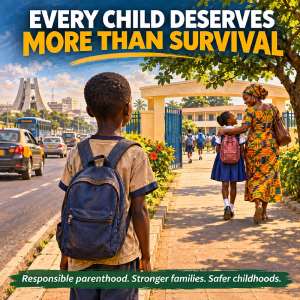
Children weaving between vehicles to ask for money should trouble every Ghanaian. At busy junctions, a moment’s inattention can turn their search for help into tragedy. Their presence on our streets raises an uncomfortable question: are families, communities and public institutions doing enough to protect childhood?
Ghana’s child-protection procedures identify children’s street begging as hazardous work. It exposes children to dangers that no child should have to face to obtain food or support. These children deserve protection, education and care, rather than blame for circumstances they did not choose.
Parental responsibility must be part of this conversation. Bringing a child into the world involves a continuing duty to provide food, shelter, healthcare, education, affection and supervision. Before having another child, parents should honestly consider their ability to meet those needs. Social pressure, the desire for a particular number of children or expectations from relatives should never outweigh a child’s welfare.
Faith can offer hope during hardship, but it should also encourage preparation and responsible choices. Believing that “God will provide” need not mean ignoring household finances or avoiding discussions about birth spacing. Religious and traditional leaders can help families understand that planning parenthood is compatible with caring deeply about children.
However, poverty cannot simply be reduced to irresponsible childbearing. A household that once managed comfortably may struggle after illness, unemployment, bereavement or abandonment. Even a small family can fall into severe hardship. UNICEF’s 2026 assessment of children in Ghana highlights persistent inequalities and weaknesses in financing and services that leave disadvantaged children behind. Parental accountability therefore needs to be matched by effective public support.
Family planning is an important part of prevention. The World Health Organization explains that contraception enables people to decide freely and responsibly how many children to have and how to space pregnancies. Yet access can be restricted by cost, limited supplies, misinformation, fear of side effects and opposition from partners or communities. It is inaccurate to suggest that every unintended pregnancy could easily have been prevented or that all methods are equally effective.
Ghana Health Service acknowledged these barriers during its September 2026 family-planning campaign, calling for stronger supplies, better access and respectful care without coercion or stigma. The practical response is to make confidential counselling and suitable contraceptive services easier to obtain. Men must share responsibility for contraception, parenting and household support; these duties should not be placed on women alone.
Children already living or working on the streets need immediate assistance. Local authorities, social workers, schools and health services should coordinate protection, assess family circumstances and help children return safely to education. Where exploitation or abuse occurs, those responsible must be held accountable. Poverty should never be treated as proof of criminality, nor should vulnerable children be dismissed as future criminals.
Ghana needs an honest national conversation about responsible parenthood, supported by accessible healthcare, employment opportunities and stronger child-protection services. Adults should plan carefully before taking on the lifelong responsibilities of parenting, while society must help families facing circumstances beyond their control.
The measure of our concern for children is not how strongly we celebrate their birth. It is how consistently we protect their dignity, development and future.

 Ghana introduces 21-day monitoring for travellers from Ebola-affected countries
 Let’s stop bashing NACOC anytime there is drug bust – Hopeson Adorye
 Sam George threatens to shut down political, religious affiliated media houses i...
 'We are demanding our GH¢16m back' – Abu Jinapor at 'Yɛ Gye Yɛ Sika' demo
 'Don't defend accountability only in opposition' – Osahen Afenyo-Markin tells Af...
 Mother of slain Ghanaian teenager heads to US for son's funeral
 'People want to directly elect their MMDCEs' — CDD-Ghana rejects govt proposal
 Parliament’s Human Rights Committee calls for reintroduction of safe disciplinar...
 Chief Justice orders Supreme Court to sit despite ongoing JUSAG strike
 Free SHS food suppliers threaten five-day protest over unpaid debts


