




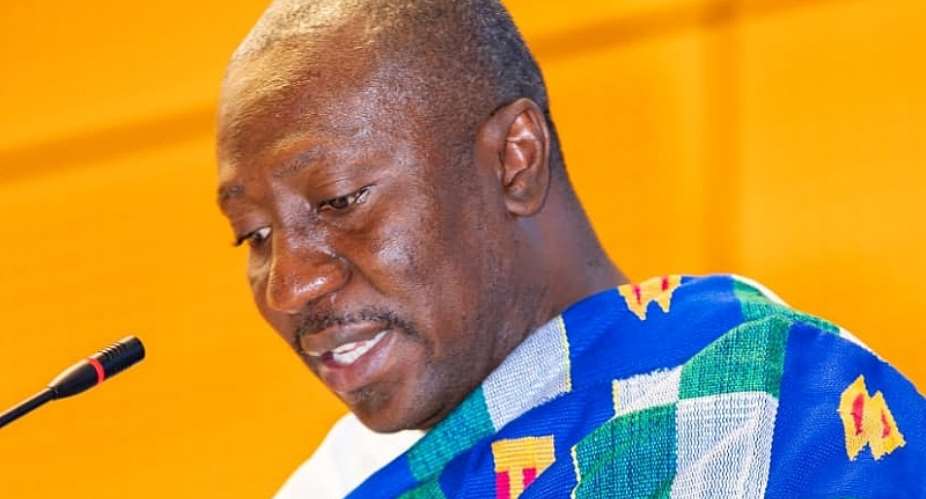
Osahen Alexander Afenyo-Markin, the Minority Leader in Parliament, has called on African countries to move beyond merely identifying financial irregularities and ensure the effective enforcement of audit recommendations, to strengthen public accountability.
He said public financial accountability could not be measured solely by the number of audit reports produced, officials questioned, or hearings conducted, but by the corrective actions taken, recovery of public funds, and sanctions imposed where wrongdoing had been established.
In an address at the opening of the Sixth Conference and General Meeting of the African Organisation of Public Accounts Committees (AFROPAC) in Accra on Monday, Mr Afenyo-Markin said the continent could not continue to “audit the same failures year after year without holding anyone accountable.”
The conference, being attended by Public Accounts Committee members, parliamentary officials, auditors and governance experts from across Africa, is on the theme: “Oversight for Resilience: Strengthening Public Accounts Committees for Accountability in a Changing Financial Landscape.”
Quoting a 2017 Supreme Court ruling in the case of Occupy Ghana vs. Attorney-General, the Minority Leader said the protection of public resources required actionable enforcement, integrity, and statutory authority.
He noted that weak financial accountability had real-life consequences for citizens, including inadequate healthcare facilities, poor educational infrastructure, unfinished roads, and limited access to essential public services.
“We are living through a period of intense global and continental economic turbulence. African nations are facing severe macroeconomic shocks, expanding debt obligations, inflationary pressures and shrinking fiscal space,” he said.
Mr Afenyo-Markin observed that citizens were becoming increasingly informed and demanding greater transparency in the management of public resources.
He noted that the growing public scrutiny placed a greater responsibility on institutions tasked with safeguarding state resources and ensuring value for money.
The Minority Leader identified the implementation of audit recommendations as one of the most significant challenges confronting public financial management systems across the continent.
“Year after year, audit reports reveal irregular expenditures, procurement breaches, weaknesses in revenue collection and deficiencies in public asset management, yet the key question remains: what happens after the hearings have ended?” he asked.
To address the challenge, Mr Afenyo-Markin proposed five structural reforms to strengthen Public Accounts Committees across Africa.
These involved: the institutionalisation of real-time and concurrent oversight mechanisms, enhancing forensic and digital auditing capabilities of committee secretariats, statutory tracking and enforcement of audit recommendations, increased scrutiny of sovereign debt and illicit financial flows, and then stronger inter-parliamentary intelligence-sharing arrangements.
He said evolving financial systems, including digital public financial management platforms, public-private partnerships, sovereign debt instruments and cross-border financial transactions, required oversight institutions to adopt modern approaches.
“If our committees remain anchored in analogue, delayed oversight mechanisms, our democratic demand for accountability will fail,” he stated.
Mr Afenyo-Markin also called for increased collaboration among African legislatures through AFROPAC to share best practices and develop common approaches to addressing public financial management challenges.
He noted that while constitutional arrangements differed across countries, many of the accountability challenges confronting African parliaments were similar.
The Minority Leader further stressed that financial accountability should not depend on whether a political party was in government or opposition.
“Public financial accountability must never become a principle that we defend only when we occupy the opposition benches and conveniently disregard when entrusted with government power,” he said.
He urged both majority and minority lawmakers to approach oversight responsibilities with fairness, diligence and fidelity to evidence.
Mr Afenyo-Markin concluded by urging delegates to use the conference as an opportunity to renew their commitment to strong parliamentary oversight and effective protection of public resources.
“The strength of African parliaments will not be measured by the number of bills they pass, but by the vigilance with which they guard the public purse,” he said.
GNA
 Illegal mining threatening Ghana’s relations with neighbouring countries - Zanet...
 NPP started TraffiTech-GH pilot in 2023 – Akim Swedru MP
 Osahen Afenyo-Markin calls for stronger enforcement of audit findings across Afr...
 Ahafo North farmers clash with Newmont, accuse Lands Commission of delaying comp...
 Loaded Transit Truck Left for Weeks Exposes Safety, Enforcement and National Sec...
 GRIDCo CEO gives December deadline for improved power supply in Ashanti Region
 GES to remove Twene Amanfo SHS teachers from Masters on Duty positions over stud...
 Speaker Bagbin urges PAC to detain officials who fail to account for public fund...
 Audit Service recovers over GH¢18bn in public funds between 2022 and 2026 – Audi...
 Mining Conference: Local Government Minister puts Regional Ministers, MMDCEs on ...


