




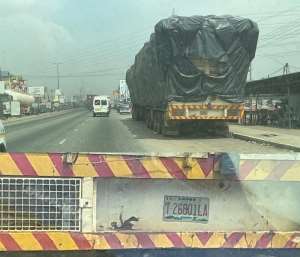
CUTS International Accra, a leading research and public policy think tank, has criticised the prolonged failure of state agencies to address a loaded transit truck parked along the Achimota stretch of the Accra–Nsawam road, just before ABC Junction.
A Nigerian-registered articulated truck, registration number T-26001LA (Lagos State), has remained at the location for more than a month, worsening rush-hour congestion on an already busy corridor. CUTS says the continued obstruction raises concerns about road safety, national security, enforcement and the monitoring of cargo vehicles.
Appiah Kusi Adomako, the Director of the West Africa Regional Centre of CUTS International in Accra, photographed the truck on 8 October 2026 after observing the vehicle at the location for several weeks.
“I photographed this truck on 8 October after seeing the vehicle parked there for weeks. The truck continues to occupy road space while motorists struggle through congestion. The responsible agencies owe the public an explanation for this prolonged inaction,” Mr Adomako said.
The truck stands less than 100 metres from the point where police officers regularly direct traffic at Neoplan Junction. CUTS questions how an obstruction so close to routine police operations has remained unresolved for weeks.
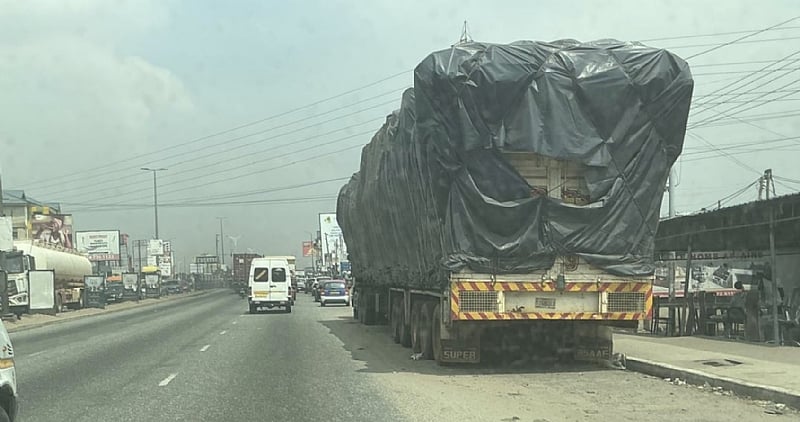
According to CUTS, traffic management requires officers to identify hazards and ensure their removal. The relevant municipal assembly must also report persistent obstructions and coordinate with enforcement agencies to protect road users.
The Road Traffic Regulations, 2026, L.I. 2519, provide a basis for intervention. Regulation 235(1)(e) prohibits parking on a road except in an emergency with adequate advance warning. Regulation 235(3)(e) also prohibits parking on a hard shoulder except in an emergency.
Where a vehicle has broken down, regulation 127(1) requires the owner or person in charge to ensure immediate removal. Regulation 127(7) requires the Police or NRSA to tow, or authorise towing of, a broken-down vehicle left in a dangerous position or likely to cause an accident or injury.
CUTS says the circumstances also warrant a security assessment. The organisation has no verified information about the cargo or whether the authorities have inspected the truck. No visible cordon has been observed.
“A loaded truck left beside a busy road for weeks should attract official attention. The Police should establish ownership, verify the cargo and assess the circumstances. Public safety requires active supervision and timely intervention,” Mr Adomako said.
Lessons from Appiaste Explosion and Beirut Port Explosion
CUTS draws attention to the Appiatse disaster of 20 January 2022, when a collision involving a truck transporting mining explosives resulted in an explosion which devastated the community. The incident demonstrates the severe consequences of road incidents involving hazardous materials.
The Beirut port explosion in Lebanon on August 2020 demonstrates the consequences of neglecting hazardous cargo. Ammonium nitrate stored without adequate safety measures for about six years exploded, killing more than 200 people, injuring thousands and devastating surrounding neighbourhoods. The disaster reinforces the need for authorities to identify cargo, assess risks and act promptly when loaded vehicles or potentially dangerous materials remain unattended. CUTS makes no allegation about the contents of the Achimota truck, but urges the responsible agencies to inspect the vehicle and establish the appropriate safeguards without further delay.
Following the disaster, the Minerals Commission introduced additional safeguards for transporting explosives, including strengthened inspection and escort arrangements. CUTS says the lessons from Appiatse should inform routine monitoring and enforcement.
Regulations 79 and 80 of L.I. 2519 address hazardous-goods transportation, including driver qualifications, cargo documentation, labelling and vehicle safety. If inspection establishes hazardous cargo, the responsible agencies must enforce those requirements and any additional applicable controls.
CUTS calls on the Ghana Police Service, National Security, NRSA and the relevant municipal assembly to inspect the truck immediately, identify its owner and operator, and verify the cargo. The agencies should assess the risks, provide appropriate warnings and arrange safe removal using suitable equipment.
They must also explain the prolonged failure to clear the obstruction, investigate any neglect of duty, and apply the relevant sanctions, including recovery of towing and storage costs where the law permits. To prevent similar situations, CUTS urges the agencies to establish routine checks and clear reporting arrangements for stationary trucks along major roads.
“The owner must take responsibility for the truck. State agencies must also fulfil their enforcement responsibilities. Road users should not continue to bear the consequences of this neglect,” Mr Adomako said.

 Loaded Transit Truck Left for Weeks Exposes Safety, Enforcement and National Sec...
 GRIDCo CEO gives December deadline for improved power supply in Ashanti Region
 GES to remove Twene Amanfo SHS teachers from Masters on Duty positions over stud...
 Speaker Bagbin urges PAC to detain officials who fail to account for public fund...
 Audit Service recovers over GH¢18bn in public funds between 2022 and 2026 – Audi...
 Mining Conference: Local Government Minister puts Regional Ministers, MMDCEs on ...
 'Illegal mining is direct assault on national security' — Lands Minister vows de...
 'Chiefs must protect lands from galamsey for generations unborn' — National Hous...
 'I’ll make you impotent' – Wife threatens husband on live radio over 'baby mamas...
 NIA begins nationwide crackdown on illegal Ghana Card photocopying



Comments
It's high time transit or local cargos shipment should be in containers likewise western cargo for safety of lives and property