




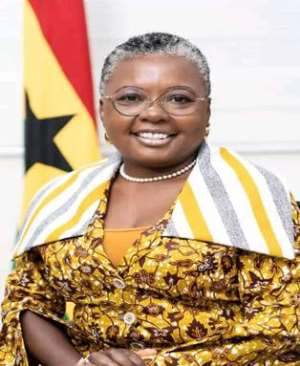
There are ministers who manage a ministry and there are ministers who change how the world sees a country. In less than two years, Hon. Emelia Arthur, MP, Minister for Fisheries and Aquaculture, has done the second. When she took office in January 2025, Ghana’s fisheries sector was in crisis: declining stocks, rising imports, persistent illegal, unreported and unregulated (IUU) fishing, weak governance, and an EU yellow card hanging over our fish exports. Today, in Novemeber 2026, Ghana is spoken about in Rome, Mombasa, New York, and Brussels in a different language: reform, transparency, enforcement, and Blue Economy leadership. This is the story of how that happened, and why the international community now listens when Ghana speaks on the ocean.
- THE REFORMER AT HOME: LAW BEFORE SLOGANS
Hon. Emelia Arthur did not begin with press conferences. She began with law. Her landmark achievement is the Fisheries and Aquaculture Act, 2025 (Act 1146), which replaces the Fisheries Act, 2002 (Act 625). As a lawyer would appreciate, this is not an amendment. It is a complete reset of the legal architecture. Act 1146 strengthens the Fisheries Commission, creates a dedicated Fisheries Enforcement Unit and a Fisheries Development Fund, toughens penalties for IUU fishing, creates aquaculture development zones, and mandates the participation of chief fishermen and queen fishmongers in decision-making. Most importantly, it doubles the Inshore Exclusion Zone from 6 to 12 nautical miles. For the first time in law, the sea closest to shore, where artisanal canoes fish for survival, is legally reserved for them, and industrial trawlers are pushed out. The UN Working Group on the Rights of Peasants, which visited Ghana in 2026, called Act 1146 a “robust shield” for rural fishers. That is the language of international law recognising domestic law. That is rare, and it matters. Under her leadership, Ghana also declared its first Marine Protected Area at Greater Cape Three Points in April 2026, 704 square kilometres, from Ampatano to Domunli, benefiting 21 communities, after extensive consultation with fisherfolk, chiefs, scientists, and partners. It was inaugurated by Vice President Naana Jane Opoku-Agyemang, a signal of how high the Government places this reform. She reformed premix fuel, the lifeblood of canoe fishing and the source of years of corruption and shortage. In January to June 2026 alone, 22.41 million litres were supplied, a 58 percent increase over 2025, with 138 automated stations completed. She launched the Small-Scale Fishers’ Forum, the SSF Academy in Winneba, working hard to operationalize the Ghana National Fisheries College at Anomabo, and a 10-year Blue Economy Action Plan. This is delivery, not declaration.
- THE DIPLOMAT ABROAD: GHANA TAKES CENTRE STAGE
A minister’s international image is not built by travel. It is built by being invited, being quoted, and being validated by independent bodies. On all three tests, Emelia Arthur passes.
At FAO in Rome: At the 37th Session of the FAO Committee on Fisheries (COFI) in September 2026, before world leaders, she issued Africa’s rallying call: “Africa’s aquatic food production should, and can, be increased.” She aligned Ghana with the FAO Blue Transformation Agenda and demanded capital, technology, and science for Africa, while presenting Ghana’s reforms in full detail. International media reported it the same way: “Ghana Takes Centre Stage,” “Ghana Demands Global Shift in Ocean Governance. ”
At Our Ocean in Mombasa: Representing President John Dramani Mahama at the 11th Our Ocean Conference in June 2026, the first ever held on African soil, she announced Ghana’s MPA, the 12-mile zone, and US$20 million in Aquaculture Economic Zones. Reports described Ghana as having “strengthened its position as a leader in ocean conservation.” The CEO of Blue Ventures had expressly invited her to speak, after signing an MoU with Ghana in April 2026 on compliance, research, and community engagement.
At the United Nations: Ghana’s formal statements to the 3rd UN Ocean Conference, calling for investment in science, data, and IUU cooperation, became the basis for Ghana’s proposals to the 2026 UN General Assembly on Sustainable Fisheries. Ghana did not just attend, Ghana proposed. As Deputy Executive Director of the Fisheries Commission, I witnessed this shift at first hand. In technical meetings abroad, Ghana was no longer asked only what had gone wrong, Ghana was asked how the reform was done, and whether the model could be shared. That is the difference between scrutiny and respect.
- THE VALIDATION THE WORLD CANNOT IGNORE
The strongest proof of her international standing came not from Ghana, but from outsiders. In August 2026, the Fisheries Transparency Initiative (FiTI) International Board unanimously approved Ghana as a FiTI Implementing Country, after Ghana published its fisheries data through its new Fisheries Information System. The Board did not just approve Ghana. It expressly recognised “the dedicated work” and “personal leadership” of Hon. Minister Arthur, and praised Ghana’s application as “professional, participatory, and inclusive. ” In June 2026, Ghana was among the first 15 countries to sign the Mombasa Declaration on Fisheries Transparency, committing to publish vessel ownership, authorisations, and subsidies. In May 2026, Ghana launched a 3-year WTO Fish Fund project to implement the Fisheries Subsidies Agreement it has ratified. In October 2026, she hosted Nigeria’s Fisheries Minister in Accra to agree on regional vessel records and joint enforcement, and signed the Ghana-Norway Oceans for Development Programme to fix Ghana’s ocean data deficit. This is what diplomacy looks like when it is backed by law at home: other nations want to partner with you, not lecture you.
- THE PHILOSOPHY: PEOPLE BEFORE OFFICE, EQUITY BEFORE ECOLOGY
What makes Emelia Arthur different is not only what she has done, but how she thinks. Her defining principle, repeated in Accra and abroad, is this: “Environmental sustainability could not be achieved without social equity.” That is why she exempted artisanal fishers from the 2026 closed season while enforcing it strictly on industrial vessels. That is why she insists that MPAs must benefit communities. That is why she fights for women processors, youth in aquaculture, and financial access for fishers through the National Plan of Action for Small-Scale Fisheries, developed with FAO and FiTI. She understands, as a leader from a coastal constituency herself, that a fisher who is hungry will not protect a fish. A fisher who is respected will. That people-centred philosophy is why fishers trust her at home, and why delegates trust her abroad. She speaks the language of the landing beach and the language of the United Nations, and she does not betray either. At the Fisheries Commission, we see the practical effect of that philosophy every day: chief fishermen and queen fishmongers are now in the room where decisions are made, not outside it. That alone is a revolution in Ghanaian fisheries governance.
- THE VERDICT OF HISTORY SO FAR
No honest profile can pretend all problems are solved. The EU yellow card remains. Enforcement needs more vessels and funds. Ghana still imports fish. The Blue Economy Strategy still needs full costing. But history will record this: Emelia Arthur inherited a sector described by her own Ministry as broken, and in under two years gave it a new law, a new protected zone, a new marine protected area, a new transparency status, a new Blue Economy plan, and a new voice in the world. She has made Ghana’s fisheries story a story of reform, not a story of decline. For a coastal nation where fish is 60 percent of animal protein and 10 percent of the population depends on the value chain, that is not just good politics. That is national security. Ghana’s ocean diplomat has done her work at home. The world is now listening and the sea, slowly, is beginning to listen too.
By Dr. Eric Cobbinah (Esq)
Deputy Executive Director, Fisheries Commission of Ghana

 'I’ll make you impotent' – Wife threatens husband on live radio over 'baby mamas...
 'Some radio stations struggle to buy prepaid electricity' – GIBA president
 GMet warns of prolonged dry spells and hotter days from December to February
 'Watch your words on air' – Suhuyini cautions journalists
 'I killed them for saliva' – Man confesses to killing three people for Ghc500
 Some NDC MPs must lose their seats for Upper East region to get development – Ko...
 Dumsor looms as El Niño could reduce Akosombo Dam inflows and affect power gener...
 'I will suggest we limit TraffiTech-GH's application to some major routes within...
 NIA begins nationwide crackdown on illegal Ghana Card photocopying
 Lebanese customs say 46.7kg cocaine trafficker through Accra used insulation tec...


