




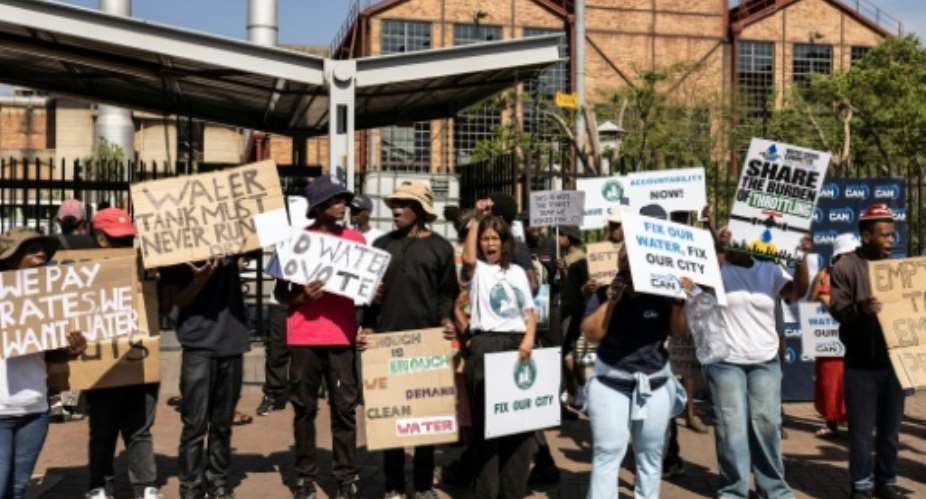
Authorities said Monday they were working to restore reliable water supplies to South Africa's main city Johannesburg after nearly two weeks of disruption that has become a major issue ahead of local elections.
Taps have been dry for at least 10 days in parts of the city, the mayor acknowledged, responding to public frustration that has sparked several protests ahead of Wednesday's local government elections.
Failures to deliver basic services such as water, electricity and garbage collection are a key issue in the November 4 vote.
The African National Congress, the largest party in the national unity government, is expected to suffer a further slide in support, in a test of its standing ahead of national elections in 2029.
Many parts of Johannesburg -- the country's economic hub with a population of roughly five million people -- have experienced severe water outages and low pressure since October 19, Mayor Dada Morero said.
He blamed high consumption and leaks in the ageing water system, which would cost billions of rands to repair, but said the city's overall storage supply had improved to 41 percent by Monday.
"Restoring a reliable water supply remains our priority," he said.
Johannesburg's water reserves had dropped unexpectedly after high temperatures, said regional premier Panyaza Lesufi, making a link with the El Nino warming weather pattern.
"Suddenly, we had water losses, and we're told it's because of El Nino... we were indeed caught off guard because we have put (in) systems to monitor all these things," he said.
An inquiry by the South African Human Rights Commission released Monday said nearly 45 percent of water flowing through Johannesburg municipal pipelines was lost because of poor infrastructure.
Compounding the problem, several municipalities in Gauteng province had weak financial management and not enough qualified personnel, such as engineers, it said.
There have been reports of lengthy periods of water shortages in other centres, including the east coast city of Durban.
Around two weeks ago, residents in parts of the Tshwane municipality, which includes the capital Pretoria, were told to stop drinking tap water after around 800 people fell ill.


 Loaded Transit Truck Left for Weeks Exposes Safety, Enforcement and National Sec...
 GRIDCo CEO gives December deadline for improved power supply in Ashanti Region
 GES to remove Twene Amanfo SHS teachers from Masters on Duty positions over stud...
 Speaker Bagbin urges PAC to detain officials who fail to account for public fund...
 Audit Service recovers over GH¢18bn in public funds between 2022 and 2026 – Audi...
 Mining Conference: Local Government Minister puts Regional Ministers, MMDCEs on ...
 'Illegal mining is direct assault on national security' — Lands Minister vows de...
 'Chiefs must protect lands from galamsey for generations unborn' — National Hous...
 'I’ll make you impotent' – Wife threatens husband on live radio over 'baby mamas...
 NIA begins nationwide crackdown on illegal Ghana Card photocopying


