




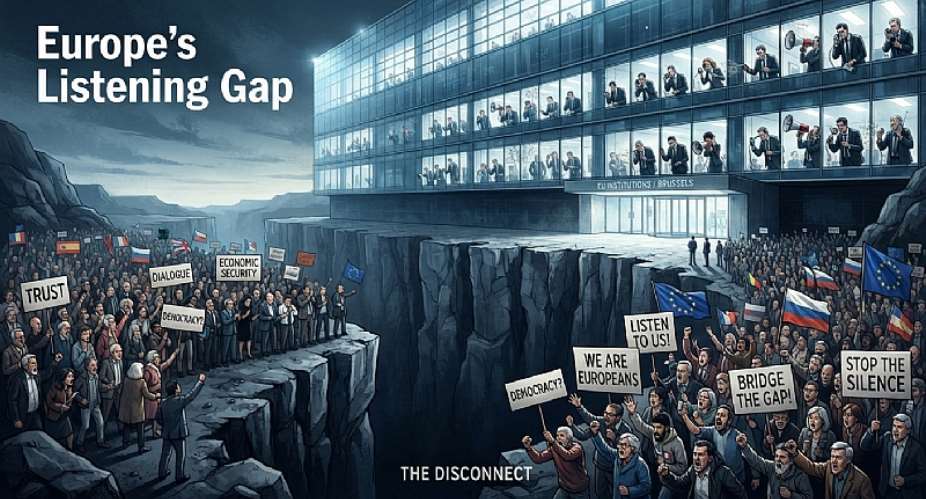
The protests are different. The frustration is starting to sound the same
Europe may not yet be experiencing a continent-wide revolt. But something more subtle, and potentially more consequential, is developing across its streets.
From France to Portugal, Germany, Italy, Austria and Albania, citizens have been marching over different immediate grievances: schools, university funding, housing, rents, wages, inflation, public services, corruption and the prospects facing younger generations.
The demonstrations did not begin as one movement. They have no single leader, no common European manifesto and no unified command structure. Yet beneath the different demands sits a recurring question: are European institutions actually listening?
That question is at the heart of a new study measuring latent public trust, institutional responsiveness, risk and threat exposure across six countries. Its central finding is striking. Europe is not yet facing a single European trust crisis. It is facing six national trust problems with a shared material base, and an increasing risk that the European Union itself will appear absent from them. The message is not that Europe is collapsing. It is that a warning light is flashing.
The study puts its six-country Trust-Gap at 66.4 out of 100, in the Severe band. Its EU Listening Gap stands at 36.6 (Emerging), its Voice-to-Institution Gap at 58.2 (Significant) and its European Protest Transmission Risk at 67 (High). These are model-derived estimates, not opinion-poll results. The six countries comprise five EU members plus Albania, an EU candidate.
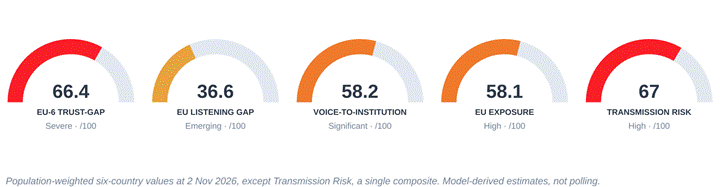
Figure 1. The study’s headline indicators on a 0–100 scale. These are model-derived estimates, not polls.
Perhaps the most important warning concerns the temptation to dismiss the mobilisation as simply a “Gen Z protest”. The study finds that the label accurately describes only two of the six countries. France, Austria, Portugal and Italy show broader coalitions involving unions, workers, staff, households or several generations.
That changes the question. If policymakers answer what is really a household-security problem with a youth-policy response, they may misjudge the scale of the grievance.
The numbers behind the warning
Severe in all six countries, but estimates rather than polls
All six countries fall into the study’s Severe Trust-Gap category, from 62.9 in Austria to 73.4 in Albania. The spread is narrow, and differences of a few points should not be read as a ranking.
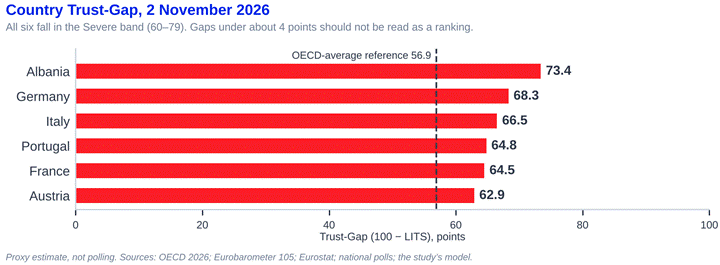
Figure 2. All six countries sit above the 56.9 an OECD-average country would score on the same rule.
There is an important caveat. These are proxy-derived estimates of latent trust, not survey percentages. The study deliberately separates observed facts from analytical inference and model-derived estimates, and that distinction may be one of its most important contributions.
Europe does not currently have a survey asking citizens across these countries whether European institutions are listening to their protest grievances. The absence of that measurement is itself significant. The EU has extensive economic, political and social polling, but the listening gap generated by this protest wave has not been directly measured.
That leaves policymakers looking at crowds when they should also be measuring confidence.
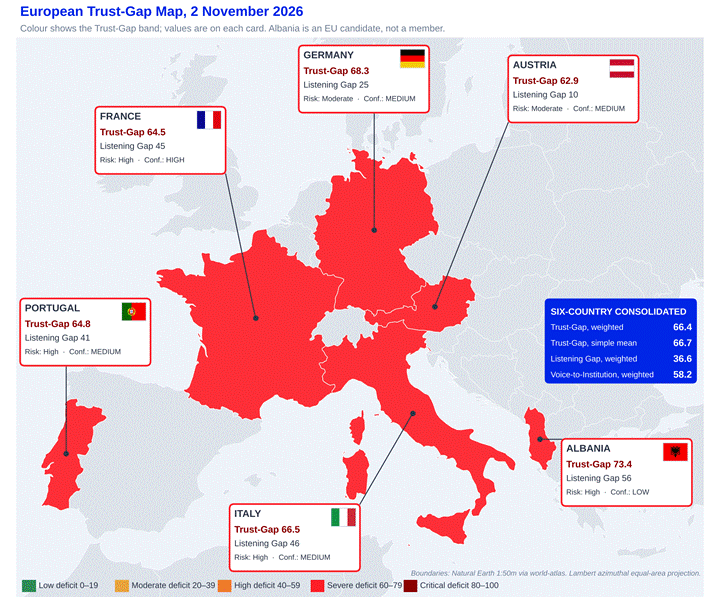
Figure 3. The European Trust-Gap map. All six countries share one band, so the numbers carry the comparison.
Six countries, six triggers, one underlying question
The protests cannot be understood as one European event
France began with schools. Austria’s mobilisation centres on university funding. Portugal’s streets have been dominated by housing. Germany has seen a youth-led mobilisation around education, living costs and rents. Italy’s demonstrations have brought students and workers together over the cost of living, wages and social spending. Albania’s protests began with students and widened into a far more confrontational political movement over corruption and accountability.
Yet the study finds substantial overlap.
France: from schools to social discontent
Since late September, school blockades have been followed by large demonstrations. On 17 October, official turnout was put at 550,000, against 800,000 according to organisers. By 31 October the ministry estimate had fallen to 320,000, while organisers claimed nearly 500,000.
The decline could easily be read as declining anger. The study warns against that conclusion. In a poll taken on 21–22 October, 68% still called the movement justified, even as 63% wanted it to end after the school holidays. Crowds can shrink while grievances remain.
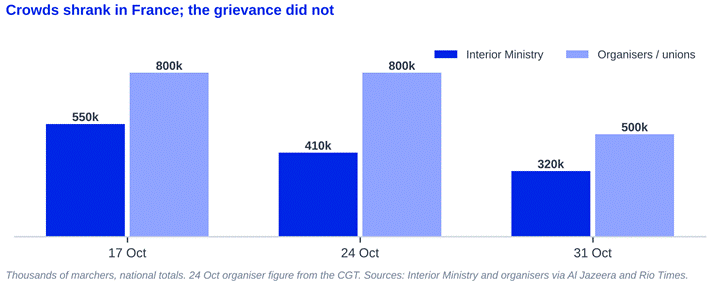
Figure 4. French turnout by both counts. Official figures fell 42% between 17 and 31 October.
France has a Trust-Gap of 64.5 and a Listening Gap of 45. The pressure is concentrated on the cost of living and fuel, education and political responsiveness. The next test is a general strike called by the main unions for 5 November.
Austria: a narrower dispute with a deeper warning
Austria looks different. Around 30,000 people reportedly demonstrated in Vienna on 22 October over university funding, by the student union’s count. The government has offered about €16 billion for 2028–30 against requests for €18 billion, and the dispute has remained largely peaceful.
Its Trust-Gap still reaches 62.9. But Austria produces one of the study’s most interesting findings: a Listening Gap of just 10. The country may carry a significant latent trust deficit without a correspondingly large listening deficit around this particular protest. Not every protest is evidence of an institutional legitimacy crisis. Because no protest poll exists for Austria, the study treats that reading with caution.
Portugal: when housing becomes a trust issue
Portugal may be the clearest example of a material problem turning into an institutional one. Housing affordability records an Issue Pressure Score of 86.8, rental law and evictions 82.9, and wages and the cost of living 74.7.
Since 10 October, housing camps have appeared in Lisbon and Porto. By the study’s count there have been seven clearances and 99 arrests. On 1 November, 13 officers were reported injured and 25 people were treated by emergency services. The government has offered amendments but ruled out scrapping the rental bill. If protesters believe the policy itself is the problem, can amendments restore trust, or merely extend the confrontation?
Portugal’s Trust-Gap is 64.8, its Listening Gap 41 and its Voice-to-Institution Gap 61, described as rapidly widening. This is no longer simply a housing story. It is a story about whether young people and households believe the political system can deliver something as basic as a place to live.
The bigger pattern
Across the six countries the recurring grievances are familiar: the cost of living, education, housing, wages, public services, political responsiveness and future opportunity. Yet the organisations and triggers remain largely national.
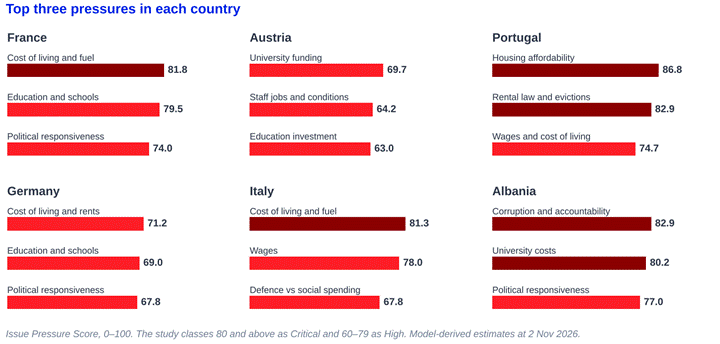
Figure 5. The three strongest pressures in each country, by Issue Pressure Score.
That creates a paradox. The grievances are converging faster than the movements, and that may be precisely what Brussels needs to watch.
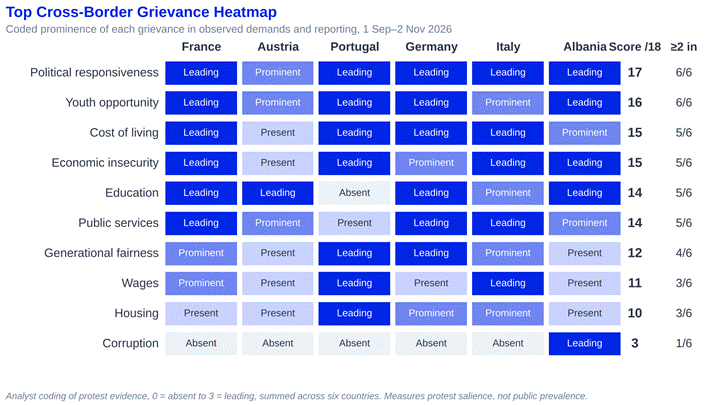
Figure 6. How prominently each grievance features in protest evidence. This measures protest salience, not public opinion.
The “Gen Z protest” label may be getting Europe wrong
The common denominator is security, not age
There is a seductive simplicity in calling the demonstrations Europe’s “Gen Z revolt”. It makes an attractive headline, suggesting a generational rebellion driven by social media and economic frustration. The evidence in this study complicates that story.
The study classes the movements in Germany and Albania as youth-led, although Albania’s is widening. France, Austria and Italy are intergenerational coalitions, and Portugal is a wider socioeconomic mobilisation. A purely youth-focused policy response could therefore miss the underlying problem.
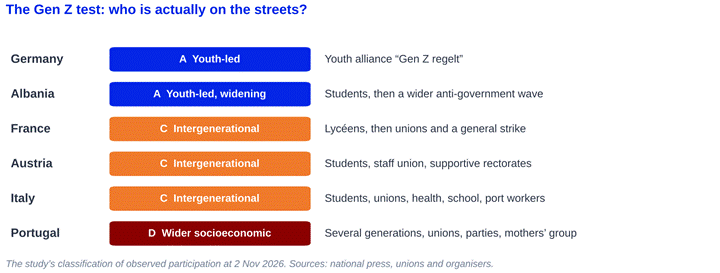
Figure 7. The Gen Z test. Only Germany and Albania are classed as youth-led.
Portugal’s protests involve several generations, political parties and a mothers’ group alongside labour mobilisation. In Italy, students are joined by health, school and port workers, farmers and unions. In France, students and unions have converged. In Austria, students stand with staff unions and supportive rectorates.
The common denominator is therefore not age. It is security: of income, housing, education, employment, public services and future opportunity. Perhaps most importantly, it is the security of knowing that institutions still respond to ordinary citizens.
The trust numbers are worrying, but not apocalyptic
Europe is not experiencing a general collapse of social confidence
The study’s Latent Institutional Trust Score ranges from 26.6 in Albania to 37.1 in Austria.
| Country | Latent trust | Trust-Gap |
| Albania | 26.6 | 73.4 |
| Germany | 31.7 | 68.3 |
| Italy | 33.5 | 66.5 |
| Portugal | 35.2 | 64.8 |
| France | 35.5 | 64.5 |
| Austria | 37.1 | 62.9 |
The study also provides evidence against an overly dramatic reading. Life satisfaction remains high across the five EU member states, between 82% and 89%. Before the protests, trust in the police stood at 68% in Portugal and 65% in France.
That may make the current warning more important, not less. The danger is not that citizens have lost faith in everything. It may be that they are increasingly dissatisfied with specific institutions’ ability to solve specific problems. That is a more targeted, and potentially more manageable, problem. But it can become much larger if ignored.
The Listening Gap
The study’s most intriguing concept asks how large the distance is between the intensity of public grievance and the responsiveness citizens perceive from institutions.
The differences matter. Austria’s dispute, at 10, may be serious without becoming a broad institutional listening crisis. Italy (46), France (45) and Portugal (41) present a different picture, with material pressure and perceived responsiveness pulling apart. Germany sits at 25. Albania has the largest gap at 56, but the study gives that result low confidence because its evidence base is weaker.
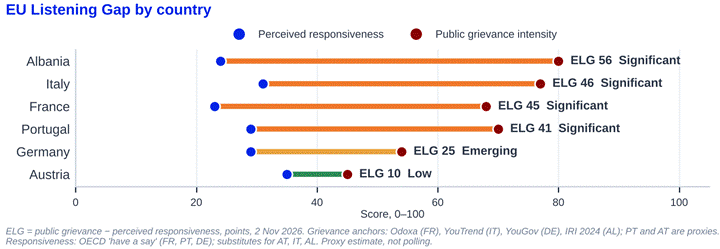
Figure 8. The Listening Gap is the distance between public grievance and perceived responsiveness.
This is how a responsible intelligence assessment should work. The numbers are not presented as unquestionable facts. They are signals.
Germany, Italy and Albania: three different warning lights
A youth signal, an economic coalition and a confrontation over accountability
Germany: the youth signal
Germany’s Trust-Gap of 68.3 is the highest among the five EU member states, while its Listening Gap is 25. The figure owes much to a 10% satisfaction rating for the federal government in an October poll, not to the size of the protest. The mobilisation of 31 October reportedly spread across more than 30 cities, with estimates of around 120,000 participants.
The study classes Germany as youth-led, not yet intergenerational. The early-warning signal is whether workers, unions and households begin to join in. It therefore places Germany at AMBER rather than RED, but the next national protest day could change that quickly.
Italy: when economic pressure connects the street
Italy’s Trust-Gap stands at 66.5, its Listening Gap at 46 and its Voice-to-Institution Gap at a widening 57.
The study records general strikes on 2 and 30 October. Participation estimates vary dramatically: the Interior Ministry reported 255,000 on 30 October, while the USB union claimed 1.5 million. That discrepancy shows why protest numbers should never be treated as precise measures of public opinion.
What matters more is the breadth of the mobilisation. Students, health workers, school workers, port workers, farmers, unions and hauliers have all taken part. This is no longer adequately described as a student movement. A separate poll found that 77% of Italians understand the grievances. With October inflation preliminarily at 5.4%, the economic environment could intensify the pressure.
Italy is classified RED. The next triggers include the Ecofin meeting on 9 November, a CGIL strike on 20 November and a grassroots strike on 4 December.
Albania: the most serious trust deficit
Albania records the highest Trust-Gap, 73.4, but also carries the lowest confidence grade. That caveat is critical.
The protests are the most politically confrontational of the six. Buildings have been burned, including the Prime Minister’s office. Police reported 167 arrests and 132 officers injured over five days, confirmed limited use of rubber bullets, and suspended seven officers pending investigation. A movement that began with students has widened into a broader anti-government mobilisation.
Here the trust issue is not merely socioeconomic. It is institutional. Corruption and accountability score 82.9, university costs 80.2 and political responsiveness 77.
Yet Albania presents a paradox for Europe. Trust in the EU stands at 80%, according to the spring 2026 Eurobarometer. The country may be living with low trust in national institutions and high trust in Europe at the same time. That is both an opportunity and a risk: high expectations can bring strong European legitimacy, but also severe disappointment if citizens conclude that accession is too slow or does not improve everyday life.
The European paradox
This may be the most important finding in the study. The protesters are not necessarily turning against Europe, and the study finds no evidence that this wave represents a broad anti-EU movement. Instead, the EU appears exposed because citizens may expect Europe to matter, even where Brussels does not directly control the issue.
Brussels is not necessarily the target, but it could become the bystander
EU exposure is currently driven more by silence than by blame
The EU’s direct responsibility for these grievances varies sharply.
| Grievance | EU attribution |
| Education and university funding | Low |
| Wages and public services | Low to indirect |
| Housing | Indirect |
| Cost of living and energy | Shared |
| Defence versus social spending | Shared |
| Corruption in Albania | Shared, because rule of law is central to accession |
This produces an important conclusion. The EU should not accept responsibility for problems it does not control. But neither should it assume that a lack of legal competence means a lack of political relevance. Citizens may not distinguish between Brussels, national governments and local authorities when judging whether “Europe” is working.
The Commission’s listening problem
The study identifies the European Commission as the EU institution with the clearest exposure. It found a Commission statement on Albania, but no comparable statement on the protests in member states as of 2 November. It is careful to say that this does not prove none exists.
Politically, though, perception can matter more than institutional intent. If citizens see hundreds of thousands demonstrating over housing, education, wages and living costs while European institutions appear silent, the EU can acquire an unwanted identity: the bystander. Institutions that are blamed can defend themselves. Institutions perceived as absent struggle to demonstrate relevance.
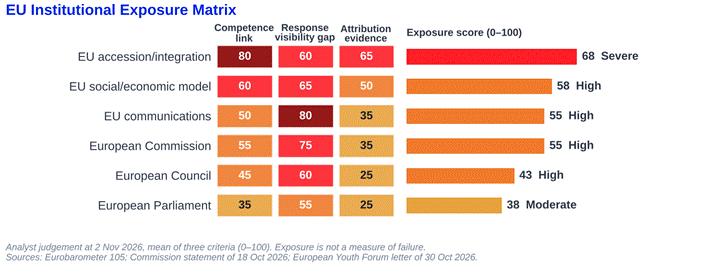
Figure 9. Where the EU is exposed. Accession ranks highest because of Albania; among institutions, the Commission leads. Exposure is not a measure of failure.
The European Parliament: an opportunity
The European Parliament has an opening. In its own survey, 47% wanted inflation and living costs to be its priority, which aligns directly with several of the current grievances.
A public hearing before the December European Council could become more than a symbolic event. It could become a demonstration of institutional listening. The European Youth Forum’s call for the Youth Advisory Board to be convened before that summit provides another opportunity. The question is whether Europe will use these mechanisms before the grievances become more politically entrenched.
The most serious structural risk
The study identifies a deeper concern. Only 44% currently describe the EU economy as good, while 36% expect it to worsen. A separate ECFR study found that 74% across six countries believed Europe was not coping.
That does not mean citizens have rejected the European project. But it raises a harder question: can Europeans continue to believe in integration if they increasingly doubt that the European economic model can provide material security?
This is not a protest question. It is a social-contract question.
What happens if Europe does nothing?
A slow transfer of anger from the street to the ballot box
The study does not predict collapse. The path it describes if nothing changes is considerably more subtle. If protests continue without satisfactory responses, unresolved grievances could migrate into strikes, elections, anti-establishment politics, polarisation and national political crises.
Its central warning is therefore not that Europe is about to collapse. It is that Europe could gradually lose institutional trust while appearing politically stable. That may be harder to detect, and harder to reverse.
Peaceful protest is not treated as a threat. The study’s threat scores concern only violence, serious disruption, polarisation or institutional destabilisation. On that measure, France and Albania carry the highest exposure.
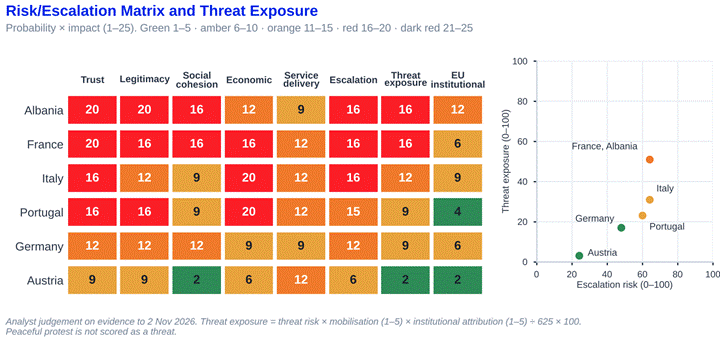
Figure 10. Eight risks by country, scored as probability times impact, alongside threat exposure.
Three possible futures
| Scenario | Probability | What it looks like |
| Baseline | 45% | Protests stay episodic, governments make targeted concessions and turnout eases. The Trust-Gap stabilises in the Severe band and the EU engages at the margins. |
| Escalation | 35% | General strikes succeed, housing clearances continue, inflation stays high, and youth and worker mobilisation merge. Budget and government crises become more likely, and EU institutions grow more exposed to blame. |
| De-escalation | 20% | Dialogue takes place, governments introduce credible measures, oversight findings are published, and European institutions explain what they can and cannot do. Trust begins to recover. |
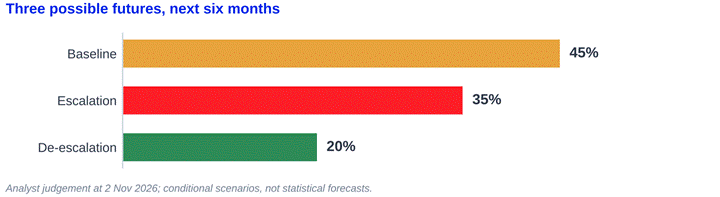
Figure 11. Scenario likelihoods are analyst judgement, not statistical forecasts.
These are conditional scenarios, not predictions. But they give policymakers something protests themselves cannot: a structured early-warning system.
The 90-day test for Brussels
The study proposes relatively modest interventions.
1. Listen. Convene the Youth Advisory Board and answer the European Youth Forum. Do not promise what Europe cannot deliver, but explain clearly what it can.
2. Housing. Connect the European Affordable Housing Plan visibly to the concerns being expressed on the streets.
3. Education. Treat education investment as trust infrastructure.
4. Cost of living. Develop a composite household-pressure indicator.
5. Communication. Publish a recurring “What We Heard / What We Can Do / What We Cannot Do” statement.
6. Early warning. Establish a monthly European Protest Trust-Risk Dashboard.
7. Youth participation. Give young citizens a structured channel to European decision-makers.
These are not dramatic interventions, and that is precisely the point. The EU may not need to “solve the protests”. It may need to demonstrate that it is listening.
The danger of the wrong language
There is another lesson in the study. Officials should be cautious about describing these movements as “just Gen Z”, “youth tantrums”, “social-media activism” or “political noise” unless evidence shows that a movement is genuinely narrow.
Language itself can widen the Listening Gap. When citizens believe that institutions do not understand their grievances, dismissive language confirms the suspicion. The study suggests that the “Gen Z” label travels faster than the evidence for it. The mobilisation is more complicated, and that complexity is why Europe needs better measurement.
The real question is not whether Europe can stop the protests
It cannot, and should not try to
Peaceful protest is a democratic expression. The real question is whether European institutions can identify what the protests are signalling before the signal becomes a structural crisis of confidence.
The study’s most powerful proposition is to measure the deficit that makes people believe the street is their most effective channel for being heard. The evidence only partly supports it. French young people report feeling less heard than other generations, but large numbers still intend to vote. Austria shows that significant protest can coexist with a relatively low Listening Gap.
The street, therefore, is not necessarily replacing democracy. It may be supplementing the ballot box.
Europe’s trust problem is still manageable
The study finds no general collapse of European confidence. Life satisfaction remains high, trust in the police remains relatively strong in several countries, and trust in the EU stood at 51% in spring 2026 and 61% among 15–24-year-olds, although those figures predate this protest wave.
That should give European institutions room to act. But the window may not stay open indefinitely. If housing remains unaffordable, wages fail to keep pace, education is squeezed, public services deteriorate and citizens keep hearing that governments are listening without seeing change, the problem can evolve. First comes dissatisfaction, then mobilisation, then distrust, then political realignment.

Figure 12. How pressure may travel from household costs to EU exposure. These links are associations, not proven causes.
The warning from Albania
Albania may offer the clearest illustration of both sides of the European equation. National trust is weak and political confrontation severe, yet trust in the EU remains exceptionally high.
That is an enormous reservoir of European legitimacy. But reservoirs can also become expectations. If citizens associate Europe with opportunity, rule of law and institutional fairness, a failure to see progress can eventually turn optimism into disappointment. For Brussels, Albania is therefore not merely an accession story. It is a trust-management story.
The verdict
The common denominator is not youth. It is insecurity
Europe is not experiencing one protest. It is experiencing a collection of protests connected by a growing set of common pressures: insecurity about housing, income, education, public services, opportunity and fairness and, ultimately, about whether institutions still listen.
| Headline measure | The study’s assessment |
| EU-6 Trust-Gap | 66.4, Severe: a warning signal, not a polling result |
| EU Listening Gap | 36.6, Emerging |
| Voice-to-Institution Gap | 58.2, Significant |
| EU Institutional Exposure Index | 58.1, High |
| European Protest Transmission Risk | 67, High |
The message from the streets is therefore neither simply anti-government nor anti-European. It is more fundamental. Can institutions still hear us?
Europe’s answer over the coming months may determine whether today’s demonstrations remain separate national disputes or become the early symptoms of a much larger European trust problem.
The choice for Brussels is not whether to silence the streets. It is whether to listen before the streets become louder.
Editorial note and disclaimer of neutrality
This feature is based on the study “Europe’s Listening Gap: Measuring Latent Public Trust, Risks & Threats Behind the 2026 Protest Wave”, with an assessment cut-off of 2 November 2026. The study distinguishes observed facts, analytical inferences and proxy estimates. Trust-Gap, Listening Gap, Voice-to-Institution Gap, EU Exposure and Protest Transmission Risk figures are model-derived estimates unless explicitly identified as survey findings. They must not be interpreted as polling results.
This study is neutral, non-partisan and non-advocacy. It is produced for intelligence, risk-awareness and decision-support purposes and does not endorse or oppose any protest movement, political party, government, institution or policy position. Protest activity is treated as a democratic form of public expression; any assessment of threat relates only to evidence of escalation, violence, disruption, polarisation or institutional risk.
Source basis: The study’s 2 November 2026 assessment, drawing on the OECD Trust Survey, Eurobarometer, Eurostat, the European Commission, the European Youth Forum, ECFR, Odoxa, YouTrend, Reuters, Al Jazeera, Lusa and national media. Figures were correct at the cut-off and may change.
About The Author: Messan Mawugbe (PhD), [email protected]


 'I’ll make you impotent' – Wife threatens husband on live radio over 'baby mamas...
 'Some radio stations struggle to buy prepaid electricity' – GIBA president
 GMet warns of prolonged dry spells and hotter days from December to February
 'Watch your words on air' – Suhuyini cautions journalists
 'I killed them for saliva' – Man confesses to killing three people for Ghc500
 Some NDC MPs must lose their seats for Upper East region to get development – Ko...
 Dumsor looms as El Niño could reduce Akosombo Dam inflows and affect power gener...
 'I will suggest we limit TraffiTech-GH's application to some major routes within...
 NIA begins nationwide crackdown on illegal Ghana Card photocopying
 Lebanese customs say 46.7kg cocaine trafficker through Accra used insulation tec...


