




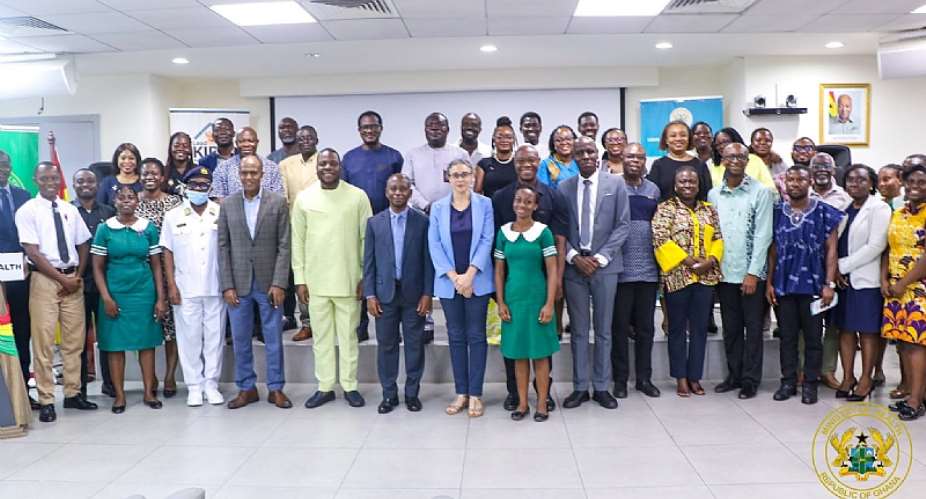
The Ministry of Health has called for stronger regulation, improved public awareness and stronger collaboration across sectors to tackle lead poisoning, particularly among children, whose health and development are most at risk.
The call came at the launch of the 2026 National Lead Poisoning Awareness Week on Friday, under the theme “From Detection to Prevention,” which aims to promote practical measures to reduce lead exposure and protect public health.
Speaking on behalf of the Minister for Health, Kwabena Mintah Akandoh, the Ministry’s Chief Director, Desmond Boateng, described lead poisoning as a serious but preventable public health threat that requires a coordinated response beyond the health sector.
He warned that exposure to lead could cause lasting damage to children's brain development, learning abilities and behaviour and increase the risk of kidney as well as cardiovascular problems in adults.
Mr Boateng identified lead-based paints, mining activities, battery recycling, electronic waste, and contaminated consumer products as common sources of exposure.
He called for stronger public education, protection of vulnerable communities, improved capacity among health workers to detect and manage exposure, and stricter enforcement of regulations to control lead at its sources.
The Deputy Country Representative of UNICEF Ghana, Emmanuelle Collet, also emphasised the need for a coordinated national surveillance system to identify children exposed to lead, trace sources of contamination and ensure that unsafe products are removed from the market.
The Ministry of Health, in collaboration with Pure Earth, Vital Strategies, the Environmental Protection Agency (EPA), the World Health Organisation (WHO), the Food and Drugs Authority (FDA) and the Ghana Health Service (GHS), is working to strengthen public education, surveillance and regulatory enforcement to reduce exposure and protect vulnerable populations, particularly children.

 'I’ll make you impotent' – Wife threatens husband on live radio over 'baby mamas...
 'Some radio stations struggle to buy prepaid electricity' – GIBA president
 GMet warns of prolonged dry spells and hotter days from December to February
 'Watch your words on air' – Suhuyini cautions journalists
 'I killed them for saliva' – Man confesses to killing three people for Ghc500
 Some NDC MPs must lose their seats for Upper East region to get development – Ko...
 Dumsor looms as El Niño could reduce Akosombo Dam inflows and affect power gener...
 'I will suggest we limit TraffiTech-GH's application to some major routes within...
 NIA begins nationwide crackdown on illegal Ghana Card photocopying
 Lebanese customs say 46.7kg cocaine trafficker through Accra used insulation tec...


