





The Paramount Chief of the Ada Traditional Area, His Royal Majesty Djetse Nene Abram Kabu Akuaku III, has declared that access to safe water and sanitation is not a favour to be granted to citizens but a matter of justice, dignity and human rights.
Delivering his address at the opening ceremony of the 37th MOLE Conference on Water, Sanitation and Hygiene (MOLE XXXVII) at Aqua Safari Resort, Big Ada, on Monday, the Paramount Chief said Ghana's development success cannot be measured by how well cities are served but by whether the smallest and most vulnerable communities can access the same essential services.
The ceremony was graced by Vice President Prof. Naana Jane Opoku-Agyemang as Guest of Honour, Ministers of State, Members of the Parliamentary Select Committee on Sanitation and Water Resources, the Ada East DCE, development partners and CONIWAS leadership.
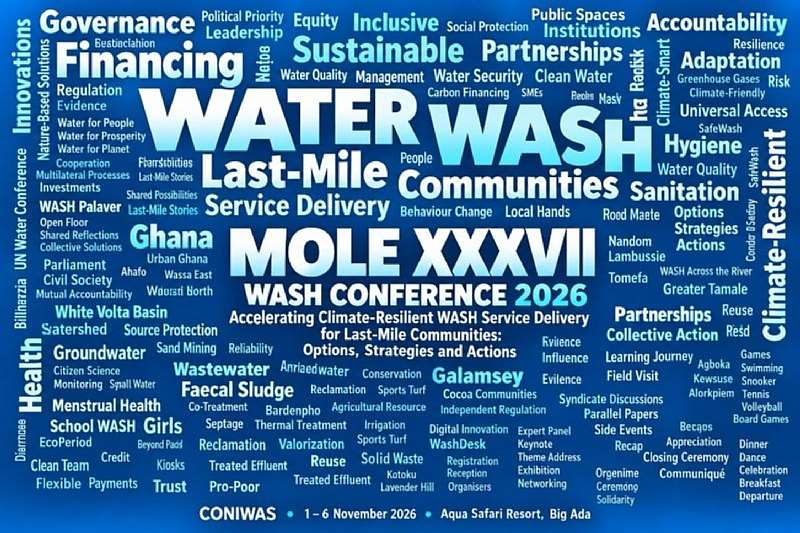
The conference is being held from November 1st to 6th, 2026, and is on the theme "Accelerating Climate-Resilient WASH Service Delivery for Last-Mile Communities: Options, Strategies, and Actions", building on deliberations of MOLE XXXVI.
The Media Coalition Against Open Defecation (M-CODe), through the empowerment of World Vision Ghana, is providing a strategic and targeted communication platform for the conference, ensuring national visibility and citizen engagement.
Speaking on the theme, Djetse Nene Akuaku III said water is more than a natural resource, describing it as the foundation of communities, the lifeblood of economies and the critical determinant of human development.
“Water is life, but access to safe water is a matter of justice, dignity and human rights. Sanitation is about the dignity of the individual, cleanliness of settlements and preservation of life. Hygiene is not simply a personal habit; it is a public health responsibility and collective social obligation,” he stated.
He painted the human cost of failure: “When a child cannot access safe drinking water at school, education is compromised. When a woman must travel long distances in search of water, her time, productivity and dignity are affected. When a health facility lacks adequate water and sanitation infrastructure, the safety of patients and healthcare workers is placed at risk.”
The Paramount Chief particularly welcomed the conference's emphasis on last-mile communities, warning that national coverage figures often mask exclusion.
“For too long, development conversations have celebrated national coverage figures without always paying sufficient attention to those who remain outside the reach of essential services,” he said.
He cited communities like Totope in Ada East and Bonikope in Ada West as examples, stressing, "Development must not become a privilege determined by geography, income, social status or proximity to political power. A community does not become less deserving of safe water because it is small, rural, difficult to reach or commercially unattractive to service providers.”
“The true test of inclusive development is whether we can deliberately reach those who are most easily overlooked,” he added.
He challenged participants to move beyond infrastructure delivery as an end in itself and embrace sustainable service delivery systems that anticipate risks and withstand climate shocks.
He urged frank deliberations: “Let this conference be a place where evidence confronts policy, where innovation meets implementation and where institutional commitments are translated into action. Let us also be courageous enough to acknowledge what has not worked, understand why it failed and identify better approaches.”
“May its greatest legacy not be the number of distinguished personalities who attended, but the number of communities whose circumstances will improve because of the decisions taken here,” he said.
Concluding with a powerful call, he said, "The future we seek must be one in which no child is denied a safe learning environment because of inadequate sanitation; no family is compelled to drink unsafe water because of where they live; no woman is burdened by absence of basic facilities; and no community is abandoned because reaching it requires additional effort.”
“If we are serious about leaving no one behind, then we must be equally serious about reaching everyone, especially those who are furthest behind.”


 Loaded Transit Truck Left for Weeks Exposes Safety, Enforcement and National Sec...
 GRIDCo CEO gives December deadline for improved power supply in Ashanti Region
 GES to remove Twene Amanfo SHS teachers from Masters on Duty positions over stud...
 Speaker Bagbin urges PAC to detain officials who fail to account for public fund...
 Audit Service recovers over GH¢18bn in public funds between 2022 and 2026 – Audi...
 Mining Conference: Local Government Minister puts Regional Ministers, MMDCEs on ...
 'Illegal mining is direct assault on national security' — Lands Minister vows de...
 'Chiefs must protect lands from galamsey for generations unborn' — National Hous...
 'I’ll make you impotent' – Wife threatens husband on live radio over 'baby mamas...
 NIA begins nationwide crackdown on illegal Ghana Card photocopying


